On The Ground newsletter: Get a weekly dispatch from our international correspondents
Get a weekly dispatch from our international correspondents
Get a weekly international news dispatch
Donald Trump's threats to blockade the Strait of Hormuz have sparked fears Iran could counterattack by urging its Houthi allies in Yemen to halt sea traffic through another major shipping corridor in the Middle East.
The entry of the Houthi rebels into the Iran war at the end of March sparked concerns that the group, known for their attacks on shipping, could block the vital Bab al-Mandab strait to oil tankers, causing further economic chaos.
Like the Strait of Hormuz, the strait, also known as the "Gate of Tears" is a chokepoint in the region through which large volumes of petroleum and liquefied natural gas pass. Crucially, it’s a vital strategic link in the maritime trade route between the Mediterranean Sea and the Indian Ocean, via the Red Sea and the Suez Canal.
Hundreds of commercial vessels have been unable to leave the Strait of Hormuz (Getty)
The Strait of Hormuz usually accounts for the transit of around a fifth of the world’s oil and gas. But most Western commercial shipping has been effectively halted by Iran since the outbreak of war, meanwhile, Iran has still been able to sell oil to its allies – particularly China – through the use of so-called "dark transit" vessels, which have turned off their location transponders.
Meanwhile Bab al-Mandab sees around 12 per cent of global oil shipments pass through it as well as other goods, meaning an escalation that results in its closure would deliver yet another blow to the economies relying on imports from the Middle East.
"If the U.S. proceeds with its plan to blockade the strait [of Hormuz], Iran’s escalation strategy could dictate that it ensures Gulf countries can’t export, either," Mona Yacoubian, an expert at the US's Center for Strategic and International Studies, told Fox News.
"This could translate to further attacks on Gulf energy infrastructure or even deploying the Houthis to blockade the Bab al-Mandeb," she added.
Iran's control of the Strait of Hormuz has meant around 20 per cent of the world's oil supply has been constrained since the beginning of the war – a far larger figure than the 1973 oil crisis, during which around just 7 per cent of the world's oil supplies were brought to a halt in the Middle East.
Brent crude, the global oil benchmark, soared back past $100 a barrel on Monday, rising by more than 7 per cent to $102 (£76) in morning trading and sparking fears of a worsening global energy crisis.
Oil had fallen back below the psychological 100 dollars barrier last week after the US and Iran had agreed a two-week ceasefire deal, which included reopening the Strait of Hormuz.
Prior to the war in Iran, it cost $78 (£58) per barrel.
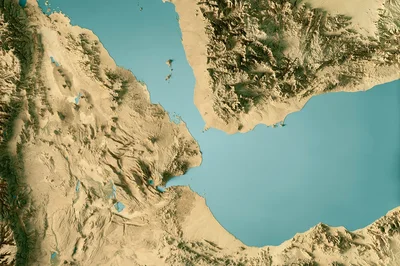
Bab al-Mandab separates Yemen and Djibouti (Reuters)
Where is the strait?
The Bab al-Mandab strait, also known as the “Gate of Tears”, resides between Djibouti and Yemen. The route, around 50km long and 16km wide, is where vessels travel between the Red Sea and the Arabian Sea.
The strait provides access to a number of vital ports, such as Saudi Arabia’s Yanbu, Djibouti’s Doraleh, Eritrea’s Assab, as well as Somalia’s Kismayu and Somaliland’s Berbera.
How important is it economically?
Between 2020 and 2023, Bab al-Mandab saw a growing number of barrels transit the strait daily, peaking at 9.3 million a day, according to the US Energy Information Administration (EIA).
This dropped drastically to 4.1 million in 2024 after the Houthis launched systematic attacks attacks on commercial ships associated with Israel using the strait.
The International Monetary Fund said that trade through the Suez Canal fell by 50 per cent in the first two months of 2024 compared to the year before, while trade through the Panama Canal fell by 32 per cent.
As traffic fell, insurance costs surged. Major shipping firms rerouted vessels to go past the Cape of Good Hope in South Africa instead, adding an additional 10-14 days to journeys.
What impact would closing it have?
Yanbu, a key port for Saudi Arabia, relies on Bab al-Mandab (Getty Images)
Closure or disruption to two of the world’s main strategic waterways could be catastrophic for global trade, with energy supplies from the region potentially cut off.
Bab al-Mandab has allowed a trickle of oil to leave the Middle East through circumvention. Saudi Arabia has used the strait strategically to export crude through its vital Yanbu port.
Yanbu is on the west coast of Saudi Arabia, receiving oil through the country’s east to west pipeline.
Matthew Wright, a freight analyst for Kpler, told The Independent earlier this monththat the pipeline was “being pushed to the maximum”.
“While all the attention is rightly on what’s happening in the strait, Yanbu is significant in that it’s the most active port out of the Middle East gulf at the moment and if anything were to happen there, it would be a massive blow to continued crude exports from the Middle East,” he said.
According to analysts, as of April 2026, Saudi Arabia was exporting around 4.6 to 5 million barrels per day of crude oil from Yanbu, with 80 per cent of exports bound for Asian markets.
Mr Wright warned that potentially losing this, on top of the loss of shipments through Hormuz, would be a “major problem”.