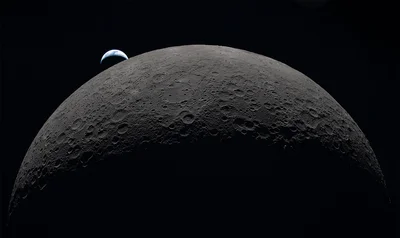
The Artemis II mission to the moon was much more than a mere flyby. With the best digital imaging equipment available, the astronauts on board came home with some of the most detailed photographs of the lunar surface ever captured by human beings. Below are some of the most breathtaking images from the launch, lunar voyage, and return of the Artemis II mission.
Credit: NASA/Joel Kowsky
The Artemis II crew standing in front of the Space Launch System that sits ready to propel the Orion spacecraft out of Earth’s atmosphere. From left to right: NASA astronauts Reid Wiseman, commander; Victor Glover, pilot; Christina Koch, mission specialist; and Canadian Space Agency astronaut Jeremy Hansen, mission specialist.
Credit: NASA HQ PHOTO/Flickr
The Artemis II Space Launch System (SLS) rocket clearing the tower on April 1, 2026. The SLS features a core stage with an expendable fuel tank filled with liquid hydrogen and oxygen that power its four engines. On the sides, it’s flanked by two solid rocket boosters. It’s NASA’s most powerful rocket to date.
Credit: NASA HQ PHOTO/Flickr
The two solid rocket boosters shortly after they separated from the SLS. With their job of helping the Orion spacecraft reach escape velocity concluded, they returned to Earth, where they were recovered for reuse.
Credit: NASA/Keegan Barber
A three-minute exposure showing the parabolic path taken by the SLS, as well as the exhaust from its engines.
Credit: NASA/Reid Wiseman
A glimpse back at dimly lit EarthThe same view as above photographed by mission commander Wiseman from the Orion spacecraft shows a crescent sliver of light, and illuminated cities dotting continents around the globe.
Credit: NASA/Reid Wiseman
The same view as above, photographed with a longer exposure that shows the green light of the Aurora Borealis creeping across Earth’s magnetic north pole. Looking at the same location on the southern hemisphere shows a faint hint of the Aurora Astralis. Prior to the Artemis II launch, a coronal mass ejection from the sun sent charged particles scattering across Earth’s magnetosphere, producing the aurorae.
Credit: NASA/Reid Wiseman
Another view of our planet from space, among the first to be taken from this distance by a human being in over half a century. You can see the dramatic transition where night ends and day begins, the line dividing the two is known as the “terminator.”
Credit: NASA/Reid Wiseman
Earth peeks through the window of the Orion spacecraft’s command module. Fifty percent larger than the Apollo command module, this vehicle will be the crew’s home and work area for their 10-day voyage until it returns to Earth for reuse on future missions.
Credit: NASA
A selfie of the Orion spacecraft taken during a routine inspection on day two of the mission.
Credit: NASA
A crescent Earth glimpsed from the window of Orion on day three of the mission.
Credit: NASA
A closer view of Earth taken on day four of the mission with a different camera.
Credit: NASA
A variety of lunar geographical features along with the terminal on the left, separating day and night on the moon. The Artemis II crew observed these features in a series of observation blocks, describing them in detail to mission control.
Credit: NASA
The wide dark region across the top of the frame is the Oceanus Procellarum, below it lies the smaller Mare Humorum, or “Sea of Moisture.”
Credit: NASA
The moon’s nearside, featuring the 600-mile wide impact crater Orientale basin, on the youngest such craters on the lunar surface. The dark round spot to the northeast is the Grimaldi crater, named for the Italian mathematician, physicist, and Jesuit priest Francesco Maria Grimaldi.
Credit: NASA
A closer look at the Orientale basin. The dark area in the center was formed by the remnants of ancient lunar lava erupting through the surface billions of years ago.
Credit: NASA
A photo of Earthset taken just moments before the Orion capsule slipped behind the moon and lost signal with mission control for 40 minutes.
Credit: NASA
Another view of Earthset. Hertzsprung Basin is visible as two faint concentric rings near the top, interrupted by Vavilov Crater, named for the Soviet scientist Nikolai Vavilov.
Credit: NASA
A close-up of Vavilov Crater.
Credit: NASA
Another view of Earthset.
Credit: NASA
As the Orion spacecraft passed behind the moon on day six, the crew witnessed a solar eclipse. This photo, taken from a GoPro camera attached to a solar panel, shows the moon backlit by the sun. The bright spot located just off the bottom right edge of the moon is Saturn.
Credit: NASA
A selfie taken by the Artemis II crew with their eclipse glasses on.
Credit: NASA
The crescent Earth peeks from behind the moon, photographed in one frame by a camera on the solar panel.
Credit: NASA
One of the Milky Way galaxy’s two spiral arms and the multitudes of stars contained within, photographed on day seven of the mission during the voyage home.
Credit: NASA/Bill Ingalls
The Orion capsule splashes down on day 10, marking a successful end to our latest—but not last—voyage to the moon.
Enjoying Nautilus? Subscribe to our free newsletter.
Lead image: NASA