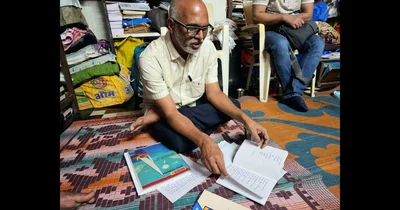
When Sudhir Dhawale was growing up in Nagpur’s Dalit-dominated Indora area in the 1970s, a calendar depicting a child with a pistol hung on the wall of his family’s rented home. It bore a slogan declaring that rights are not handed out – one has to fight to seize them.
“It was just a poster but it brought the understanding through cultural means that we needed to agitate,” said the 57-year-old Marathi poet, activist and co-founder of the Republican Panthers party. “We could not hope our rights would automatically flow.”
That realisation has driven Dhawale for much for his adult life. He has worked relentlessly to ensure that India’s most marginalised people receive the basic rights that every human deserves – using culture as a weapon to achieve that goal.
Culture, Dhawale said, is the medium for organising. It gives one class or group the opportunity to bond and empathise with others.
In India, where agriculture is still a major source of livelihood, “life has a different rhythm”, he said. He elaborated: “The khat khat khat pace or frenzy of a highly capitalised world hasn’t quite overwhelmed us as yet. Oral tradition which speaks of one’s suffering to another still prevails. The song becomes the medium for understanding their lives and toiling.”
Currently out on bail in the Bhima-Koregaon case in which 16 lawyers, college professors, poets and human rights workers have been accused of conspiring to organise a caste riot near Pune in 2018, Dhawale took time off from his work editing the bi-monthly Marathi magazine Virodhi to explain his ideas about culture, politics and social change.
“Those who have truly understood culture are those who have made history,” he said.
Dhawale’s cultural activism draws from the folk forms of Maharashtra, which have long been intertwined with resistance and revolution. The experiences of ordinary people have been reflected in the kirtans of the region’s mystic poets, powadasor traditional ballads of heroism focusing on Shivaji and the theatrical tamasha form.
From the 18th century, lok shahirs or folk singers began to articulate social and political messages in simple language. Both the Satyashodak movement of caste reformer Jyotiba Phule and the Ambedkarite movement used this form effectively.
Jyotiba Phule (left) and Bhimrao Ambedkar.
Dhawale’s passion for the arts came relatively late in life, a result of being exposed to the activities of Left political outfits when he was in college.
Radical activists Anuradha and Kobad Ghandy were living in slums in Nagpur, where they set up student organisations, trade unions and cultural groups. Dhawale and his classmate Surendra Gadling – an advocate who is a co-accused in the Bhima Koregaon case – began attending song sessions.
“The songs…struck a chord because it was about people,” said Dhawale. About our joys, our sorrows and so it was natural to lend our voices. We would join in the chorus.”
These activities brought them in touch with the Vidyarthi Pragati Sanghatana, a students’ outfit that, the police later claimed, had links with banned Maoist groups.
It was the era of Afro hairstyles and breakdance. Dhawale sported one and was proficient in the other. But it was also a time of social ferment. The Vidyarthi Pragati Sanghatana taught the young man and his friends how to organise and take politics to the people.
Dhawale became associated with the Aavhan Natya Manch, which began as the cultural wing of the Vidyarthi Pragati Sanghatana. They would hold performances in neighbourhoods and street plays outside colleges, factory gates and slums.
“One of the plays on the state of education was titled Shiksa ka Circus, a scathing critique on the system,” Dhawale said. Sambhaji Bhagat, the hugely creative shahir or folk poet from Mumbai, wrote and sang Garv Se Kaho Hum Insaan Hai – say with pride that we’re human.
It was a response to the Hindutva slogan, Garv Se Kaho Hum Hindu Hai, (Say with pride that we’re Hindu),which was becoming more popular as Bharatiya Janata Party leader LK Advani began his rath yatra across the country demanding a Ram temple on the site of the Babri Masjid in Ayodhya.
As Dhawale became more immersed in these organisations, he left home in 1989 to live in the office of a progressive group that survived on contributions.
At that time, the Namantar Andolan had been going on for a while. The Dalit movement to have Marathwada University renamed after Babasaheb Ambedkar had a profound impression on the young man.
“I gained the political understanding of how, in reality, there was little or no democracy in the lives of Dalits,” said Dhawale.
A detail from the Namantar Shahid in Nagpur. Credit: JAIBHIM5, CC BY-SA 4.0, via Wikimedia Commons.
Though the Maharashtra legislature had approved the change in 1978, the decision faced enormous opposition from members of the upper castes. Dalit settlements across Marathwada were attacked.
For Dalits, the Namantar movement was an assertion against a caste-driven society where education was the prerogative of the privileged. Gradually the movement became an expression of self-respect and dignity.
The movement kicked off on November 11, 1979, with a march by Jogendra Kawade, an MLA and founder of the Peoples Republican Party, from Nagpur’s Deekshabhoomi – where Ambedkar and 400,000 others had converted to Buddhism in 1956 – to the district magistrate’s office to press for the change.
On December 3, four Dalits died when police opened fire on protesters. “I was nine years of age when it began,” said Dhawale. “While I was too young to know the full implications, some incidents occurred which impinged in my political consciousness.”
It took until 1994 for the name of the university to be changed. As the Namantar movement stretched on, Dhawale became involved with it.
Among the other Dalit campaigns he helped organise was one demanding justice for Manorama Kamble, a Dalit domestic worker who was found dead in her employer’s house in Nagpur’s Jarripatka aea, in March 1994.
The police registered a case of rape and murder. The Republican Party of India called for a morcha and bandh but the traders of Jarripatka refused to close their shops. The ensuing fracas resulted in protestors being lathi charged. This incident reaffirmed Dhawale’s distrust of a system in which elected representatives and the police were not interested in ensuring justice for Dalits.
The razing of the Babri Masjid on December 6, 1992, was another landmark incident in the evolution of Dhawale’s political consciousness. “The Muslims had agreed to abide by the legal and Constitutional decision-making but the Hindutva leaders lawlessly brought the Masjid down,” he said.
During this period, progressive organisations were sharpening their strategy of using culture not just to spread political consciousness but also use songs and street plays to organise. Among those who came to Nagpur from Mumbai to offer insights was Vilas Ghogre, the Dalit balladeer and member of the Aavhan Natya Manch. Armed with the simple iktara, he sang about the plight of labourers and lives of the marginalised.
Then there was Gaddar, the poet and singer whose work combined radical left ideas with Ambedkarite principles, who visited Nagpur in 1992. The hall Aavhan had booked for his performance was sold out. But the police withheld permission for the event.
The organisers went to court. But even though the performance was given permission to proceed, the police sealed the venue. Anticipating this, the organisers had booked an alternative venue. But here too, the police stopped the audience at the gates.
“We announced we would hold a performance right there on the streets,” said Dhawale. A local Dalit artist named Sanjeev Jeevane, dressed in Gaddar’s iconic style with bare chest and a blanket slung across the shoulder, clutching a staff, began performing.
Meanwhile, the organisers attempted to bring Gaddar to the venue. The police responded with a vicious lathi charge on the crowd.
The balladeer Gaddar.
The incident had personal repercussions for Dhawale. He was set to get married to an activist of the Stree Chetana Sanghatan in June 1992. Instead of a traditional celebration in a wedding hall, the couple booked an ordinary one.
“The police got hold of an invitation and believed it was a ruse to actually hold a Gaddar performance,” Dhawale said. “They sealed this hall. Fortunately, some of our guests rushed to the police and convinced them it was just a wedding. Permission was granted provided we agreed not to sing.”
The wedding was held. It made the news, with the papers the next day carrying the headline “All is well.”
“And yes,” added Dhawale with a smile, “songs were sung.”
By the mid-1990s, however, the progressive movement began to dissipate. Prominent organisers went underground. Shambhaji Bhagat had left Aavhan.
Dhawale moved to Mumbai where his wife had found a job as a nurse with the Railways. He had a disappointing stint as a journalist because the newspaper he was at kept extending his period as an apprentice, refusing to pay him.
The lull in his cultural activism was broken by the violence in Ramabai Nagar on July 11, 1997. Ten Dalits were killed and 26 injured when the State Reserve Police opened fire on crowds protesting against the desecration of a statue of Ambedkar.
Three days later, on July 15, the poet Vilas Ghogre died by suicide in his home in the north eastern suburb of Mulund. He wrote “Ambedkari Ekta Zindabad” (A salute to Ambedkai unity) on the wall and hung himself with a trademark blue scarf. The previous year, Ghogre’s pregnant daughter had died. He was also deeply disturbed by the Ramabai killings.
Dhawale went on to write Sangeet Vadlache, Krantikari Lokshahir Vilas Ghogre Yanchi Shahir aani Jeevan, a book that traces Ghogre’s belief that revolutionary consciousness and folk culture are inseparable.
Folk culture has never been mere entertainment or about aesthetic pleasures but about social transformation, Dhawale wrote. Cultural resistance, he said, is integral to political struggle – and song is a vital tool in this battle.
Ideas like this have not sat well with the authorities. Dhawale was first arrested on January 2, 2011, after he returned from a Dalit conference, and charged under the Unlawful Activities Prevention Act with sedition and waging war against the Indian state.
He was acquitted in 2014 but arrested again on June 6, 2018 in the Bhima Koregaon case.
He continues to write. Among his latest poems is one on the Mahad satyagraha, led by Ambedekar on March 20, 1927, where he and thousands of followers had marched to the tank in Maharashtra’s Raigad and drunk water from it to protest against the casteism which denied them the right and access to public resources.
“O Bhima
When you bent down to take a handful,
All the tanks became the Chavdar Tank.”
Freny Manecksha is the author of Behold, I Shine: Narratives of Kashmir’s Women and Children.