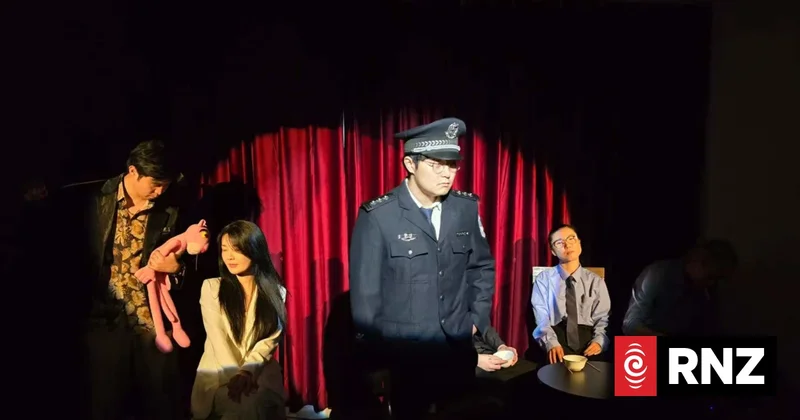
A group of strangers sits around a table in Auckland dressed in traditional robes, embroidered jackets and period-style costumes.
Each holds a script and has assumed a new identity, becoming detectives, nobles, servants or suspects in a fictional world.
Over the next several hours, the participants question one another, search for clues and role-play scenes as they seek to unravel a mystery.
The group is playing jubensha, a form of scripted role-playing game that combines deduction, character development and interactive theatre.
Unlike games such as Werewolf, which primarily rely on bluffing and deduction, jubensha places players inside a detailed story, with assigned characters, relationships, secrets and, in some cases, elaborate costumes and sets.
After surging in popularity in China, jubensha is now attracting a growing following in Auckland.
For many players, its appeal goes beyond solving a mystery.
Participants say the games help them make friends, build social connections and briefly step into lives far removed from their own.
Miura Su, an Auckland store display designer, said the game allowed her to become the person she had once dreamed of being.
"I want to live a life different from my own," she said.
"So, I intentionally play characters whose personalities differ from mine."
Su said jubensha games typically require about six players, which was another reason she was keen to expand her social circle.
"Whether the six players are friends or strangers, I see it as a form of socialising," she said.
"Personally, I do not mind playing with strangers … it gives me the chance to form new connections."
Jubensha researcher Ruoyu Wen, a PhD candidate in human-computer interaction at the University of Canterbury, has spent years studying the game in China.
Wen recalled taking part in an elaborate jubensha game in the central Chinese city of Wuhan.
Inspired by Dying Light, a video game set in a post-apocalyptic world, the experience unfolded across a purpose-built, two-storey miniature town.
Each player assumed a character with a distinct storyline and a separate set of missions.
During the game's "daytime," players could move through the town and accept quests from supporting characters, who rewarded them with food and water.
During the "night," they had to hide inside buildings to avoid zombies.
Like an open-world video game, Wen said, the experience allowed players to move freely, speak with one another and interact with non-player characters.
Uniforms, sound effects, custom sets and supporting actors helped create what he described as a highly immersive experience.
Wen said that while live-action role-playing games often remained a niche form of entertainment in Western countries, jubensha had become a mainstream social activity among young people in China since 2015.
In 2013, a murder-mystery board game called Death Wears White was introduced to China, an event some researchers regard as the beginning of the country's jubensha industry.
Original Chinese-language scripts soon followed.
However, the format did not gain widespread attention until 2016, when Mango TV, one of China's largest media companies, launched Who's the Murderer, a reality show adapted from a South Korean television programme.
During the Covid-19 pandemic, online jubensha apps became a popular way for people to socialise and play together remotely.
At the same time, China's rapidly expanding escape-room industry began combining scripted role-play with elaborate, immersive settings.
Wen said demand for social connection among young people, together with the appeal of immersive entertainment, helped drive the game's rapid growth.
The development of higher-quality Chinese-language scripts, along with elaborate costumes, live supporting actors and detailed sets, also helped jubensha evolve into a mature commercial industry, supporting professional scriptwriters, game hosts, box set publishers and venue designers.
According to the Chinese technology news outlet 36Kr, the number of jubensha venues in China rose from about 2400 in January 2019 to 12,000 by the end of the year.
The research firm iiMedia Research said China's jubensha market was worth 17.02 billion yuan ($4.4 billion) in 2021, up about 45 percent from the previous year.
By 2025, the market had grown to 44.81 billion yuan ($11.5 billion), although its annual rate of growth had slowed.
That growth has also reached Auckland, where jubensha venues are drawing an expanding community of players.
Lin Zhang, owner of Qihuan Mystery Studio on Auckland's North Shore, said the local market was tiny when she opened the venue in 2019.
As interest grew, the business moved into a larger space to meet demand.
Still, weekend sessions are often fully booked.
"After we moved here, we had enough rooms for seven groups to play at the same time," she said.
"But demand remains high on weekends, especially on Saturdays."
Zhang said the studio now had about 1000 Chinese-language scripts covering a wide range of genres and themes.
A standard session typically costs between $38 and $43 per player.
More elaborate productions can cost between $108 and $158 a person.
Performance-based games, which may involve interactive theater, elaborate costumes, live actors and detailed sets, often need to be booked at least a month in advance, Zhang said.
Tangmen Studio, another jubensha venue in central Auckland, has developed a loyal base of regular players, many of them office workers, over its seven years in business.
Carina Zhang, the studio's owner, said Auckland's scripted murder-mystery market remained relatively small and was concentrated largely within the Chinese community.
She estimated that Auckland had about six jubensha venues and said the quality of their scripts had become a key factor in attracting and retaining participants.
But acquiring high-quality scripts from publishers in China can be expensive, she said, with some box sets costing several thousand dollars.
"A standard boxed script costs about 300 to 600 Chinese yuan (roughly $76 to $150)," Zhang said.
"But city-limited scripts, which are typically licensed to only three to five venues in a city, can cost between 2000 to 3000 yuan (about $500 and $800)."
The rarest scripts are licensed exclusively to a single venue in each city, she said.
"For those city-exclusive scripts, the price can be several times higher and may reach about 10,000 yuan (roughly $2500)," Zhang said.
"If you want something exclusive, you have to compete with other venues."
Zhang said the studio was a side business, with turning a profit proving difficult.
Nevertheless, she remained optimistic about the industry.
"I believe face-to-face interaction will always be part of our lives," she said.
"Whether they are playing board games, visiting escape rooms or taking part in murder-mystery games, people need genuine human connection."
Hamish Cameron, a senior lecturer at Victoria University of Wellington who specializes in game research, said role-playing was still quite popular in New Zealand, particularly in the form of tabletop games.
The appeal of role-playing games extended beyond costumes and performance, he said.
They also offered players a chance to inhabit unfamiliar lives and consider perspectives different from their own, he said.
"Whether you are pretending to be someone else or putting yourself in a position that you would not normally be in, either just for fun or exploring a serious idea," Cameron said.
"That is why role-playing is sometimes sort of like therapy situations as well, because it can be a useful exercise to put yourself into the perspective of someone else. "
Cameron said the games also offered many players an accessible introduction to collaborative storytelling, which was part of their appeal.
For players who became deeply absorbed in role-playing games, Wen said, it was important to maintain clear boundaries between the fictional world and everyday life.
He said parts of China's jubensha industry had faced problems, including scripts containing sexually suggestive material, harassment of female players and cases in which players found it difficult to separate themselves emotionally from their characters or the game world.
Wen said pregame and postgame workshops, which are common in some European live-action role-playing communities, could help players establish those boundaries.
Such practices should be adopted more widely across the industry, he said.