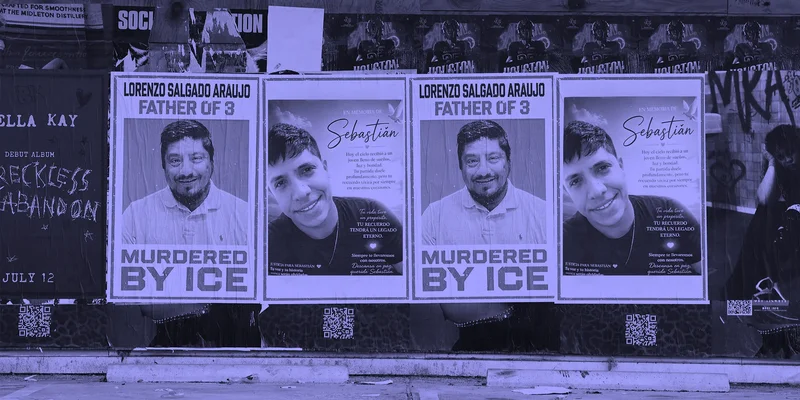
Within the span of a week, federal immigration agents shot and killed two people in Maine and Texas, and another was hit by a truck and killed in Florida after trying to avoid ICE agents. A fourth person recently died in ICE custody after reportedly being denied medication.
Their deaths prompted yet another round of questioning as to how federal immigration agents have amassed so much power and so little accountability. This week on The Intercept Briefing, host Akela Lacy speaks with Naureen Shah, of the American Civil Liberties Union, and Nayna Gupta, of the American Immigration Council, on the consequences of allowing the government to build a national policing force that’s bringing Trump’s war on immigrants into communities across the country.
“The $240 billion injection that the Trump administration has given ICE and Border Patrol make these agencies — which already were the largest federal law enforcement agencies — make them far larger than anything that we’ve seen at the federal law enforcement level,” says Shah. “Their budgets are bigger than that of many, actually most militaries around the world.”
“It’s not really just about who they’re hiring and even the training that they’re getting — it’s the message that they get all the way from the top,” says Shah. “And of course, the message after the killings of Alex Pretti and Renee Good was, you have immunity in the conduct that you’re engaged in. It’s basically a message of, you’re going to get away with it. Don’t worry about it.”
“The signal from the very top of the administration is unmistakable: Arrest as many people as possible without regard for the actual impact on public safety, without regard for the killings that may result, the harm that results.”
Congressional funding for those agencies has outpaced any action on comprehensive immigration reform. And with Republicans pushing to strip voting rights from millions of Americans while campaigning against immigrants, says Gupta, the solution is to neutralize their argument by creating a path to citizenship — a proposal with broad bipartisan support.
“There’s no question that the immigration enforcement agenda that this administration is pursuing ties to voting rights. Now, the question is, given that, how do we still make sure we’re offering solutions and reforms that can be viable and build a broad enough coalition of support to overwhelm that far-right base and the way they’ve weaponized this issue?” Gupta says.
“I think those kinds of conversations are a more effective antidote to the far right’s effort to weaponize the immigration system, not only to hurt immigrants, but to hurt core democratic rights like the right to vote.”
For more, listen to the full conversation of The Intercept Briefing on Apple Podcasts, Spotify, YouTube, or wherever you listen.
Transcript
Akela Lacy: Welcome to The Intercept Briefing, I’m Akela Lacy, senior politics reporter at The Intercept.
Jessica Washington: And I’m Jessica Washington, politics reporter at The Intercept.
AL: Jessie, the big news this week has been the ongoing fallout from the most recent killings by federal immigration agents in Texas and Maine, along with two other deaths in relation to immigration enforcement within the last month. What did we learn this week about those deaths? And is Congress responding?
JW: We’ve continued to learn more about the ICE officer, David Brouillette, who shot Johan Sebastián Durán Guerrero at a traffic stop in Maine two weeks ago. His ex-wife, Ashley Brouillette, said that he called to ask her to vouch for his character, which she refused to do. Instead she’s been speaking publicly about the violence she said she endured during their marriage and his apparent racism, which she believes may have been a motive in the shooting.
Ashley Brouillette: He’s like, well, I need you to lie about my character because this is what it comes down to, like my character. I don’t want you talking about any of the abuse in our relationship, like, this is literally about me actually. I told him that I was not going to lie for him, that I’ve waited years to speak my truth. I’ve been silenced long enough and now I need to come out with everything because a man lost his life.
JW: I think for many, this story is highlighting the kinds of people, and the caliber of people who are being hired at ICE as the agency rapidly staffs up.
There was some additional news The Intercept broke recently. Last Thursday, Intercept contributor Karl Loftus reported that the ICE officers who were on the scene at the Maine shooting were actually wearing body cameras but they just weren’t turned on.
We also learned more about the man who was killed fleeing from ICE agents in Florida. According to Mexican officials, the man who was struck by a truck after fleeing into traffic to avoid ICE, Juan Coronilla Durán, was in the United States legally on a tourist visa and was visiting family.
I want to preface this by saying there are still more details to come about why ICE targeted that vehicle and about the people inside. But so far, the incident does bolster claims that ICE is targeting people based on their race and ethnicity, not a sophisticated calculation about their immigration status, or as Juan Proaño, the CEO of LULAC, the oldest Latino civil rights organization in the United States, put it when describing the other recent ICE shooting on Democracy Now!:
Juan Proaño: ICE was casing Magnolia Park, which is a 97 percent Hispanic community. They were hunting for Latinos.
JW: As for Congress, there really isn’t much to report. Last week, Democrats sent a letter to the Department of Homeland Security demanding new restrictions on ICE after the fatal shootings in Maine and Texas. Democrats also attempted to add enforcement guardrails to a new sweeping immigration bill in the House but were shut down.
There is some noise, but the closer we get to the possibility of Democrats regaining control of Congress in November, the clearer it becomes that there isn’t an appetite from leadership, or frankly much of the caucus, to come up with a Democratic solution to do anything but tinker around the edges of a broken, violent system.
AL: While those shootings were all over national news the last two weeks, the Trump administration has been busy all over the map. Officials froze more than $1 billion in Medicaid funds to California and Minnesota as the president and his allies attack blue states with claims of fraud. The president has also been laying the groundwork to contest the outcome of the 2026 midterms — continuing to push Republicans in Congress to pass an unpopular and unprecedented voter ID law. And on Tuesday, the Justice Department announced the monitoring of polling sites in Arizona.
Meanwhile, the House approved $1.1 trillion in military funding on Wednesday and another $95 billion budget blueprint with $70 billion in funding for the Iran war. The House also passed another war powers resolution directing the president to withdraw the U.S. military from Iran on Thursday. The Pentagon had requested $67 billion to make up for spending on the Iran war, which has already cost $37.5 billion, Defense Secretary Pete Hegseth told senators in a hearing on Tuesday.
Sen. Dick Durbin: Do you have a new estimate about what the war has cost us so far in this, the fifth month of the first year of this war in Iran?
Pete Hegseth: Senator, the estimate we have as of today is $37.5 billion.
AL: Trump has continued to escalate the war on Iran and promised to strike an Iranian bridge or power plant for every U.S. service member killed as that number continues to climb. Our colleague Nick Turse also reported this week on the unraveling of the administration’s efforts to cover up the number of U.S. military casualties.
We’re talking about cutting all this money from social services while simultaneously pumping tens of billions of dollars into federal law enforcement and the military. These are some of the hallmarks of a country shifting to an authoritarian form of neoliberalism. Is that what’s happening?
JW: Short answer: yes. Longer answer: It does feel pretty clear that the Trump administration is employing classic authoritarian tactics. Step one, focus the country’s attention on a marginalized group with little political power who are already being scapegoated. In this case, immigrants. Step two, use that group to deflect from the fact that you are pillaging all of the resources, privatizing everything and concentrating enhanced military and police power in your control. Step three, which I think we’re all familiar with, crush all dissent.
The administration is really using alleged and unfounded, by the way, fraud by immigrants, whether that be claims of voter fraud, or Medicare and Medicaid fraud to enact policy goals that either enrich or empower them, or enrich and empower their allies.
We don’t need to go back to the Nazis to see authoritarianism in action. For example, In the 1970s and ’80s, former President Ronald Reagan deployed the myth of the “welfare queen.” So this was a woman, typically Black, who defrauds and abuses the welfare system. And he did this in order to push draconian rollbacks in the social safety net. And you can’t divorce that from the Cold War politics and militarism, and rapid wealth and income disparity growth, that was also a key feature of that administration.
So, yes, this is a march to authoritarianism, but it’s a march we’ve been on before.
AL: This is something that came up in my conversation this week with Nayna Gupta, the policy director at the American Immigration Council. And she says, “We have over the many months of this administration seen them use the immigration system as the tip of the spear in their attack on democracy and core democratic institutions.”
JW: To her point, we are really seeing the administration use immigrants as a way to come after democracy writ large. I’m really interested in hearing that conversation between the two of you.
AL: I get into all that and more with Nayna Gupta, who also leads the Council’s legislative, administrative, and policy portfolio, and Naureen Shah, the director of government affairs, equality division at the American Civil Liberties Union, where she leads the ACLU’s immigration policy and advocacy work.
Naureen Shah, welcome to the Intercept Briefing.
Naureen Shah: Thanks for having me.
AL: Nayna Gupta, welcome to the show.
Nayna Gupta: Thanks so much for having me.
AL: Within the span of six days, federal immigration agents shot and killed two people — 52-year-old Lorenzo Salgado Araujo in Texas and 25-year-old Johan Sebastian Durán Guerrero in Maine. That brings the total number of people fatally shot by immigration agents in Trump’s second term to at least 11. Two more people died in connection with ICE within the last month. A third man — identified this week as a Mexican man on vacation in the U.S. — was struck by a truck after fleeing an encounter in Florida. A fourth man died in [ICE] custody in Georgia after his family says he was denied medicine, reported by our former colleague José Olivares at The Guardian.
Their deaths are not isolated incidents. A new analysis from the ACLU that documented 1,200 ICE incidents last year across eight states finds a pattern of federal immigration enforcement that consistently flouts civil liberties.
Naureen, one of the report’s findings that struck me the most was the emphasis on these most recent killings and deaths not being an aberration but part of a broader systematic pattern. And that the way the U.S. government is conducting immigration enforcement is moving us further away from a liberal democracy and toward authoritarianism. Can you tell us more about that finding and others from the ACLU report?
NS: Again and again, ICE and immigration agents that work for ICE are resorting to violence. They are using the threat of violence and actual physical violence in their interactions with people — not because they are facing a specific threat, but just as a default tool, as a way to compel immediate obedience, as though that is the main tactic they have in understanding how they engage with the public. What we saw was that they weren’t doing so in a professional way. It wasn’t calibrated. It wasn’t specific, as though they were following a carefully designed protocol.
Let me give you an example. There was a situation not far from where I live in Maryland — in Hyattsville, Maryland — where a man was pulled from his car. He is in the traffic intersection being held down. He’s being pinned down by the neck by an ICE agent, and that agent fumbles his gun. His gun falls while he’s doing this. He grabs the gun, picks it back up, and points it at the crowd that has gathered to watch this. A second agent then moves in on the crowd with his weapon raised as well. So you’re seeing them act as careless as they are reckless.
That is really dangerous. Because the other thing we found in the report was that ICE is now on our streets, at our grocery stores, at our parking lots, even at school playgrounds. That presence there in masks, in street clothes, with that kind of aggression is changing the nature of daily life in this country.
When you have to be afraid that when your 15-year-old is waiting for the bus and they are brown, that they may be accosted by a masked agent, that they may be questioned about their citizenship. I’ve heard about people wearing their identification around their necks because they’re so afraid.
That is a change in our country; it’s a change for the worse.
AL: I want to back up a little here and just remind people of the arc of this mass deportation project from the beginning of Trump’s second term, although it was a feature of his previous administration. This attack has reached an unprecedented scale since 2025 when Trump entered office for the second time.
We saw, as you mentioned, Naureen, masked and unidentified ICE agents descend on our cities attacking pro-Palestine students. We saw, as the report notes, the president send the military to cities run by his political opponents, first deploying the National Guard to California to suppress anti-ICE protests, where we also saw a surge of masked federal agents targeting Latinos and grabbing people off the streets at gas stations, grocery stores, churches, and so on.
We started the year with immigration agents flooding Minneapolis and killing two protesters and shooting another who survived. Although the killings of those protesters, Renee Good and Alex Pretti, really drew national attention to this issue in a new way, you all documented just how widespread this kind of action from immigration agents has been over the past year.
While we’ve covered a lot of that at The Intercept, namely the targeting of pro-Palestine students by ICE, ICE has been doing this kind of thing in ordinary neighborhoods across the country. Fifty-two people have also died in ICE custody since Trump reentered the White House, putting the mortality rate of deaths in ICE custody at its highest level in over a decade, more than doubling that rate since he started his second term. That’s according to a new report from Physicians for Human Rights and Human Rights Watch.
Nayna, can you talk a little bit about why you think January was a turning point in terms of people paying attention to this?
NG: I’ll just start by saying, the Trump administration right now may have moved away from the more theatrical displays of force that characterized those earlier operations in places like Minneapolis and Chicago.
But just as you say, the basic objective has not changed — and that is a fixation on increasing detention and deportation simply for the sake of numbers. This is an administration that has made clear that sheer volume is their goal. What we saw in January was a lot of Americans waking up to the fact that this is the first time in U.S. history that we are seeing the immigration system taken to its extreme and sometimes beyond its legal limits within American communities against long-standing immigrant neighbors and those that stand up for those neighbors.
In other words, while in the past we have had harsh, or punitive or restrictive immigration policies at our border, this is the immigration enforcement system used to the extreme within the interior of the United States in our communities. Folks seeing that in their streets — this indiscriminate enforcement driven by sheer quotas and numbers — is a wake-up call. That includes for folks who voted in support of this president and mass deportation. We’ve heard stories reported early on of communities in places like Missouri that voted in large numbers for the president who are suddenly out on the streets calling for the return of their favorite local business owner and soccer mom who was swept away by arrest and detention.
In other words, a lot of the protests and pushback we’ve seen is both because of the extreme nature of this agenda, but also who it’s targeting — and those are long-standing members of our communities who pose absolutely no public safety threat. We’re seeing a lot more Americans than ever before say, “Wait a minute, why do the laws subject these people to this kind of extreme response? That doesn’t make sense.”
AL: This is for both of you. I want to talk about the people who have been dying in ICE custody, which often does not get as much attention as the shootings. What is happening to people when they enter these facilities?
NG: Look, the immigration detention facility had a record of endemic abuse long before the Trump administration. And now what we’re seeing is the administration sweeping in, again, people who largely pose no public safety threat, who have no prior criminal convictions, who are being put into a system that no longer records where they are in the system so that family members and lawyers are unable to locate or find their loved ones.
We’re talking about a system where now under the Trump administration, the vast majority of people locked up in these inhumane facilities don’t even have a right to a court hearing in the immigration system to make a case for their release. The administration is rapidly expanding the use of mandatory detention so that people who would have a good case for release don’t get to make that. That means that then folks are stuck inside, and sometimes when U.S. citizens or folks with lawful status get swept into these detention facilities, it can take weeks before they’re able to show that they shouldn’t even be there — because they don’t have access to that basic kind of due process.
Then finally, again, the endemic, abusive conditions of this system predate the Trump administration, but this administration has taken that to an all-new extreme.
At this point, we’re seeing an average of one death every eight days out of the immigration detention facilities across the country, and the kinds of conditions we’re hearing about include starvation; not just medical neglect but intentional medical abuse; people not being able to receive life-saving medical treatments; pregnant women not being given the support they need.
This is extreme inhumanity, and that is what folks are facing when they go inside. And it’s a lot harder to shine a light on those abuses because we don’t have viral video footage like we do when we see some of these shootings and killings in our streets.
NS: If you’ve ever been to one of these detention facilities, you get a sense of the geography that’s at play. The geography of a detention facility is that sometimes you’re driving hours from the nearest city. These are in the woods. They are in areas that no one is supposed to be able to reach.
The Trump administration has a design. They have a plan. They want to put people in detention sites that are remote, where lawyers have a harder time getting access, where journalists are not going to visit, and they don’t want people to be knocking on the doors and finding out what’s going on inside.
They don’t want congressional staff and members of Congress to be there either because what’s happening inside is truly frightening. It is straight out of the most dystopian novel, which is that you go inside these detention facilities, and you have no ability to reach back out into the world and get that lawyer to help you navigate the system — or even talk to an ICE officer and say, “I have no idea what’s going to happen to me.”
The most tragic cases are the ones where people need something as basic as their heart medication, and without it they will die, and they can’t get answers. They can’t get seen by a doctor. There is just no way to reach out to people to say, “This is happening to me.” That is why we’re seeing the record number of deaths in ICE detention because once you go in, you are stuck there in the most nightmarish kind of way.
We hear from people, not as much as we would if people actually had working phones in all these detention facilities. The ACLU just published a report with Human Rights Watch about Camp [East] Montana, the largest detention facility that’s on a military base. The conditions there are appalling. It really just strikes at your conscience to think that people are living in this kind of nightmarish condition where they don’t think they’re ever going to make it back out of these facilities — and that, again, is what the Trump administration wants to do.
There was an ICE official who last year said we’re going to create the “Amazon Prime” of deportations. They want to treat people like they are not human beings, and that is partly why they put them in these detention sites; it’s to be able to get them out of public view quickly and deported quickly.
That is just anathema to our Constitution, our entire system. Under our laws, detention is not supposed to be used as widely as it is being used; it’s meant to effectuate a final order of removal. That doesn’t mean that it’s meant to be used as punishment or to deter people from coming here or to terrorize people into self-deporting, but we know that’s the Trump administration’s aim.
AL: I just want to mention while we’re on this note, the case of Mohsen Mahdawi, a pro-Palestine student targeted by Secretary of State Marco Rubio, whose arrest by ICE I reported last year. In his case, on Tuesday, a panel for the 2nd U.S. Circuit Court of Appeals overturned a ruling that had released him from ICE custody. He told me that, though, that he was “in good spirit, unshaken, and determined and hopeful.”
[Break]
Turning back to the most recent shootings in Maine and Texas — neither of those men were the people ICE was “supposed to be targeting.” The shootings also renewed criticism of ICE having slashed its training standards for new recruits, including cutting the amount of time that they had to go through training. They actually instituted new training in June in response to backlash, though they said it was to protect ICE agents from “coordinated campaigns of violence against them.”
The AP reported that David Brouillette was the officer who shot Guerrero in Maine. Brouillette was an Army veteran with a history of mental health issues and domestic violence, according to relatives.
Naureen, what do we know about how ICE is screening officers, and does that really matter when even vetted agents are also carrying out these policies or involved in misconduct?
NS: A number of members of Congress have been asking questions about ICE’s vetting and hiring standards, as well as their training standards. What they have heard from the new DHS secretary, Secretary [Markwayne] Mullin, was meant to assuage them, meant to assure them that things are going back to the way they were before and that standards are going to be increased, that the training is going to go back up to its full level. But as you say, it’s not really just about who they’re hiring and even the training that they’re getting — it’s the message that they get all the way from the top.
And of course, the message after the killings of Alex Pretti and Renee Good was, you have immunity in the conduct that you’re engaged in. It’s basically a message of, “You’re going to get away with it. Don’t worry about it.” Even now, after these latest shootings, when Secretary Mullin said OK, we’re going to pull back on vehicle arrests, the very next day, the president was out there saying yes to vehicle arrests.
The signal from the very top of the administration is unmistakable: Arrest as many people as possible without regard for the actual impact on public safety, without regard for the killings that may result, the harm that results. And we’ve still got an ICE arrest quota, and we still have ICE officers out there who are being told to just get it done.
As Nayna was saying, it doesn’t matter for them how many U.S. citizens, how many green card holders, or how many kids. One of the things our report documents is how many kids have been caught up by ICE and other immigration agents. We identify more than 200 kids, including 32 U.S. citizen kids, who were subjected to misconduct and targeted by ICE.
They just keep going and you don’t see any accountability for the missteps — the clear missteps — that they have made, let alone, real investigations into these killings that result in people being held accountable.
AL: Yeah, talking about not taking accountability — I remember listening to Tom Homan when he went to Minneapolis in January, effectively blaming the shootings of Good and Pretti on “hateful rhetoric” toward ICE.
NG: It is important to talk about some of these political players at the top. Again, this is an enforcement agenda, as Naureen is alluding to, that rewards volume and scale.
Just before these most recent shootings, there was reporting on how the White House was doubling down again on a quota. We have heard reports from law enforcement leaders who engage directly with people inside the administration that Stephen Miller himself was on the phone with ICE field offices around the country asking them why arrest numbers weren’t higher.
When you combine that kind of pressure from the White House with a workforce that has grown exponentially very quickly with relaxed training, vetting, and hiring standards, and a slush fund from Congress that has no meaningful accountability and oversight — these killings are no surprise. They are not isolated incidents. They are inevitable results of the combination of all of these factors that are at play. So even with more training and vetting, so long as Stephen Miller is on the phone, and Homan is backing him up, pushing for higher arrest numbers, I don’t think we can expect to see much difference on the ground.
That being said, in the immediate term, it is incumbent on members of Congress to push for training, vetting, and hiring. This is an administration that marketed this agenda as being focused on the “worst of the worst,” that has used public safety as a pretext to advance mass deportation — when they themselves are hiring people with questionable criminal records that underscore an inability to manage tense situations like the kind of enforcement that they are being thrown into, and like what we’ve seen out of Maine from the officer there.
AL: I also just want to mention before we move on to the next question that The Intercept recently reported on ICE adopting a new dress code after the deaths of Araujo and Guerrero and a botched raid in Las Vegas. An ICE official who spoke to us anonymously, citing the Las Vegas incident where a man was tackled to the ground by two plainsclothed people, said, “What an embarrassment the Vegas video was. Those two fucking clowns should’ve been immediately fired. Half these fucking new DOs” — that’s deportation officers — “don’t even know the basics of immigration law or how to process an alien. They hired a bunch of fucking clowns and they look sloppy as shit.”
Naureen, we spoke last year for a story about ICE rapidly expanding its cooperation with state and local police departments, even with wildlife and gaming commissions, and I remember you describing this dystopian image of a nationalized police force dispatched to do Trump’s political bidding. Does that match up to what you’re seeing now? Is it not quite there, or is it worse?
NS: We are at a really dangerous point with this national deportation policing force, which is what we call the cannibalization of federal law enforcement and state and local law enforcement to serve the mass deportation agenda. What we see all around the country is that law enforcement agencies, sometimes the entire law enforcement agency, are deputized to work for ICE. There’s a huge financial incentive for them to do so. They can get performance bonuses. They can get people’s salaries paid for, new cars, new phones.
What it means is that you have signed up to work for ICE. And so we see, for instance, highway patrols in some states just posting up. Their weekend duty is to set up checkpoints and have ICE in cars nearby, and they stop people for the purpose of funneling people to ICE.
You’ve got local police who are in Florida. They’re seeing people and saying, “Hey, you’re walking your dog in the wrong part of the beach. No dog walking here. And by the way, where were you born? You seem to be speaking with an accent. Oh, I’ve gotta call ICE.” So what we have now is local police doing ICE’s bidding. From a democracy perspective, what’s so dangerous about that is that ICE is not just a law enforcement agency, it is a political tool of the White House.
They’ve made no bones about it during the funding shutdown last year. The president threatened to deploy ICE to the airports and did so really in a blatant political stunt to try to put pressure on Congress and say, “Look, I’ve got ICE and I can send them after you if I don’t like what you’re doing. If you’re putting the squeeze on me, I’ll use ICE to put the squeeze on you.”
So if you look not very far into the future and you think about, well, there’s more than 50,000 law enforcement agents that are now working for ICE — with ICE directly from another federal law enforcement agency, as you’ve reported, from the FBI, from state and local police, they’ve got more than 50,000.
Every day there’s even more law enforcement agencies signing up to work for ICE, and now they can be deployed by the president, by Stephen Miller, to go after dissent. That’s not a hypothetical. That’s not a hypothetical because we’ve seen it in states all around the country.
In our report, which was just looking at 2025, we identified more than 780 people who were engaged in First Amendment-protected activity. They’re documenting ICE’s behavior, they’ve got their cellphones on recording. They’re not trained legal observers, they’re just people. But there’s also members of the clergy, elected officials, journalists — more than 780 of them who were targeted or subjected to misconduct by immigration agents.
I think that should scare all of us when ICE is tear-gassing people. We documented 132 times when immigration agents were directly targeting people with chemical irritants, like spraying them in the face. That is brazen. Again, thinking about that as a politicized force, concentrated power at the beck and call of the president, not just here in Washington, D.C., but in states all around the country, it is truly frightening from the perspective of our democracy.
AL: You mentioned the reporting that I did in May on the FBI redirecting a quarter of its staff — over 9,000 personnel — to target immigrants. And at the state and local level, cooperation between federal immigration agents and local police has exploded under Trump. In his first year alone, the number of local and state police departments partnering with ICE to do immigration enforcement increased by 600 percent. As of July, ICE has partnered with more than 2,100 such agencies. Naureen, you touched on this a little bit, but Nayna, I wonder if you can elaborate on how those specific partnerships are making this deportation machine possible.
NG: Let me start with the diversion of resources from other federal agencies. One thing here that’s important to talk about on both fronts is public safety. These are agencies — federal agencies — that have typically focused on core public safety priorities like political violence, domestic terrorism, human and drug trafficking. Instead, these are now officers that are focused on low-level immigration enforcement with very little understanding of the immigration system altogether. That is a way to supercharge this mass deportation agenda at the federal level, but also a way in which it undermines safety for all Americans, not only immigrant communities.
At the local level, this expansion of partnerships between local sheriffs and the federal government absolutely, as always, can serve as a force multiplier for ICE. That means police officers out on the street using routine traffic stops that can turn into detention, deportation, family separation, or even death. There was the young 3-year-old boy who died because his mother had been deported; and she had been picked up by a local police officer during a traffic stop. That is an example of how these partnerships have real human harms.
Now on the public safety front, what we know is that when local police are deputized to work as ICE agents, of course they lose the trust of community members because communities become afraid that reporting crime or contacting public government services will result in deportation and detention.
Earlier in the administration, we saw a public post from a sheriff in Tennessee who said that a baby died in the care of a non-citizen caretaker who was too scared to call 911 in Tennessee because of recent raids that had just happened at the hands of Tennessee State Police officers and federal agents.
So those public safety implications are real, and at the [American Immigration] Council, we have been talking to sheriffs around the country who do not want to enter into these partnerships because of how it erodes their credibility and how it works against public safety. These are sheriffs in places, including North Carolina, who say, “We can’t investigate homicides in immigrant communities if we’re in bed with the Trump administration and ICE.”
We’ve seen the most conservative sheriffs in Florida who cozied up to this agenda saying, “Wait a minute, why are we going after people who pose no safety threat for these kinds of arrests?” So this kind of collaboration, as Naureen said, it obviously has implications for our democracy. It’s growing our federal police force. But it also has terrible negative effects for actually protecting public safety and maintaining public trust of public institutions.
We can expect the kind of violence we’re seeing, not only at the hands of federal agents, but also local police officers if we continue to see the administration expand this kind of collaboration.
AL: I’m not really sure people grasp just how unprecedented the amount of federal money we’re giving to ICE and CBP is compared to when those agencies were created after 9/11. Congress just gave ICE and CBP another $70 billion on top of the money allocated in Trump’s economic bill last year, which allocated $170 billion over four years for federal immigration enforcement.
Naureen, can you put in perspective for our listeners that explosion in funding, and how is that money shaping what federal immigration agents are doing, what resources and the kinds of weapons that they have?
NS: The $240 billion injection that the Trump administration has given ICE and Border Patrol make these agencies — which already were the largest federal law enforcement agencies — make them far larger than anything that we’ve seen at the federal law enforcement level. Their budgets are bigger than that of many, actually most militaries around the world. So most militaries around the world are funded less than ICE and Border Patrol at this moment in our nation’s history.
If you think about where ICE even comes from, like how it came into being, it came into being after the 9/11 attacks and the creation of the Department of Homeland Security. It’s a pretty young agency as they go, less than 25 years old. And even after 9/11, which spawned a lot of legitimate concern and also a lot of hysteria about terrorism and immigration. Even after that, we didn’t see this kind of funding. Nothing near this kind of funding.
We’ve actually got a bar chart that shows just how enormously, like a staggering amount of money this is in comparison to anything ICE and Border Patrol got before. Even if you compare it to the first Trump administration, even if you look at several years combined, it does not meet $240 billion. So what can they do with this money?
I mentioned that they want to create the “Amazon Prime” of deportations. It means that they can not only expand ICE’s footprint directly in terms of hiring, but they can do more of what we’ve been talking about, which is incentivizing state and local police to join their ranks through a program called 287(g).
They’re going to spend billions of dollars on that, billions of dollars on detention, and detention not to make it more safe. It will be deadly. It will be large facilities where people are just left to suffer all kinds of abuse and all kinds of medical neglect, and of course, just to deport as many people as they can.
It’s worth remembering that their ambition is to deport 100 million people. That’s what they’ve said on their social media platform. 100 million, which is about a third of the country, that’s how many people they want to get rid of. And they’ve got a lot of ideas about how to do it. So they will be spending that money unless Congress takes it back, and we will certainly be looking for members of Congress now to make that commitment that they will take that money back because it is just too large a sum.
AL: I want to end on how immigration is coming up in the midterms. There’s been an intractable debate on immigration reform in Congress for as long as I can remember. Congress could create a path to citizenship for people. We saw efforts to that effect under President Joe Biden, which were then used to attack him and the eventual nominee, Kamala Harris, in 2024 as a preview of what Trump would do in office.
Meanwhile, Republicans are campaigning in this midterm cycle on attacking immigrants and taking advantage of anti-immigrant sentiment among their base. We also have Trump basically trying to hold the GOP hostage until they pass his SAVE Act bill that has previously failed and is even unpopular among Republicans and would require people to prove their citizenship to vote with a birth certificate or a passport, documents that more than 21 million Americans already lack access to, according to the Brennan Center.
I wonder if you could talk about how the war on immigrants is tied to the war to strip people of their right to vote. Nayna, I’ll start with you.
NG: The challenge of advocating and pushing to reform and fix the immigration system has always been that so many of the people impacted are quite obviously the most politically disenfranchised. They’re non-citizens. They don’t have a right to vote. That means that pathways to permanent status and citizenship could wake up new constituencies that would be a threat to the far right, given the far right’s anti-immigrant sentiment. That is always a backdrop in the fight for advancing reform.
We have, over the many months of this administration, seen them use the immigration system as the tip of the spear in their attack on democracy and core democratic institutions. Once again, we’re seeing the administration use immigration and the authorities they’ve been given in the system to attack fundamental voting rights — whether that’s using immigration agents at polling locations, whether that’s pushing back against these efforts to provide folks pathways to permanent status and protect them from the arm of ICE.
So there’s no question that the immigration enforcement agenda that this administration is pursuing ties to voting rights. Now, the question is, given that, how do we still make sure we’re offering solutions and reforms that can be viable and build a broad enough coalition of support to overwhelm that far-right base and the way they’ve weaponized this issue?
At the Council, what we’ve observed is that while we’ve done a great job at talking about what we don’t want — we don’t want this many dollars, we don’t want an immigration detention system to enforce civil immigration rules — it’s been harder to explain to folks how do you get rid of those harmful parts of the system but still have a system of rules.
We still have to enforce immigration laws in the United States. And what we’ve been doing is talking to members of Congress, talking to the public about what that can look like, that you can have penalties for violations of civil immigration law. But deportation should not be this one-size-fits-all punishment, and that is the system that we have right now.
When we talk in those terms, there are many Americans who are increasingly uncomfortable with what they’re seeing, given the killings of people like Renee and Alex, but who still believe in a system of rules and are worried about an America that welcomes anybody and everybody. And so what we’re really saying is, you can enforce rules and have a system, but no, it doesn’t have to mean that any person in violation of civil immigration law could be subject to arrest and mass incarceration. What does that look like? Those kinds of conversations are a more effective antidote to the far right’s effort to weaponize the immigration system, not only to hurt immigrants, but to hurt core democratic rights like the right to vote.
NS: Most Americans still support citizenship as a pathway. More than 80 percent of Americans support a path to citizenship for Dreamers, people who came here as kids. That includes 54 percent of Republicans, according to a Gallup poll from July. [Editor’s note: 56 percent of Republicans support Dreamers’ citizenship in the Gallup poll.]
So even with years and years of anti-immigrant scapegoating, Republicans, Democrats, Independents, all support a path to citizenship. I think it gets to what Nayna is speaking to, which is a value of fairness, a value that cuts across a lot of different parts of our political spectrum — a sense that people ought to have a fair shot.
When we talk about the rules of the system, we are talking right now about if you were playing this, if you were explaining this as a board game to a child, there would be no way for most people to win that board game. They would just keep landing on go directly to jail, do not pass go, just go to jail.
That is how our immigration system is set up. It’s a game with rules, and the rules are rigged so that people will fail, and they will be punished, and they might even lose their lives, and they might even be torn from their small children. And of course, we’ve seen heartbreaking cases like that. So the ACLU is seeing this moment as a moment for policymakers to call for transformative change to an immigration system that has long been cruel, and has long not served anybody’s interest.
Right now, that system is on overdrive. We are seeing that cruelty on display, and it means that we just need to transform this entire system. How do you turn a broken, upside-down system right-side up? The first thing is that people in this country, millions and millions of them, need a path. They need a path to being here with legal residency and ultimately with citizenship.
But if we continue to have a system where more than 10 million people — who are our neighbors, our loved ones, ourselves, people who are working, who keep this country going — if those people are stuck in this game that they just cannot win, we’ll never have a system that works. Enforcement will always be broken.
It will always mean people being put in detention because they just never had a chance at any kind of alternative where they could live freely and openly and with legal authorization. And, just say also, that’s really terrible for our democracy. I think about, I’ve got little kids, I think about the country they’re going to grow up in.
If Stephen Miller has his way, the undocumented people in this country and their U.S.-born children are not going to have the same right to education. They won’t have the same right to free speech. So two decades from now, if we were having this conversation and one of us was undocumented or one of us was the child of an undocumented person, Stephen Miller’s pipe dream is that some of us would have the right to speak our minds on this, in this conversation, and some of us would be afraid. That’s where we’re headed to unless we have transformative change to this broken immigration system.
AL: We’re going to leave it there. Naureen Shah and Nayna Gupta, thank you so much for joining me on The Intercept Briefing.
NS: Thanks for having me.
NG: Thanks so much.
AL: We want to hear from you. Tell us what you’re following or want to see more coverage of. Email us at podcasts@theintercept.com or leave us a voice mail at 530-POD-CAST that’s 530-763-2278
That does it for this episode of The Intercept Briefing.
This episode was produced by Laura Flynn. Ben Muessig is our editor-in-chief. Maia Hibbett is our managing editor.
Fei Liu is our product and design manager. Nara Shin is our copy editor. William Stanton mixed our show. Legal review by David Bralow.
Slip Stream provided our theme music.
This show and our reporting at The Intercept do not exist without you. Your donation, no matter the amount, makes a real difference. Keep our investigations free and fearless at theintercept.com/join.
And if you haven’t already, please subscribe to The Intercept Briefing wherever you listen to podcasts. And leave us a rating or a review, it helps other listeners to find us.
Let us know what you think of this episode, or If you want to send us a general message, email us at podcasts@theintercept.com.
Until next time, I’m Akela Lacy.
IT’S EVEN WORSE THAN WE THOUGHT.
What we’re seeing right now from Donald Trump is a full-on authoritarian takeover of the U.S. government.
This is not hyperbole.
Court orders are being ignored. MAGA loyalists have been put in charge of the military and federal law enforcement agencies. The Department of Government Efficiency has stripped Congress of its power of the purse. News outlets that challenge Trump have been banished or put under investigation.
Yet far too many are still covering Trump’s assault on democracy like politics as usual, with flattering headlines describing Trump as “unconventional,” “testing the boundaries,” and “aggressively flexing power.”
The Intercept has long covered authoritarian governments, billionaire oligarchs, and backsliding democracies around the world. We understand the challenge we face in Trump and the vital importance of press freedom in defending democracy.
We’re independent of corporate interests. Will you help us?
** IT’S BEEN A DEVASTATING** year for journalism — the worst in modern U.S. history.
We have a president with utter contempt for truth aggressively using the government’s full powers to dismantle the free press. Corporate news outlets have cowered, becoming accessories in Trump’s project to create a post-truth America. Right-wing billionaires have pounced, buying up media organizations and rebuilding the information environment to their liking.
In this most perilous moment for democracy, The Intercept is fighting back. But to do so effectively, we need to grow.
That’s where you come in. Will you help us expand our reporting capacity in time to hit the ground running in 2026?
We’re independent of corporate interests. Will you help us?
** I’M BEN MUESSIG,** The Intercept’s editor-in-chief. It’s been a devastating year for journalism — the worst in modern U.S. history.
We have a president with utter contempt for truth aggressively using the government’s full powers to dismantle the free press. Corporate news outlets have cowered, becoming accessories in Trump’s project to create a post-truth America. Right-wing billionaires have pounced, buying up media organizations and rebuilding the information environment to their liking.
In this most perilous moment for democracy, The Intercept is fighting back. But to do so effectively, we need to grow.
That’s where you come in. Will you help us expand our reporting capacity in time to hit the ground running in 2026?
We’re independent of corporate interests. Will you help us?
Latest Stories
The War on Immigrants
U.S. Website Gave False Approval to Green Card Applicants — Then Blamed Glitch and Took It Away
“It was heartbreaking,” said one recipient of a false approval who was told about a USCIS website snafu.
Trump’s Crypto Corruption Puts Centrist Democrats in Bind
Moderate Democrats want to put a stop to Trump’s meme coin self-dealing. But that might cut off campaign donations from crypto interests.
Israel’s War on Gaza
On a West Bank Eviction Tour, Israeli Settlers Advertise “No Arabs Here”
Israelis celebrated evicting Palestinians on a tour of the West Bank, where government-backed settler violence has spiked.