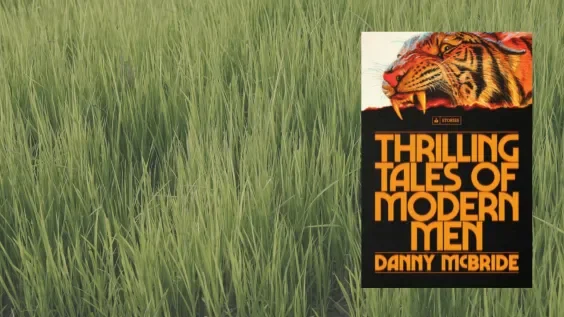
I imagine the pitch for Danny McBride’s new short story collection, Thrilling Tales of Modern Men, went a little something like this: Hey, this is Danny McBride’s agent. Yeah, that guy. He wants to write a short story collection called something like Thrilling Tales of Modern Men. And I imagine the response from the editor at Random House was similar to my own, upon hearing about the book: Hell yeah.
Amidst a moment in our culture where the question of what defines the contemporary man is subject to quarterly declarations of a loneliness epidemic and, in a fun new twist, mandatory testosterone tests, there's basically nobody better suited to probe the hollow inner workings of modern masculinity than McBride. He’s had a lot of practice, after all. As a screenwriter and performer, he’s demonstrated a particular genius for understanding the Dumb Guy in a way that only a really smart one can. That McBride can write is not in dispute, but I’m not sure what, exactly, to make of this book or his intentions behind it.
The difficulty I found in reading and responding to Thrilling Tales is that Danny McBride, as a concept, already exists in our collective societal brain. (If you're looking for the obligatory Kenny Powers mention, it’s already over.) This isn’t a fame issue, though. Celebrities turning to fiction may be a fun recent micro-trend which the publishing industry is using to provide something of a higher audience baseline, but it is historically a pretty normal endeavor. David Duchovny cranked out Bucky Fcking Dent in 2016, and Carrie Fisher gifted us Postcards From the Edge three decades before that, and somewhere in the middle Hugh Laurie wrote The Gun Seller, or rather, as his most devout readers know it, Tout Est Sous Contrôle*. No, the circle I struggled to square is that this is a book that, in many instances, feels like it was written by somebody with clear talent who recognized that writing a book is simply a thing they can do. It’s not laziness, to be clear: The stories here do not read like recycled character sketches from a writer’s room scratch pad. You can hear in McBride's book press tour that he wanted these short stories to exist as short stories.
Some of the miscues of Thrilling Tales are simply jokes that perhaps through the lips of the author or Walton Goggins or Edi Patterson would land a laugh, but on the page feel forced. In “The Illusionist,” the story that opens the book, the conclusion winds up with a mall guard shooting the antagonist, an overly territorial magician. Our protagonist—a fellow magician, who we’ve followed for a pretty languid 66 pages as he performed his pathetic act on the victim’s turf—asks if the guard knows CPR. “Is that to do with computers? I’m afraid my knowledge is limited in that realm. I rely on my son.”
Other stories involve this tic that McBride and many writers have: They make a perfectly good point, then insist on explaining it once more, in a less interesting manner. In “RoboCare™,” a limp-wristed son tries to convince his dad, George, to take on a robot caretaker rather than get shipped off to an old folks’ home (emphasis mine): “Well, Dad, what if we told you there is a way for you to stay in this house and put our minds at ease about your well-being. A win-win, if you will.” Later in the same story, the robot, DJ, fully on to George’s attempts to have him decommissioned and removed from the home, is preparing breakfast (emphasis mine, again): “George entered the kitchen as DJ cracked eggs into the pancake batter and began to rapidly stir. Fast movements. Cold precision. There was something ominous and foreboding in the strange chore.”
I can grant that not every joke is going to land, and that for every 10 times McBride’s editor snipped one of these little in-line bonks on the head, one or two slipped through. That’s plenty excusable. What isn't, though, is this collection’s cardinal—and most confounding—sin.
The secret to McBride’s charm on screen, and to his career as a TV screenwriter, is his ability to immediately notify us that the character he's portraying is from somewhere. He has never been or tried to be a smoothed-over everyman. He’s never really attempted to be much more than a guy from the South, which he expresses through accent, mannerisms, dialogue, and ideology. McBride's work has been meaningful to me, and I'm sure many others, because it's so grounded in a place we recognize. He places the obvious bit at the center of the trap, priming the audience, many of them from somewhere else, to laugh at him and by proxy us, then he works his magic—which often relies on a found community of weird fuckups, proper rule-followers, and previously holier-than-thous, all tied together by the strange gravity of that somewhere—and pulls that audience over to a place where they can laugh with.
That sense of place, however, is notably absent in the 10 stories in Thrilling Tales of Modern Men. McBride somehow concocted a collection where geography, ideology, and community are almost completely divorced from storytelling. That it doesn’t entirely sink the book is a credit to his skill for concocting intriguing concepts and propulsive plots, and a sea’s worth of dolts, has-beens, and fuckwads. But it holds him back from achieving what could have been a true announcement of a debut. Nowhere is this combination of bizarre placelessness, layered storytelling, and thoughtful character development more infuriating than in what is undoubtedly the high point of this collection, “The Book Burner.”
The story is a daring setup. McBride introduces a mysterious book burner, Dwayne, who appears to be targeting the latest work of a dickhead author, Marcus. We soon find through a well-executed manifesto that Dwayne is accusing Marcus of stealing the most devastating moment of his life and reworking it for a new novel. The story functionally sets up two games of cat and mouse: of Dwayne hunting down Marcus and then of Tony, a psychotic hired gun, hunting down Dwayne, cut with flashbacks of Dwayne’s dissolving marriage and the accident that drives this entire mess. All the while, McBride artfully switches us from vantage to vantage, with a keen eye for whose perspective is most critical for each moment. It’s the kind of storytelling that makes me want to rip its pages out, staple them together, and hand them out to people on the street so they can read it devoid of McBride’s celebrity.
"The Book Burner" understands so well the dynamics and relationships between the men at its center. It would be all the more rich had McBride worked to offer more than a passing acknowledgement of the story’s North Carolina setting. A few offerings:
“Dwayne sat outside of the Books-A-Million near Crabtree Mall, in Raleigh, North Carolina.”
[...]
“Brendan was waiting for Marcus Mel as he arrived at the hotel in Charlotte.”
[...]
“Chimney Rock hung in the distance—that tall mountain with the lake made him feel like he was in the Alps or something.”
If you'd like to make the argument that Crabtree Mall and Charlotte are soulless places devoid of any real character, and that a Books-A-Million and “the hotel” are apt descriptors, you will hear no counterargument from this North Carolinian. However, the characters featured in this story do, by all insinuation or outright admission in the text, have existing relationships with these places, and this relationship is left almost entirely off the page. Home, generally speaking for this collection, could be anywhere in the United States; these characters could be plunked down in most any town or city, and the plots he’s devised would need little alteration. Rarely are the characters placed in the true thrum of community, even as a mechanism to show us how they may have slipped out of it. That’s what the great Southern short story writers do—George Singleton, Ashleigh Bryant Phillips, and Deesha Philyaw don’t merely conceive of a person, but of the place they were born into. Perhaps they fall out of that place or deeper into it, but that place, particularly in the South, must be acknowledged.
Without a deeper sense of where these people are from, there's no unique sense of dialogue or prose from story to story in Thrilling Tales. Too often it falls back on a tone that can only be described as How Danny McBride Talks. That works great for the screen but cannot be applied to the exposition across 10 stories.
It’s a missed opportunity, since McBride's knack for scene and character work is stunning at times. This rings true perhaps most notably the deeper he takes us into the psyche of Tony, who is the most fully realized character in these pages:
“Tony had dealt with stalkers. He had killed a woman in Pensacola who wouldn’t stop sending panties caked with menstrual blood to David Attenborough’s home address. She’d done that for six straight years. Tony was hired, Tony found her, and, well, she didn’t send period-blood panties to anyone ever again.”
There's only one brain that comes up with something as stupid and hilariously dark as the centenarian Brit, who talks stoner college kids through the ways of the natural world, ordering a hit on an obsessive Floridian. That brain happens to belong to a guy who has a knack for subverting expectations. It belongs to a guy who delights in making us laugh at, then cry for the venal men who raise stupid children. It belongs to a guy who, if he really wanted to, could be one of the best Southern short story writers around.
After my final read of Thrilling Tales, the question I had was how committed McBride is to the game. You imagine he could ring up the same HBO execs he’s been working with for 20-odd years, pitch them on a new show, and have a two-season order sizzling in his inbox by the next morning. Seeing how horror films are demolishing every box-office prediction imaginable right now, and his bona fides with the Halloween trilogy he co-wrote, he could print some easy money while stepping back into a producer role or sliding over to the director’s chair and giving us a heady Southern slasher. Or … Untitled G.I. Joe 2, 3, and 4.
But what if he didn’t do that? What if McBride said he wasn’t going to do this as a shtick, a la typewriter-humping-ass Tom Hanks, and that he was going to sit back down and crank out a dozen more short stories? Then trash all of them. Then write another dozen, and maybe pull three out of that pile, and the innards of some of the others, and get to revising and super-gluing. What I mean is: Now that Danny McBride has checked off becoming a published author, what if he became a proper writer?