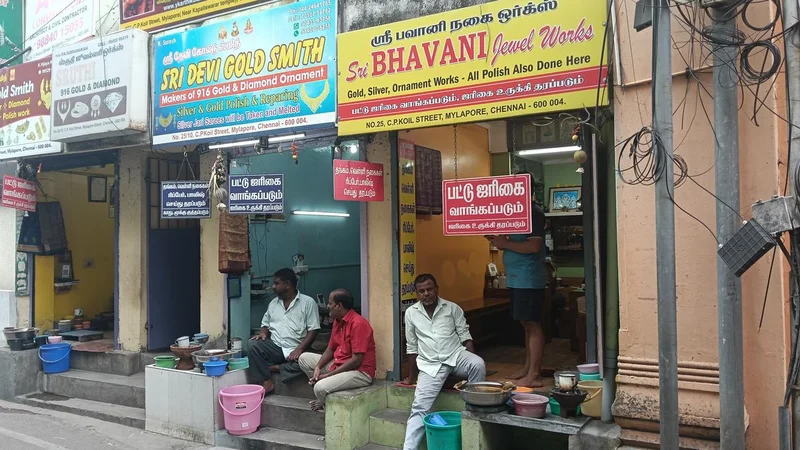
Chengazhuneer Pillaiyar Koil Street off North Mada Street in Mylapore can be missed by footwear-clad hooves other than those heading to it aware of what it has to offer, a standout craftsmanship nestling quietly inside. Narrow and hemmed in by non-decrepit buildings, it slips past the eye unless one has known it for what it is: the bling street in these parts. In terms of numbers, both of shops and transactions, C.P. Koil Street is no patch on Edapalayam Street, which winds like a necklace between NSC Bose Road in George Town and Walltax Road in Park Town. While Edapalayam Street is the undisputed capital for gold and other precious metal jewellery-making and testing in Chennai, C.P. Koil Street could be placed in a “family” that includes gold jewellery-making enclaves in T. Nagar and Purasawalkam.
The description of a lane fitting it better than that of a street, C.P. Koil Street (the quickly recognised contraction) is lined with shops of gold-and-other-precious-metal jewellery-making craftspersons strategically interspersed with those selling jewellery. There are flower vendors, and shops selling temple-related items at C.P. Koil Street sketching the classic image of a street running close to a famous temple (in this case, Kapaleeswarar temple), but the one trait that overrides everything else is that of a turf for craftspersons adept at shaping precious metal into wearables. These craftspersons, some of whom also work with silver and zari saris that have gold and silver threads woven into them, draw upon the trust built patiently over generations. At Santhosh Thanga Maligai, the owner M. Padmanabhan is carrying forward a family business that had its genesis on North Mada Street where his grandfather operated for nearly 50 years. In its current location at C.P. Koil Street, the business has weathered 40 summers. And if one does a simple addition math, there is an unmistakeable and majestic hoariness to the enterprise. This account of a skill passed down generations is a recurring feature, the story reappearing at different addresses across C.P. Koil Street’s storefront.
This business cannot get any more family-oriented than it is. It could not be put more lucidly than how Karthik Gopal of Sagunthala Testing on C.P Koil Street does. “It is a family business started by my grandfather Venkatesh,” and on who has been running it now, Karthik rattles off a list: “My father, me, my uncle, my aunt, my mother, my cousins, my niece... everyone” And that certainly is pretty much everyone in the family.
Just as craftsmanship and ownership are passed down the generations, on the other side of the counter, customer loyalty also follows an unbroken line of continuity, generations of a family getting gold jewellery done at a shop whose work ethics they trust. This trust is coming in handy as these craftspersons are battling challenges arising from a mammoth civic work just beyond C.P. Koil Street’s doorsteps.
Finding itself in the long shadows of Metro rail work all around it, C.P. Koil Street might be a little less hoofed now, but the adverse situation has not significantly detracted from its glitter. The trust factor carries the day for these craftspersons as floating customers have dwindled on account of access unwittingly restricted by Metro rail work on main corridors in Mylapore, examples being Kutchery Road, Luz Church Road and RK Mutt Road.
“Now, almost all roads leading to the street have been affected by Metro rail work. Our regular customers still return because they know us,” says Karthik, noting that accessibility as a whole has been a difficult hurdle to bypass. Years of dedication and craftsmanship have earned them a loyal customer base. However, reputation alone cannot replace the steady stream of first-time visitors the place once enjoyed. “Seven years ago, there was much more footfall,” Karthik recalls. Being overly dependent on your established customer base with little scope for new customers swelling it can bring about a frustrating clinginess and a tendency to want to play Aladdin’s servile genie to those loyal customers from the past. Padmanabhan says his shop is open all days of the week, from 10.30 a.m. to 8.30 p.m.; and they close for work only on two festival days in a year. This challenge plonks alongside others faced by all goldsmiths, particularly those in south India, in Karthik’s view. While technology would have brought a cutting edge of accuracy and speed to the goldsmith’s job, Karthik notes, customers still prefer the sight of a goldsmith seated in front of them and testing and assessing the precious metal. It is down to trust issues, he points out. Laser technology makes jewellery-making swift, but too many people cannot be allowed to stay around lest there could be spread of dust. Those who work with this technology are in the right gear for it. The challenge lies in making the process effective through technology and at the same time making it reassuringly visible for the customer.
A picture of sameness
“The street has not changed much,” says Karthik. Padmanabhan echoes that sentiment in a tone that rings wistful. “There has been no development. The street remains the same, and its narrowness leaves little scope for change,” says Padmanabhan, pointing to the infrastructural constraints that have shaped the area. And perhaps that is what makes the present struggle so striking and relevant. The businesses remain where they started and the community they created continues to seek them. It is the journey moving forward that has become increasingly difficult for them. Preserving the place’s commercial character also means preserving the ease with which people, the outsiders, can be a part of it. And at present, that is a challenge.
Published - July 25, 2026 05:59 pm IST