Rajendra Chenni’s A Critical History of Kannada Literature is a timely, much-needed, readable history of one of India’s major literary cultures. While there have been such overviews before, it is necessary that each generation rewrite history with new foci and commitments. It is increasingly rare – in the age of academic specialisations – for scholars to be able to summon up a millennium and a half of literary production and be able to engage in good-faith conversation and dialogue with that tradition.
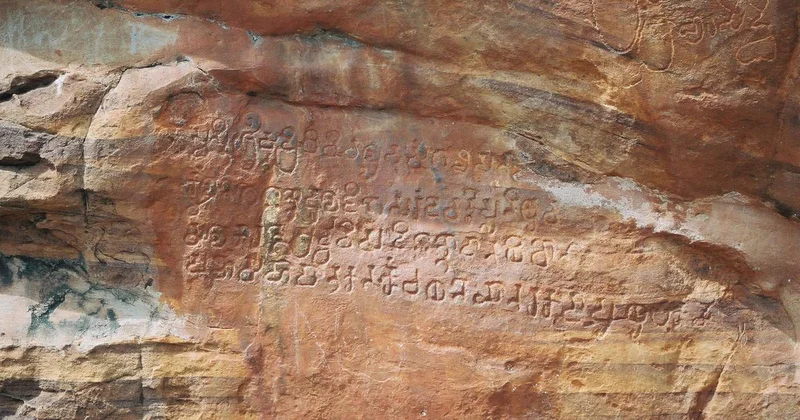
Chenni begins with some of the unavoidable issues of literary historiography. The first canonical text, the 9th-century Kavirajamarga, is celebrated as arguably the “first book of aesthetics in a vernacular language anywhere in the world”. Unsurprisingly, however, the content is deeply indebted to the Sanskrit tradition of scholars such as Bhamaha and Dandin.
The beginnings
What one thus needs is an appreciation of more reflective, rather than reflexive, nationalisms and sub-nationalisms. Further, the Kavirajamarga has a seemingly unproblematic engagement with worldly authority – it pits itself against other regional polities, but does not question aesthetics itself as needing to be homogenised and entirely aligned with political power.
In contrast, there were already Jaina, Shaivite and Buddhist traditions that often took a more sceptical position vis-à-vis political and temporal power, and the relation of Kannada to Prakrit is glossed over. According to Chenni, the imprint of Prakrit on even today’s Kannada (in meaning, pronunciation and grammar) remains immense and underappreciated. Surprisingly, there seems to be less literary give and take with the more proximate Tamil tradition.
Chenni gives us the full complexity at play. Twentieth-century scholarship of the Navodaya period proved beyond doubt that the Kavirajamarga already had a mature tradition behind it, albeit sadly lost. Chenni questions whether the entire idea of “regional” versus “pan-Indian” is ever conceptually or empirically meaningful. After all, boundaries kept shifting (dramatically due to wars, but also in more passive ways) and because polities always contained speakers of several languages and religious/sectarian persuasions.
Different points of dissidence
Chenni also points out that “what is missing is the attempt to keep records of these texts in the public domain”. Only small private salons/courts/monastic sites served as durable “receivers” of these texts and even if the texts moved slowly into more public domains, we do not know how these larger circles responded and modified these shastric and poetic texts. Chenni notes that this increase in the modes of critiquing tradition operated well into the 20th century – he discusses the varying attitudes of canonical writers/groups such as Kuvempu (1904-1994), Masti (1891-1986) and the fiercely anti-casteist group the Bandayas, responding to the same millennial Kannada tradition from different vantages and from different points of dissidence.
Something that famously expanded the circle of receivership were the Vachanas, mostly searing “questing” poems, whose authors were largely from the artisanal classes. The early texts of this Vachana tradition may be dated to around the 12th century. Exactly how much the public sphere expanded, and how sustainably, is still debated.
But the Vachanas broke Kannada forever from the overly ornate Sanskrit style and thematics that were dominant until then. Henceforth, even if Sanskrit meters were used, the meters were more straightforward, and set themes (such as the “description of the sex-workers’ quarters in the city”) were no longer deemed imperative. Yet, as Chenni notes, Sanskrit never dies, and in the 20th century, Kuvempu, for example, deliberately and lyrically recreates, in a rural landscape, a Sanskritised Kannada that “no Kannadiga has spoken in the past two thousand years”.
The book does move from the medieval world into the present. There are many insights, but this is also more familiar territory. An important achievement in Chenni is that he always keeps on the double lens of the text-in-itself, as well as the chain-of-interpretations of that text, until the twenty-first century. Even these chains are embedded in institutional contexts, and Chenni has an appreciation of the large publication projects helmed by various universities and government grants, even as these have had uneven outcomes. More happily, the book references the vibrant contemporary scene in Karnataka, evoking the works of key practitioner-researchers such as KV Akshara, TP Ashoka, Vivek Rai, HS Shivaprakash, Vanamala Viswanatha, among many others.
This is the kind of book that hopefully will be produced for at least all the major Indian languages, so that literature programs in the country have a base text from which further specialisations by theme or time period can be undertaken by scholars and students. There is a revival of interest in regional literatures, and it has to be accomplished in a spirit that fully accommodates the complexities involved, without falling into simple binarisms of authentic/inauthentic, native/foreign, oppressive/liberating and so on. This book may helpfully serve as a dispassionately argued template, and one looks forward to the forthcoming titles promised in the series – critical histories of Marathi, Malayalam and Punjabi.
Nikhil Govind is the author, most recently, of Rama Rasa: Transcendence and Worldliness in the Ramayana Tradition (Bloomsbury, 2026).
A Critical History of Kannada Literature, Rajendra Chenni, Orient Black Swan.
We welcome your comments at letters@scroll.in.