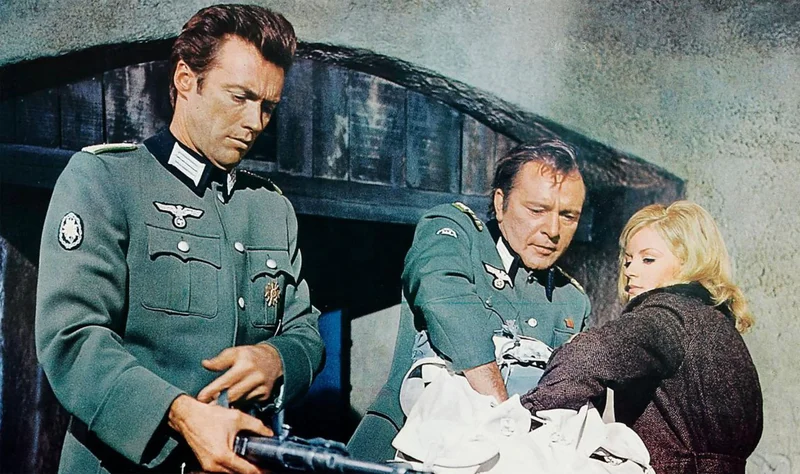
I was surprised to discover how many people I know are fans of the film Where Eagles Dare (1968) and of the author of the story, written directly for the screen, Alistair MacLean, who later turned it into a novel as splendid as the film. Among those who admire Brian G. Hutton’s adaptation and the Scottish author are none other than Michael Ondaatje, the author of The English Patient (a considerably subtler story, certainly), Steven Spielberg, who has cited it as his favorite war picture, and a writer I have adored since I read his lovely — especially the first part — Jeff in Venice, Death in Varanasi (Canongate, 2009), Geoff Dyer.
With Dyer I share several things: we are almost the same age (68 years old, he is a few months younger), we both like to travel and we have both had disappointments with the aurora borealis — see the chapter on that in his book White Sands (Pantheon, 2017) — and his soul has been stolen by the sword Stormbringer in Michael Moorcock’s Elric of Melniboné. Also, both of us have been aboard a U.S. Navy aircraft carrier on a combat mission to write a story. Dyer boarded the USS George H. W. Bush, and I — along with photographer Guillermo Cervera and a great deal of trepidation — boarded the USS Harry S. Truman, which was also a sheer, thunderous spectacle. Out of my stay came a feature and out of the writer’s, a great book, Another Great Day at Sea (Pantheon, 2014). Both he and I were by far the oldest on our ships and Dyer was the tallest.
Well, the other day, sniffing around Foyles bookshop in London, I came across a little book (120 pages) by the writer that I had no idea existed. It is Broadsword Calling Danny Boy (Penguin, 2018) and when I took it in my hands I literally began to tremble with emotion (and mind you, it was hot in London). The book is devoted to the film Where Eagles Dare and its title refers, as fans of the film will have guessed, to the radio code used by British major Jonathan Smith (Richard Burton) to communicate with those who have sent him — together with U.S. Rangers lieutenant Morris Schaffer (Clint Eastwood) and agent Mary Ellison (Mary Ure) — on a dangerous commando mission to a Nazi castle, Schlöss Adler, the Eagle’s Nest, in the Bavarian mountains. In the Spanish version of the film, the code Smith/Burton uses in several communications, with his unforgettable Shakespearean emphasis, was “Espada llamando a Daniel.” In English, the phrase has become a commonplace lodged in the national psyche.
Discovering that Dyer is passionate about Where Eagles Dare, which is the original title of that apotheosis of adventure with a castle, a cable car, Nazis and double- and triple-agent intrigue, delighted me. But reading the book, I learned that we share many more things than I realized. For example, Dyer enthusiastically cites a book I also own, The Nazis by Piotr Uklański (Patrick Frey Edition, 1999), an almost cult volume that reproduces 164 full-page photos of film actors who have been costumed as characters of the Third Reich for various movies. There they are in brown or black uniforms, from Robert Duvall and Michael Caine in another eagle-titled picture, The Eagle Has Landed, to Lee Marvin and Charles Bronson in The Dirty Dozen, James Coburn in Cross of Iron, Marlon Brando in The Night of the Following Day, James Mason as Rommel in The Desert Fox, Ralph Fiennes in Schindler’s List, Helmut Berger in Salon Kitty or Robert Vaughn in The Bridge at Remagen, among many others.
Dyer writes in Broadsword Calling Danny Boy about his youthful passion for Action Man outfitted in ski-patrol gear that evokes both The Heroes of Telemark, another daring raid and a great film, and the white parkas of the hardy German mountain troops, the Gebirgsjäger, the Edelweiss men who guard the rugged alpine stronghold in Where Eagles Dare and whose uniforms Burton and his commandos wear as disguises. He also confesses his fascination with the Schmeisser submachine gun and the Luger pistol (those World War II icons we, in our 1960s-childhood innocence, asked Santa for at Christmas). And his long romance with Airfix model airplanes (his favorites are the B-17 and the Avro Lancaster). In short, Dyer is one of us (or we are one of his).
The book, the author says, is a “narrative inventory of my own repertoire of details and observations, accumulated over many years and multiple — and often partial — visits.” In other words, it is a personal tour of Where Eagles Dare “that forms part of who I am,” in which Dyer breaks down the plot and delves into aspects that interest or amuse him. To a large extent it is a great, brilliant prank, full of witty and sometimes outrageous Monty Python–tinged remarks, wordplay and a lot of irony, and it offers abundant information about the making and development of the film. For example, the mistake of showing a Bell 47 helicopter, which did not yet exist, pistols with silencers worthy of James Bond films, or that one of the German commanders is given the rank of Reichsmarschall, a title held only by Goering.
Dyer begins with the opening sequence, on the plane that flies the commandos over a snow-covered alpine landscape while the credits roll. He emphasizes that although it may seem we are in a Hammer horror film heading to Dracula’s castle in Transylvania, we are aboard a Ju-52 captured from the Germans. He goes on to describe the seven passengers, including Burton and Eastwood. He notes that Burton’s reason for taking this role is clearly monetary: he will make a lot of money that will allow him to buy his modern Cleopatra (Elizabeth Taylor) things like a private jet or lavish jewels, including the Krupp diamond and the La Peregrina pearl. In fact, Liz would often visit the set (their contracts stipulated they had to be able to dine together) and have her photo taken with Burton and the rest of the cast dressed as German military. What convinces Burton to participate in the film, besides the money, is that Gregory Peck had done something similarly dignified eight years earlier, starring in the climatically very different The Guns of Navarone.
The author recalls that the film’s title (and the subsequent novel) was not by MacLean, who was very poor at titling, but, although it echoes the SAS motto “Who Dares Wins,” it was inspired by the castle’s own name, Adler, and actually comes from Shakespeare —from Richard III — where it is said the world is going so badly that sparrows hunt where eagles dare not perch.
Dyer treats Eastwood’s character with considerable irony, noting a “post-Elvis” hairstyle and a laconic, expressionless quality worthy of a ponchoed gunslinger. He says Eastwood’s acting method amounts to squinting, which renders him monosyllabic in facial expression. On that score he compares him to Steve McQueen, a master, he says, in the display of interior nothingness, and to other sober actors like Charles Bronson or Lee Marvin. Burton cannot be described as a sober actor: as Jack Webster recalls in his biography of Alistair MacLean (Chapmans, 1991), Burton paused, to chat with the writer, during a scene in which he had to climb a wall and in an hour and a half downed five large vodkas. He then returned to the set and climbed the wall without trouble. In a later encounter, the actor and MacLean, who drank like a Scot, came to blows and Burton ended up on the ground on the end of a right that struck his nose.
The author reflects on the effectiveness of SOE clandestine operations behind enemy lines (questioning the concept in the process) and cites John Keegan and Max Hastings and their view that such warfare did not contribute much. The commando unit must rescue a captured general who holds secrets about opening the second front, but Burton has his own agenda (and the word is apt, since agendas play such an important role in the plot; as does scopolamine).
The cable car scenes — the castle is so inaccessible it makes Colditz look like a spa — are among the most thrilling in the film, especially for those who fall. Dyer devotes space to those scenes and also to the meeting in which the espionage entanglement of the story is woven and unwoven and you no longer know who’s who (there’s always a final twist), except for the good guy Clint Eastwood, who furrows his brow more than usual. Dyer links the scene to the tavern scene in Quentin Tarantino’s Inglourious Basterds, one of the many influences Where Eagles Dare had on that film.
Although Dyer insists on finding erotic charge in the relationship between SS-Sturmbannführer Von Hapen (Derren Nesbitt), “the blond beast,” and the two women on the good side, Mary and Heidi (Ingrid Pitt), even suggesting that the Nazi — so villainous he appears twice in Uklański’s book — tries to arrange a threesome, the truth is that in Where Eagles Dare, as in other MacLean films and novels, there is almost no sex: everything moves too fast and the writer was fairly puritanical. The most libidinous element is the way Eastwood oils the Schmeisser.