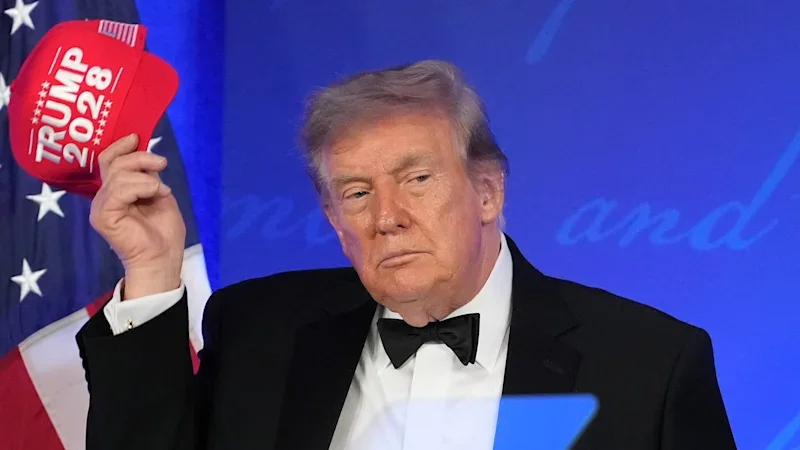
Six years into his presidency, Donald Trump has ended his boycott of the annual White House Correspondents Dinner. In a speech that included numerous attacks on his political enemies, Trump started and ended by joking about his plans to run again for president. He pulled out a “Trump 2028” hat, with the tagline “rewrite the rules”, that is now for sale on his website for $US55 ($79).
Presidents are expected to make jokes at this dinner, as Trump did on Friday night. But Trump has spent most of his second term making sure that no one can be certain if he really is joking about running for a third term, despite the explicit ban in the US Constitution. Trump’s will-he-won’t-he drama has instead frozen Republican efforts for succession planning. In 2016, when Barack Obama was term-limited, both parties had already begun their unofficial primaries by this point and we know from Joe Biden’s late withdrawal in 2024 just how damaging it can be when a figurehead of the party won’t let go.
Trump started playing this game in March 2025, weeks after being sworn in for a second time, when he told NBC News that he was serious about a third term and spoke about the ways it could be possible. He has mentioned running again at least 18 times, moving between jokes and serious escalations, before conceding at the end of 2025 that the Constitution prohibited him from running again.
Because he keeps opening and closing the door, no one can quite be sure what Trump intends to do, but it has empowered the president while freezing the Republican Party.
Those in Trump’s bubble seem to be confused as well. Hats are for sale. One of Trump’s closest allies in the House, Tennessee congressman Andy Ogles, has proposed a constitutional amendment that would permit Trump, but not predecessors like Obama or Clinton, to run for a third term. Steve Bannon has said that Trump will run again, with his strategy to be revealed at “the appropriate time”.
Chief of staff Susie Wiles has said that Trump is not serious about a third term, and that he’s aware of the constitutional limits. Speaker Mike Johnson has said that Trump is “trolling” Democrats and that the president enjoys seeing the opposition party with their “hair on fire”.
And yet, when Alan Dershowitz, the lawyer who was on the defence team for Donald Trump’s first impeachment, released a book-length plan on how Trump can remain in office, a White House spokesperson said only that the American people would be lucky enough to keep Trump in office.
It is a mistake to dismiss all of Trump’s rhetoric as unserious, as many do. Yes, some quips appear to be improv, off the cuff and unconsidered. Many more of his ideas are only discarded after they meet the institutional realities of Congress, the courts, or the markets.
But hyperbole has been a feature of his Trump’s campaigning, and he’s been deadly serious on what might have once seemed like outlandish plans for massive tariff increases, slashes to government programs, and expansion of immigration enforcement.
This air of uncertainty gives Trump continued leverage over his party as the 2028 nominating contest begins to take shape.
Secretary of State Marco Rubio and Vice President JD Vance are the leading contenders for the Republican nomination in 2028 and have built profiles that extend well past their official roles. But no candidate can offer a future that extends beyond Trump while this ambiguity about his intentions hangs over their party.
Contrast that with the work that the Democratic Party is doing to shape their primary. It has spent a year reshuffling its early primary calendar, this week landing on my home state of South Carolina as the important first state, replacing Iowa’s historic role. Prospective candidates have been travelling, raising money and publishing the obligatory campaign books.
Republicans are not only asking who should lead their party but who Trump might eventually permit to succeed him. Those are two very different questions.
It is impossible to predict what Trump will do in 2028. If he sought to get his name on the ballot, election officials in each state would make the initial decisions, likely along partisan lines. Those decisions could be expected to end up at the Supreme Court, which although ideologically conservative has been willing to step in when Trump claims too much unilateral authority over the Constitution. Just last month, they overruled his effort to revoke birthright citizenship, saying he had no singular authority to change constitutional rules
But Trump does not need a plausible path to the ballot to have power over the race. As long as the possibility remains alive, every potential Republican successor must wait and demonstrate their loyalty.
The question of Trump running for a third term should be settled under the Constitution. The 22nd amendment says that “no person shall be elected to the office of president more than twice”. It also prohibits tricks like the one Trump has openly mused about, in which he runs as JD Vance’s vice-president, only to replace Vance on their first day in office. The vast majority of constitutional scholars have said there is no loophole that Trump can reasonably exploit. But the Republican Party is largely still behaving as though its future depends on what Trump decides.
By making sure that no firm ground exists on which any candidate can stand, Trump has turned political uncertainty into leverage over his party. They remain paralysed by his influence.
The irony of this moment is that the White House Correspondents Dinner in 2012 is where Barack Obama told Trump to his face that he would never be president. A decade and a half later, it’s where Trump is keeping alive the question of if he will ever stop being president.
Cory Alpert is a PhD researcher at the University of Melbourne looking at the impact of AI on democracy. He previously served the Biden-Harris administration.
The Opinion newsletter is a weekly wrap of views that will challenge, champion and inform your own. Sign up here.