- See more Daily Mail on Google - save us as a Preferred Source
Many people will have wished Andy Burnham well when he became Prime Minister a week ago. It's in all our interests that he doesn't make a complete hash of things.
Yes, he has carried out a ruthless coup. Agreed, he doesn't have a mandate. True, he hasn't explained his policies in any detail to his party or the media.
But at least he's a chirpy, positive fellow whose sense of optimism contrasts with the hangdog pessimism of Starmer and Reeves when they took office. Burnham rightly criticises his predecessors for manufacturing an air of gloom.
I don't of course pretend that my heart was brimming with goodwill when Andy uttered a few banalities outside No 10 last Monday. But part of me was resolutely looking for hopeful signs. Nobody wants another dud PM.
How do I feel one week later? Depressed. Burnham's puppyish enthusiasm doesn't yet grate with me, but I find myself increasingly wondering whether he has the faintest idea of what he is doing.
Andy puts me in mind of a Yorkshire woman called Viv Nicholson, whose husband Keith won £152,319 on the football pools in 1961 (about £3million in today's money). Viv immediately undertook to 'spend, spend, spend', which she certainly did.
Life didn't go well for her or for Keith, who sadly died in 1965 after crashing his Jaguar. Viv was soon bankrupt, and then quickly spent a contested payout from Keith's estate. She eventually died penniless in 2015, having given the nation some entertainment.
To judge by his first week in office, Andy's own motto is 'spend, spend, spend'. He immediately promised to take VAT off domestic electricity bills, place a £2 cap on bus journeys, end rough sleeping and cut business rates for pubs and music venues.
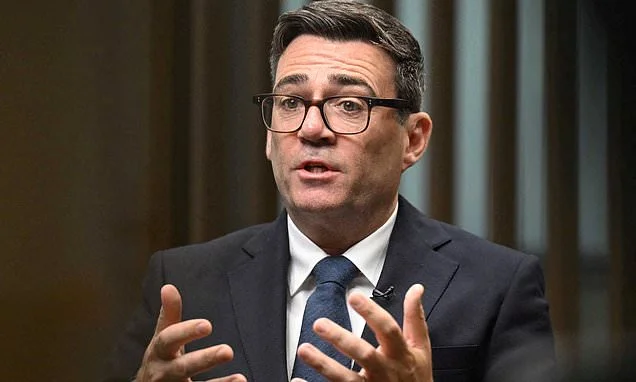
Burnham's puppyish enthusiasm doesn't yet grate with me, but I find myself increasingly wondering whether he has the faintest idea of what he is doing, writes Stephen Glover
To judge by his first week in office, Andy's own motto is 'spend, spend, spend' (pictured with John Healey at the pub)
The cost of these policies is put at £1.7billion. This is admittedly a small fraction of all public spending, which is about 750 times greater. On the other hand, it's not back-of-the-sofa cash for a government mired in debt.
Nor has Andy Burnham yet offered us the slightest clue how these doubtless welcome giveaways are to be paid for. Very possibly he doesn't know the answer.
Note, too, that our fledgling Prime Minister has so far not given any indication that he intends to make any savings, or even knows what the word means.
This week he's expected to unveil ambitious projects. One is adult social care, whose annual cost has been estimated by the Health Foundation at £18.7billion. That's not small money.
Youth employment will probably also be on his agenda, at God knows what cost. The PM is also likely to speak about defence spending. The extra cost of reaching 3 per cent of GDP by 2030 would be around £10billion a year.
Money well spent, of course, but it would create an extra strain on the public finances. We already know that, in a BBC interview with Laura Kuenssberg, Burnham refuses to commit to the three per cent target.
How shameful it would be if this generally spendthrift Government withheld vital extra funding in the one area where it is needed above any other.
The Tories have suggested that Labour's increased spending will be £96billion a year. Some prospective items, such as an £8billion increase in foreign aid, and £22.7billion to bring Thames Water under public control, haven't yet been approved by Burnham.
That said, he has recently spoken about undertaking the 'biggest council house building programme since the post-war period'. The Tories have estimated this at £18.8billion a year.
Even if their overall figure of an extra £96billion is overblown, it's clear that this profligate administration is on track to increase public spending by tens of billions.
How on earth is Burnham going to pay for it? Not by borrowing, that's for sure, since the bond markets won't provide further sums of this magnitude on top of the vast amounts they are already lending UK plc to keep it afloat.
According to the Resolution Foundation, Rachel Reeves's so-called 'fiscal buffer' – i.e. spare cash for an emergency – has dwindled from £23.6billion in March to just £10billion now.
Andy Burnham's piggy bank is shrinking, not least because of the effects on an already fragile British economy of Donald Trump's reckless adventure in the Middle East. This is the worst possible moment to be embarking on a spending spree.
The Prime Minister has a choice. He could tell the truth and declare that, without substantial cuts in public spending, he won't be able to undertake the large projects that are so close to his heart.
We know he will say no such thing. Unless forced by the International Monetary Fund, he's no more likely to reduce public expenditure than Viv Nicholson was to scale down her extravagant ways.
Burnham wants extra billions because he is determined to transform Britain. Whereas Joseph Stalin favoured five-year plans in the Soviet Union, Andy has outdone him and announced a ten-year one.
The money will come from higher taxation. There is no other way in the Burnham playbook. To begin with, he and the new Chancellor, John Healey, will convince themselves that soaking the rich will be enough.
Capital gains tax will rise. There may be a land tax, though it would be years before it took effect. A wealth tax is a strong possibility, but Healey would find that most billionaires had upped sticks without leaving their money behind.
The PM and Chancellor could well raise the top rate of tax from 45p to 50p, even though this would go against Labour's 2024 manifesto commitment not to increase income tax.
Such a dishonest ploy wouldn't raise much money. In fact, it might lose some. In Scotland, where the top rate has been increased from 45p to 48p, the cost to the public purse was £22 million in a single year. Higher earners take steps to avoid extra tax.
Burnham and Healey will soon discover that squeezing the better off with higher capital and income taxes won't begin to fund grandiose government projects.
They'll be forced to raise taxes for ordinary workers despite the commitment in 2024 not to do so – and the Prime Minister's pledge in the Kuenssberg interview to 'honour that manifesto'.
In Voltaire's novel Candide there is a character called Dr Pangloss, who is the embodiment of foolhardy optimism. That is Andy Burnham: well-meaning, always positive, but hopelessly unrealistic.
We see it not only in his attitude to money but also in his apparent unconcern about immigration, particularly the illegal sort. He hasn't mentioned it since becoming Prime Minister, though it's hard to stop him talking about matters close to his heart.
If he takes the fashionable view that illegal immigrants are no longer an issue because numbers are down, he is much mistaken. Between last Wednesday and Saturday, 881 people came across the Channel in small boats. People still care a great deal.
To have a sunny Prime Minister after the dour Starmer is a relief. But Andy Burnham's inability to face up to reality will prove to be his – and very possibly the nation's – downfall.