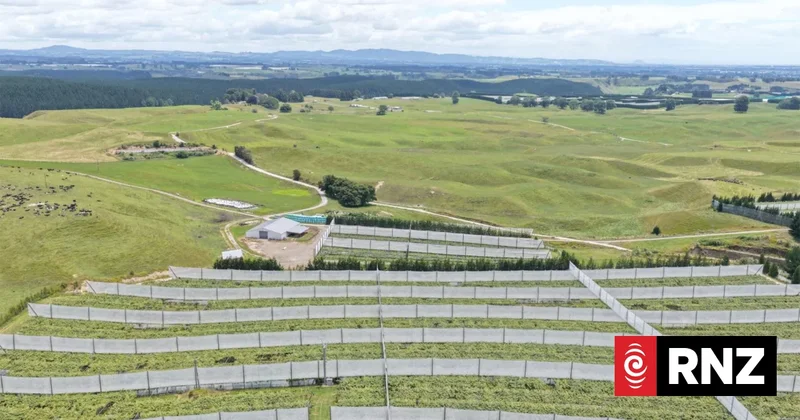
A mixed dairy farm in Bay of Plenty is in for a multi-million dollar kiwifruit orchard re-development, as its new owner, a Church of Jesus Christ of Latter-day Saints subsidiary, expands its horticulture interests in New Zealand.
Farmland Reserve, the agricultural investor for what's commonly known as the Mormon church, has bought a 359 hectare farm and orchard with major rural asset manager Craigmore Sustainables set to develop and run it.
It marked the second Bay of Plenty kiwifruit orchard purchase for the Utah-based investor, after it bought a 45-hectare site near Edgecumbe to also be run by Craigmore.
Koromiko in Pukehina near Te Puke was a dairy and dry stock farm with pine trees and an existing 20-hectare SunGold orchard, with new plans for kiwifruit expansion and development.
Last year's orchard acquistion marked Farmland Reserve's first investment in Aotearoa, though the wider church held hundreds of millions of dollars in assets like property nationwide.
The organisation with a long history of farming in the US also invested in farms across the Americas, Europe and Australia, where in the latter, it grew crops like pistachio nuts, potatoes, onions, wheat and soya bean.
Its chief investment officer Doug Rose said New Zealand had a rich agricultural heritage, talented people and was committed to responsible stewardship.
"We are excited to build on that legacy and work with local teams and communities," Rose said.
"At Farmland Reserve, we take a long-term approach to our investments, and we look forward to supporting the continued success and sustainability of this operation for generations to come."
Craigmore planning orchard re-development
The kiwifruit orchard would join Craigmore's network of more than 40,000 hectares of farms, orchards and forests it managed across the motu, with its 360 employees.
Chief executive Che Charteris said the orchard's redevelopment would "not happen overnight", taking around three years to be completed and more to mature.
"At the moment it's mostly a dairy farm, it's about 329 hectares title area and the majority of it is used for dairy.
"There's a dry stock portion of it, which is about 60 hectares, and 20 odd hectares of pine trees on it as well.
"We'd be looking to put a convert some of the dairy platform, about 100 hectares of it at least, into kiwifruit."
Charteris said the re-development would be funded by Farmland Reserve with a budget of $32 million in capital expenditure.
He said it was pulling together contractors to help set up the orchard and get the ground and infrastructure ready.
"The goal is to increase the production of kiwifruit to at least one million more trays per year," he said.
"That should create almost 90 jobs new full-time equivalent roles, as well as a whole lot of roles in the community, in packhouses.
"It's a really cool project."
Charteris said it was looking to diversify the kiwifruit varieties at this site, with plans for Green.
However, Farmland Reserve's first orchard was planted now entirely in SunGold, Charteris said, with overhead nets installed to control wind and hail risks.
"Plants in the ground, they're growing, there's been a little bit of winter chill around Whakatāne this year, which is good. A few frosts on the ground now and we're really happy with it."
Charteris said Craigmore often looked to land use change to add value to rural communities.
He declined to comment on the sale price of the land and the details were not yet available.
Orchard to help fund the church's work
Profits from the export-focused kiwifruit business would be split between the two parties, with Farmland Reserve's share going towards the church's religious, humanitarian and charitable work.
The purchase was expected to be published through Land and Information New Zealand's Overseas Investment Office soon.
The Church of Jesus Christ of Latter-day Saints Trust Board was a registered charity providing religious services across dozens of sites scattered throughout New Zealand, however Farmland Reserve was a for-profit company.
The church had around 54,000 New Zealand members, according to the latest 2023 Census.