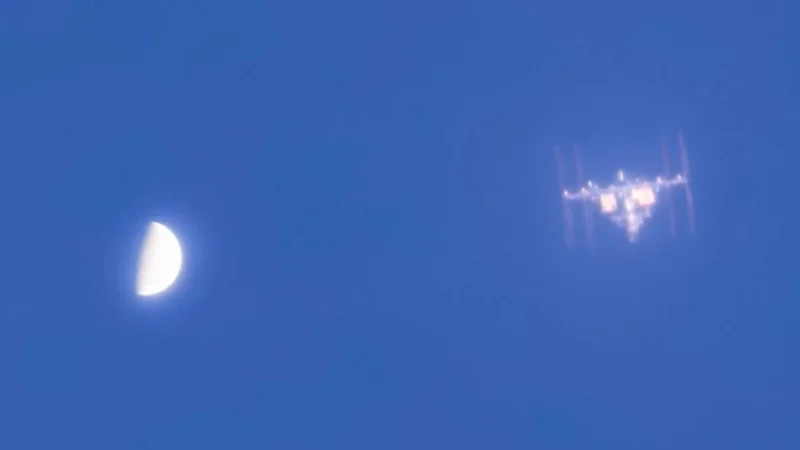
An astrophotographer captured a breathtaking scene as the International Space Station zoomed by Venus in the daytime sky.
What is it?
Photographer AJ Smadi set up the scene on July 18 in a park near Seattle, Washington. Smadi used a 9.25" (23.5 cm) Celestron Schmidt-Cassegrain Telescope and a ZWO ASI662MC camera equipped with an ultraviolet and infrared filter to capture the incredible image.
But this isn't the first time Smadi has pulled off such a feat. Just over a year ago, the photographer captured the ISS beside Venus in a photo that was selected by NASA as one of its Astronomy Photos of the Day.
"The thing that inspired me to capture Venus with the ISS is the fact that nobody has done it before," Smadi told Space.com by email. "After having realized this in April 2025 following my first time capturing the pair together, I was determined to best my own achievement," Smadi said.
Smadi regularly photographs the ISS but says the clarity differs greatly depending on the stability of the air and its distance.
Why is it incredible?
Capturing Venus, the ISS, or any other object in space (other than the moon) during the daylight hours takes careful planning and a deep understanding of astrophotography techniques and filters.
The ISS travels at a mind-boggling 4.6 miles per second (7.5 km per second) and is 84 million miles (135 million kilometers) away from Venus, so lining up a photograph of the two seemingly side-by-side is no easy feat and takes painstaking planning.
For more of AJ Smadi's work, including photos of the ISS transiting the sun, the moon, and passing by Saturn, visit his Instagram.
Brett is curious about emerging aerospace technologies, alternative launch concepts, military space developments and uncrewed aircraft systems. Brett's work has appeared on Scientific American, The War Zone, Popular Science, the History Channel, Science Discovery and more. Brett has degrees from Clemson University and the University of North Carolina at Charlotte. In his free time, Brett enjoys skywatching throughout the dark skies of the Appalachian mountains.