Warhammer company Games Workshop has said it investigated what it called “a few human errors” on the depiction of its products to make sure its staff hadn’t used AI.
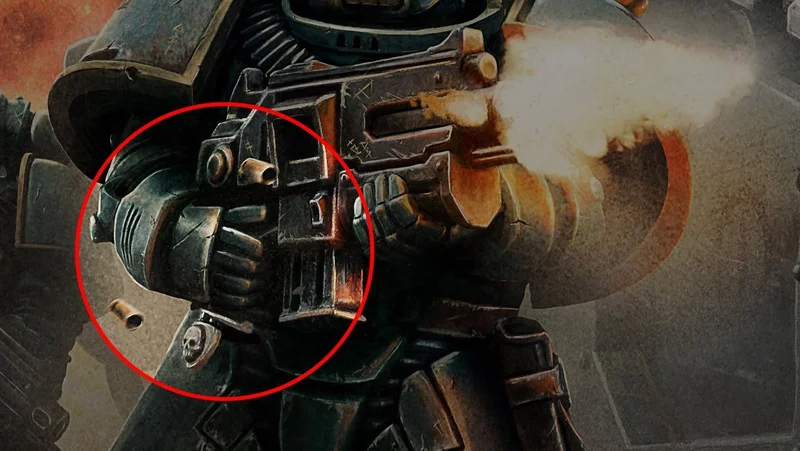
Last month, Games Workshop issued an official response denying the use of AI after fans spotted a Space Marine with an extra finger in official art for the Warhammer: The Horus Heresy tabletop game.
The artwork published on the Warhammer Community website depicts units of Space Marines clad in MkIV 'Maximus' armor. If you look closely at the Space Marine at the forefront of the image, you'll see five fingers including the trigger finger facing the viewer, which means a sixth finger, his thumb, must be behind the Tigrus-pattern bolter.
This kicked up a huge stink within the Warhammer 40,000 and Horus Heresy fandom, which is on the whole anti-AI, particularly when it comes to art. The Warhammer 40,000 setting is in many ways built upon the evocative and enduring art drawn by the likes of the late, great John Blanche, who shaped its "grimdark" aesthetic alongside other key Games Workshop staff. This official, human-made Warhammer 40,000 artwork is beloved by fans, most of whom take a dim view of the mere whiff of generative AI “art” sold or released in any official capacity by either Games Workshop itself or its partners.
Indeed, Games Workshop sells expensive Warhammer 40,000 ‘codex’ rulebooks that are packed with stunning official art as well as lore. Any suggestion that this art was created either in part or entirely by generative AI tools would cause a community uproar — and that’s exactly what we saw with this Horus Heresy artwork.
In a statement published on Facebook, the UK company acknowledged the existence of an extra finger on the Space Marine, but said it came as the result of an artist “blending miniature photography with art to create a dramatic scene.” And somewhere along the way, this process added the extra finger.
Here’s the official statement in full:
“Does that Space Marine have an extra finger? Yes, but it’s not AI or early signs of mutation among the Traitor Legions! The Horus Heresy art style, since its first edition in 2012, involves an artist blending miniature photography with art to create a dramatic scene. In this case, adding a little unexpected drama. So please, go easy on our artists. They are only (and completely) human.”
The kerfuffle with the six-fingered Space Marine came just a few months after Games Workshop went on the record to set out its anti-AI stance. In January, it banned the use of AI in its content production and its design process, insisting that none of its senior managers were currently excited about the technology.
Now, in its latest financial report, Games Workshop reiterated its anti-AI stance, and revealed it had launched investigations into these marketing gaffes to ensure staff were playing by internal rules.
“As noted in our November 2025 half year report, we are not being complacent on the topic, we are carefully monitoring what others are saying and doing,” Games Workshop CEO Kevin Rountree said of AI.
“We are not using AI at Games Workshop in our product design nor on the creation of our IP, this will protect the integrity and ownership of our IP. We have made a few human errors on the depiction of our products in our product marketing in the year, they were investigated fully to ensure that AI had not been used and that all our staff are following our internal policies.”
Rountree went on to admit that AI is now automatically included in third-party software “whether we like it or not,” which makes it difficult for Games Workshop to say definitively that it is not using AI outside of its own Warhammer studio. This is “something we are just going to have to potentially live with and monitor,” Rountree added.
“We are proud to deliver consistent great returns employing great people (many of them hobbyists themselves) celebrating with other hobbyists in the real world,” he continued. “Our business performance is still built on staff development and hard work with very little waste.”
These sorts of issues — where fans either spot genuine use of generative AI in official artwork for a product or they suspect it has been used — are cropping up more often across the entertainment industries, as company staff are put under pressure to use AI tools to ramp up productivity. And while Games Workshop’s official anti-AI stance is in contrast to that of many other entertainment firms across the likes of video games, movies and television, it is perhaps under more scrutiny than most, given its reputation for stunning, human-created artwork, and the setting itself, which has plenty to say about the dangers of AI.
Wesley is Director, News at IGN. Find him on Twitter at @wyp100. You can reach Wesley at wesley_yinpoole@ign.com or confidentially at wyp100@proton.me.