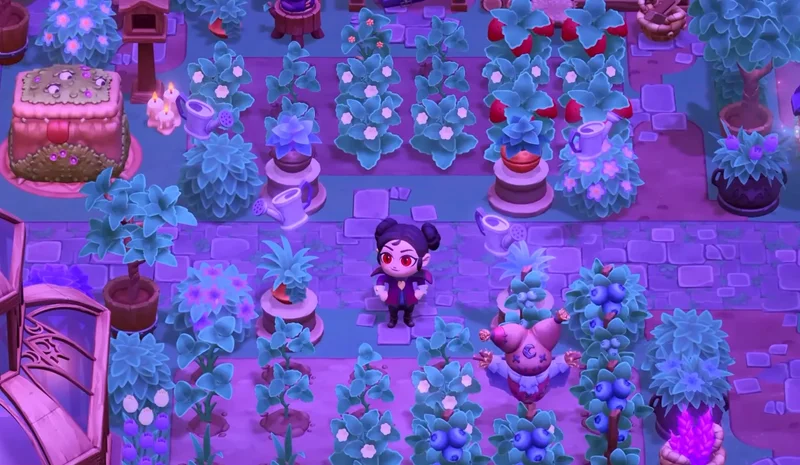
Cozy games have ossified, and it's mostly thanks to Stardew Valley. These days, regardless of a cozy game's setting, you know exactly what to expect: warm vibes, happy people or those not entirely averse to becoming happy, a hearty welcome, and quick resolutions to every problem. The sameification is hardly surprising. When a single game takes a niche genre mainstream and sells millions of copies across every platform, it makes sense for others to try their hand at the formula, carefully preserving its fundamental parts. Understandable, but no less regrettable. There are signs that growth is finally happening, though.
When Polygon spoke with Perfect Garbage co-founder Son M in May, one of the makers of the upcoming horror-farming game Grave Seasons, they said a growing trend among creatives is pushing against the boundaries of what cozy can be. Perfect Garbage wants to make Grave Seasons part of that trend, with its protagonist and their sketchy background and a heap of murders designed to make you question how society otherizes certain groups. We won't get to see how that turns out until Aug. 15. But with Little Chicken's Moonlight Peaks, the hottest cozy game of the summer, we've got the first sense of what a less comforting take on the genre might look like.
In Stardew and the games that inspired it, you start out by inheriting dear late grandad's farm, a safe base from which to launch your new life, whatever shape it might be. Moonlight Peaks starts with a fight. You're a Dracula. (That's a family name, by the way; you're not legally distinct Alucard.) After yet another fight with your father, you decide to leave. It's pretty clear the situation here is toxic. Your mother knows why you need to leave, but she's unwilling to fully recognize the problem at home. If you just talked about it (for the nth time), it might get better! No, dad won't change his mind, of course. But you might.
The first person you meet in these kinds of games is someone nice. Maybe they knew pawpaw in his less dead days. Maybe they're just kindhearted and want to help the newbie feel welcome. In Moonlight Peaks, the first neighbor you meet is a hungover vampire named Orlock (get it?) who crashed outside your house. The thing he immediately asks, undeterred by the previous day's recklessness, is for help making more wine. You might be tempted to brush this meeting off as one of those "isn't it funny when people get drunk" jokes. It isn't.
But before you realize this is a more problematic kind of behavior, you see the rest of the town, and Moonlight Peaks is not your average agricultural getaway. It's not just the werewolves and fortune tellers and witches that make it different, though that's some of it. The real defining feature is how your neighbors divide the town along those factional lines. Oh they all get along when they have to, but they frequently aren't happy about it. Nor are they happy with you, not initially. Most of the adults are old enough to remember when your father lived there, and his reputation is a poor one. It's not your fault, but you still have to deal with the ramifications of your parents' actions. (Granted, these ramifications mostly happen in bits and pieces of dialogue that don't alter your actions or hinder relationships, but theme is more important in this case.)
You eventually learn Orlok is an alcoholic, and whether that's what drove his wife away or a symptom of the event, it's not making life easy for his two kids. Mina, his daughter, puts on a brave face. She's determined not to let life make her miserable, which is an admirable trait in some ways, but one that, ideally, a young adult would develop with help from their parent — not because of them. Evan, her brother, is less emotionally confident. He takes on too much and holds himself to unfairly high standards, and he feels like he doesn't belong, thanks in no small part to his father.
There are others, like the Logan family, or more specifically, Brook Logan's family. Brook, a werewolf, is the town mayor and a much more uptight figure than his laid-back brother, the carpenter Ridge. Brook carries the weight of Moonlight Peaks, and it's crushed him. What started as passion for his community turned into cynicism and an unshakeable belief that only he can handle this burden. Which makes life for his daughter, Saga, much more difficult than it needs to be, as she doesn't understand why her dad shuts her out and stays closed off. Good thing kids don't need emotional support from their parents! Persephone Henderson is a normal human with no supernatural powers. She carts her family along to Moonlight Peaks, hoping a fresh start with heal their wounds, but she doesn't stop to think how this unusual living situation might affect her kids. (The answer is badly, at least for her son Winston.)
Everyone is messed up in Moonlight Peaks, but there's a purpose behind it all that keeps it from being scattershot trauma. It's the accidental neglect and wounding of everyday life, not the dramatic abuse of something like Persona 5, but the idea is still very much the same: The town's adults — the ones who should know better, or at least something approximating better — are making life worse for their kids, often without even realizing it. They aren't letting go of the past, or they put their own needs first, or they think what they want is what's best for their kids without ever entertaining a thought about the consequences.
Danish philosopher Soren Kierkegaard developed a theory of indirect communication, where you stand a better chance of getting your message across if it's couched in something that seems separate from the audience. At a basic level, it's the difference between preaching at someone and telling them a parable, though the best versions of such stories couch their messages so effectively in the narrative that audiences don't suspect a thing. They just walk away with a new perspective on their own lives or the emotional language to identify problems they maybe didn't know how to name or recognize before. I don't know if that's what Little Chicken set out to do with Moonlight Peaks, but it fits Kierkegaard's model perfectly. That kind of meaningful self-recognition isn't something you can get in the likes of Stardew or Coral Island. Sure, they have their moments. But things like Kent's traumatic background in Stardew, for example, are isolated events, disconnected from a broader pattern of intent in a way that prevents them from being anything other than background information.
There's nothing wrong with cozy, comfy, and familiar. The safe space Stardew and its seedlings create resonates for a reason, and with the world on fire, literally and metaphorically, such safe spaces are more important than ever. Heck, I'm counting down the days to Fields of Mistria's 1.0 update, and even its grouches are cute and nice. Moonlight Peaks isn't serious all the time, either, and you make friends and lovers in the same way you always do in these kinds of games. But staying inside those carefully drawn lines limits what that story can achieve, and 10 years of the same thing is far too long. The cozy genre, with its familiar character archetypes and daily routines, lends itself to these scenarios too well to remain bastion of predictable comfort forever.