"The moment our hearts meet, my name will be known to you. That meeting of hearts will break the profound silence."
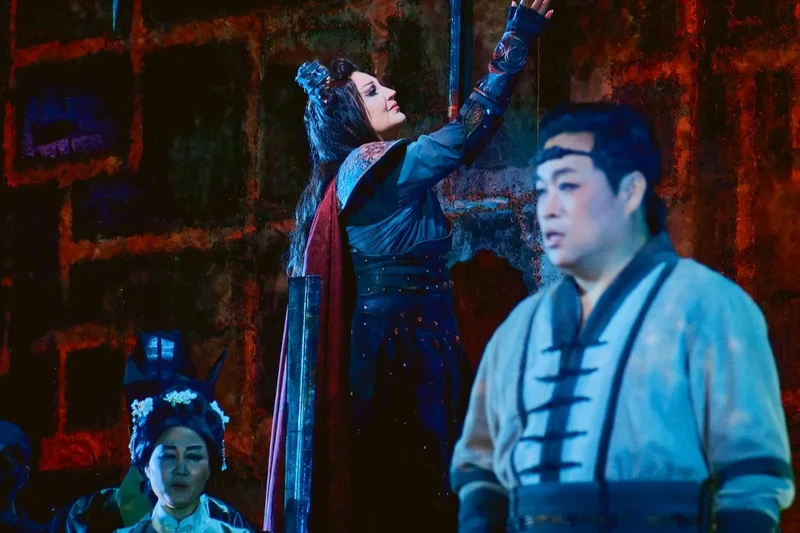
This was the newly translated Korean subtitle for "Nessun dorma" (None Shall Sleep) in "Turandot," performed four times from July 22 to 26 at the Opera Theater of the Seoul Arts Center. In Puccini's original, Calaf declares that his kiss will break Turandot's silence and make her his own. In this new production, however, the language of conquest was replaced with one of emotional connection, emphasizing "the meeting of hearts." It was the clearest expression of director Chung Sun-young's central message: "Sometimes losing is winning."
Produced by the Seoul Arts Center to mark the 100th anniversary of "Turandot," the production was based on the version completed by Puccini's student, Franco Alfano, after the composer's death. While retaining the score, it offered a fresh interpretation of the opera's ending.
Several Korean subtitles were rewritten to stress reconciliation and coexistence, and Calaf's controversial forced kiss of Turandot was omitted from the stage. During his aria "Principessa di morte" (Princess of Death), the subtitle read, "Receive the kiss through which both of us triumph," before the lights dimmed, leaving the moment to the audience's imagination. Rather than a hero who subdues Turandot, Calaf emerges as a man who reaches out to her until the very end.
The reinterpretation was intriguing, though it did not entirely resolve the opera's longstanding dramatic weakness. Turandot's sudden acceptance of Calaf, despite the deep trauma she carries from the murder of her ancestor, still felt abrupt. The revised subtitles, however well intentioned, were not enough to bridge that psychological leap.
Yet an opera is not defined by staging alone. Ultimately, it was tenor Baek Seok-jong who made the audience believe in this new Calaf. The production's reinterpretation came fully to life through his singing.
Having performed the role at some of the world's leading opera houses, including the Royal Opera House in London and the Metropolitan Opera in New York, Baek demonstrated in his first full-length "Turandot" in Korea why he has become one of the most sought-after Calafs on the international stage. A former baritone who later transitioned to tenor, he brought uncommon richness to the lower register, while his high notes projected effortlessly to the back of the hall without sounding forced. Most importantly, his warm, lyrical tone gave convincing emotional depth to this more compassionate, persuasive Calaf.
The evening reached its climax with the beloved aria "Nessun dorma." Before the final note had fully faded, the audience erupted into applause and cries of "Bravo."
At a press conference, Baek explained the aria's personal significance.
"My mother always prayed that I would be given 'a glorious voice like the breaking dawn,'" he said. "When I sing Calaf's 'Vincerò!' ('I will win!') at daybreak, I feel that her prayer has finally been answered."
That sense of quiet conviction was evident in his performance. Rather than presenting Calaf as a triumphant conqueror, Baek sang the famous aria with sincerity and unwavering confidence.
As Turandot, Eva Plonka portrayed the wounded princess with commanding high notes and a dark, powerful timbre, while soprano Hwang Sumi brought lyrical warmth to Liù through her crystal-clear tone and delicate emotional expression. Under the baton of music director Roberto Abbado, the KoreanNational Symphony Orchestra quickly recovered from a somewhat unsettled opening to provide solid support for the singers throughout the performance.
**Depth of Korean vocal talent **
Whatever one makes of the production's reinterpretation, this "Turandot" showcased the remarkable depth of Korean vocal talent. Alongside the A cast featuring Baek Seok-jong and Hwang Sumi, the B cast, led by Kim Young-woo and Seo Sun-young, also received enthusiastic applause.
Korean singers have already reached world-class standards. The next challenge for Korean opera is not musical excellence, but weaving that excellence into a dramatically compelling whole.
This article from the Hankook Ilbo, the sister publication of The Korea Times, is translated by a generative AI system and edited by The Korea Times.