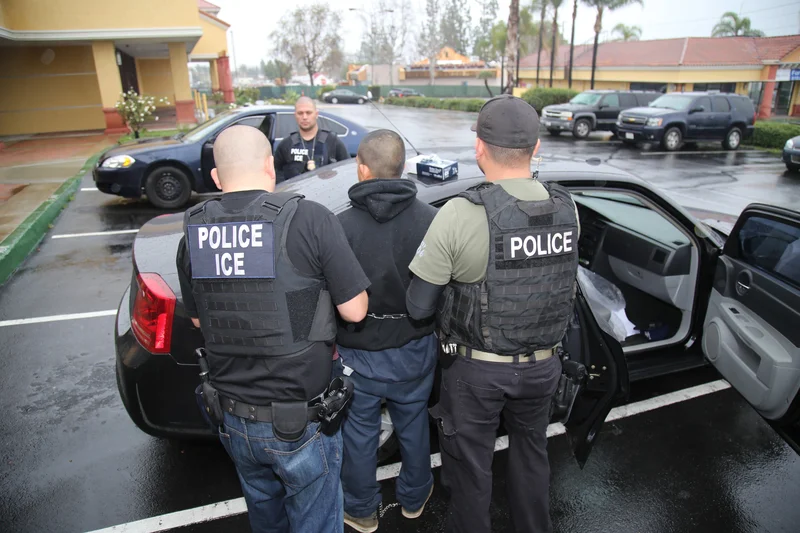
The remark was recorded on the body camera of a Border Patrol agent searching for undocumented people inside a Home Depot in Hollywood. “There was a guy, I’m pretty sure he’s a mojado,” the officer said, using a variant of a derogatory term — “wetback” — that has been used for decades to refer to undocumented migrants who cross the Rio Grande by swimming. On another occasion, before an operation in Los Angeles, another agent warned: “There are tonks everywhere selling food.” Tonks is not police code but an insult that refers to the sound a flashlight makes when it strikes a migrant’s head, a word the Border Patrol itself deems inappropriate.
The American Civil Liberties Union (ACLU) says it has gathered enough evidence of racist slurs exchanged in communications among immigration agents to ask a federal judge in California to order a halt to operations targeting undocumented people. In a motion filed Monday in a Los Angeles court, the organization argues that officers decided whom to detain based essentially on physical appearance and skin color. All of this was documented in text messages and in conversations captured by the agents’ body cameras.
“To this day, the defendants patrol the Central District of California armed and with their faces covered, detaining both citizens and noncitizens based on a profile they consider ‘suspicious’: people of Latino appearance and of low-income or working-class background,” the motion on Judge Maame Ewusi-Mensah Frimpong’s desk reads.
The filing is part of a lawsuit the ACLU and other organizations brought in July 2025 on behalf of five individuals and four immigrant advocacy groups. In it they accuse the Department of Homeland Security (DHS) of maintaining allegedly unconstitutional detention practices driven by “arbitrary law-enforcement quotas.”
So-called “collateral” arrests
According to the motion, agents do not base their operations on intelligence-led efforts targeting priority subjects, such as people convicted of violent crimes who have removal orders; instead, they detain any undocumented migrant they encounter to inflate their arrest numbers. For several years, Immigration and Customs Enforcement (ICE) has referred to them as “collaterals.”
The court document also reveals a controversial directive issued by ICE via email in May 2025. The message instructed agents to “turn up the creativity” and increase the number of “collateral” arrests.
The ACLU says that during interviews conducted with several agents as part of the suit, they admitted that the “Hispanic” appearance of people they saw on the streets, in Home Depot parking lots, or at car wash businesses influenced the decision of whom to approach to ask about immigration status. In one video cited in the case file, an agent tells another: “Send us to where you see some tonks.”
In a brief statement sent to EL PAÍS, DHS did not respond specifically to the lawsuit but defended its agents’ actions, which, it emphasized, are focused on protecting the American public. “Where is the media outrage for American families who have lost a loved one because of crimes committed by illegal immigrants?” the agency asked.
“A pattern of racial profiling”
For Mayra Joachin, deputy director of the ACLU’s Immigrant Rights Program, “the government’s own records reveal a pattern of racial profiling that violates some of the most fundamental protections in our Constitution.” In a statement, Joachin said the evidence only “confirmed what our communities have known from the start: immigration agents flagrantly violate the law by detaining people without justification.”
The lawsuit argues that detentions based on racial profiling violate both the Fourth Amendment, which protects against unreasonable searches and seizures, and the Fifth Amendment’s guarantee of equal protection under the law.
“The evidence does not lie: these detentions were never about safety, they were about skin color,” said Angélica Salas, executive director of the Coalition for Humane Immigrant Rights (CHIRLA), one of the plaintiffs, in a statement.
Although the suit initially led a district court to issue a temporary restraining order limiting certain immigration enforcement actions, the Supreme Court suspended that measure in August 2025.
Judge Frimpong will decide at a hearing scheduled for September 24 whether to grant the motion or allow ICE and Border Patrol operations to continue.