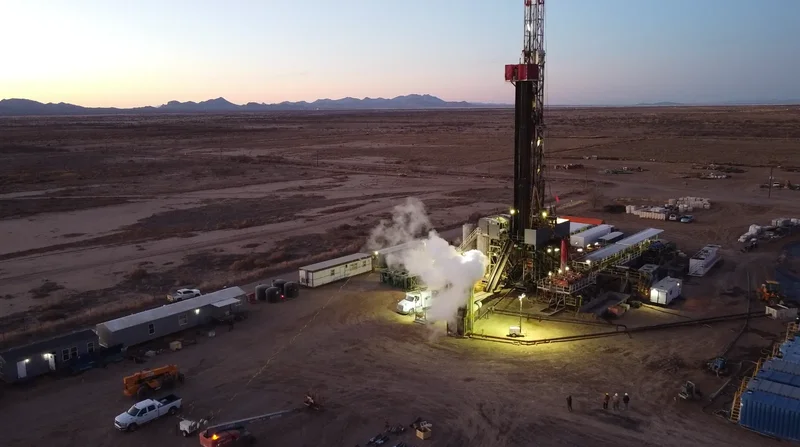
Geothermal company Zanskar bought a New Mexico power plant in 2024 that appeared from the outside to be failing. The shallow wells had been rapidly losing heat, and the plant was having trouble generating power as a result.
Now, after drilling a new well and operating the power plant for a full year, Zanskar says that it has made a complete turnaround. The Lightning Dock site, according to figures from the company shared exclusively with WIRED, has become one of the most productive pumped geothermal wells in the US, providing enough heat to run the power plant with no issues.
The productivity over the past year at the Lightning Dock site “fundamentally changes how people think about these types of systems that we really thought we understood in the past,” says Zanskar cofounder Joel Edwards.
It’s the latest bit of good news for the long-neglected geothermal industry, which is experiencing an investment renaissance. Innovative drilling technology and artificial intelligence—along with a little bit of luck—played roles in the milestone. And while not all traditional wells may have the same set of circumstances as Zanskar had at Lightning Dock, the company says that its success is a wake-up call that old well sites are still worth further exploration.
Traditional geothermal energy relies on tapping hot water within the earth to generate electricity by pumping it to the surface and spinning turbines. In theory, it’s an excellent way of generating renewable baseload power: People have been harnessing steam from hot springs for thousands of years. But geographic constraints—power plants need to be situated on geothermal reserves, which are overwhelmingly in the western US—as well as the difficulty and expense traditionally involved in finding new wells mean geothermal energy constitutes less than 1 percent of the electricity mix in the US.
Another challenge for the industry is that most wells gradually see declines in productivity. But Lightning Dock’s decline had been particularly steep, losing between five and 10 times as much heat each year as average wells, Zanskar says. When the company bought the site, temperatures in the original wells, which were less than 2,500 feet deep, had cooled some 50 degrees Fahrenheit (10 degrees Celsius) to about 250 degrees F by 2024. The onsite 15-megawatt power plant, which supplies electricity to New Mexico’s largest utility, was designed to operate at temperatures above 300 degrees F.
While conventional geothermal wells usually go down 3,000 to 5,000 feet, drilling deeper wells can tap into hotter reserves of water to use for power. But tighter rock formations deep underground make drilling more challenging—and costly. Whether or not to drill deeper is “basically a question of economics,” says Roland Horne, a senior fellow at the Precourt Institute for Energy at Stanford University. The cost, Horne says, is not linear: “If you drill twice as deep, it costs four times as much.”
To help make better bets on drilling, Zanskar uses artificial intelligence to identify what are known as hidden systems—that is, sites with ample geothermal potential but little to no signs of their viability on the surface. The company used the technology last year to make a discovery in Nevada, and it says that same modeling also helped pinpoint where to most productively drill at the Lightning Dock site. It combined those models with drill bit technology refined by the oil and gas industry, which helped it drill deeper holes 35 percent faster at what Zanskar says is a “competitive cost.” (The company didn’t provide specifics.) The new 8,000-foot well has been operating for a full year, with heat levels above where they were before the decline.
“We knew that if we were going to buy this field, we were committed to drilling deeper and going after it,” says Joel Edwards, a cofounder of Zanskar. Edwards says that the new well is so productive that it has, on occasion, supplied “too much heat” to the existing power plant, suggesting that it could power a larger facility.
“We expect, if you look at peers of this well, it has the attributes to be productive for decades,” Edwards says.
Horne points out that by buying a developed site with an existing power plant, Zanskar offset a big cost sink compared to starting from scratch. Another company had also already drilled a deep exploratory well at Lightning Dock in 2022, which, Horne says, gave Zanskar valuable geologic information to help with its modeling. (Ben Brenner, Zanskar’s director of federal affairs, tells WIRED in an email that data from the other well was incorporated into its modeling, but the company “never saw that particular well’s data as somehow definitive or essential.”)
“They haven’t discovered anything revolutionary,” Horne says of the techniques used at the Lightning Dock site. Still, he says that the statistics provided by Zanskar “hold up” to make it one of the wells with the highest flow rates—a measure of productivity—in the US. While at least one other facility in Nevada has wells with higher flow rates than Lightning Dock, Brenner says that those wells are “much colder” than Lightning Dock’s, which will make them less productive over the long run.
“It’s a really good well,” Horne says.
This has been a big year for the geothermal industry, particularly for companies that are using new technologies to tap the Earth’s heat. Enhanced geothermal company Fervo Energy went public in May, raising $2.2 billion, although there has been a pullback in stock prices since its debut. Venture capital investors—who typically have veered away from geothermal—have also been putting money into the industry, says Stephanie Diaz, a senior associate at BloombergNEF. Venture capital and private equity investment in geothermal startups has hit $432 million through the first six months of this year, meaning that “2026 is shaping up to be the best-funded year for geothermal startups since BNEF began tracking in 2022,” Diaz says. That total includes Zanskar, which raised $115 million in a funding round in January, one of the largest raises in the sector this year.
Unlike what Zanskar is doing, enhanced geothermal uses a technique similar to fracking and requires hot rocks rather than hot water, opening up the possibility of drilling wells in areas that have been off limits. Because of this, companies like Fervo have been the focus of much of the recent investment and attention in the industry, Diaz says.
But Diaz says data-driven approaches like Zanskar’s can help de-risk traditional geothermal development. Lightning Dock, Diaz says, is also a good example of finding “adjacent areas to work that have worked historically.”