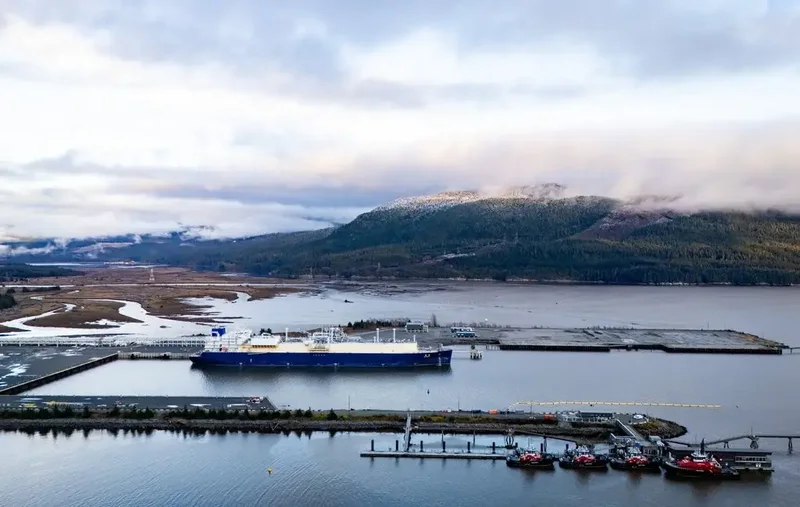
German company Uniper and B.C.’s Ksi Lisims signed what they called a landmark long-term LNG agreement on Wednesday morning.
The agreement took place in Düsseldorf, Germany, and represents the first major long-term LNG supply agreement between Canada and Germany.
Uniper will purchase two mtpa (million tonnes per annum) of LNG (approximately 30 TWh per year) on a free-on-board (FOB) basis for up to 20 years, with first deliveries expected from 2032.
“This agreement is about far more than LNG,” Michael Lewis, CEO of Uniper, said in a statement.
“By signing this long-term off-take agreement, we are strengthening Uniper’s portfolio with a reliable source of LNG from Canada.”
This announcement comes after recent moves from the federal government embracing LNG development in B.C.
Last year, phase two of LNG Canada and the proposed Ksi Lisims LNG export terminal were referred to the federal government’s major projects office for fast-tracking.
Get daily National news
Both proposals are still awaiting final investment decisions from proponents.
The federal government says these projects will attract billions in private sector investment and boost GDP growth.
“Since time immemorial, the Nisga’a people have adhered to the concept of a Common Bowl,” Eva Clayton, president, Nisga’a Lisims Government, said in a statement.
“This foundational idea teaches that we are all interdependent, and directs us to share our abundance with others. Today, that same spirit of sharing has led us to pursue LNG exports on the global stage.”
- WestJet, union talks ‘progressing’ as strike deadline nears, minister says
- House committee will meet on call to probe Carney’s Gordie Howe bridge deal
- Chris Alexander, former Harper cabinet minister, to run for Toronto mayor
- Ontario season seat holders face uncertainty with Ford’s ticket resale legislation
There has been pushback from environmental groups who argue expanded LNG production and exports could hurt Canada’s climate commitments.
In a statement, Richard Brooks, climate finance director with Stand.earth, said that “This is a major step backwards for climate action by both the German and Canadian governments who have pulled out all the stops to ink this deal.
“Moving forward with a massive new methane gas project as devastating wildfires rage across Canada and Europe is irresponsible and an abdication of leadership. To do so while rewarding a U.S. private equity-owned company is definitely not ‘elbows up.'”
One political scientist says the proposals come as voters’ priorities turn to the economy.
“Economic concerns are what voters are paying attention to,” Kathryn Harrison, a political science professor at the University of British Columbia, said.
“And climate change has fallen on voters’ priorities. I don’t think it follows that they don’t care about climate change or … that they’re willing to sacrifice future safety.
“For the economy today, I think it is more that these are the things that are top of mind for people who have a lot on their plates.”