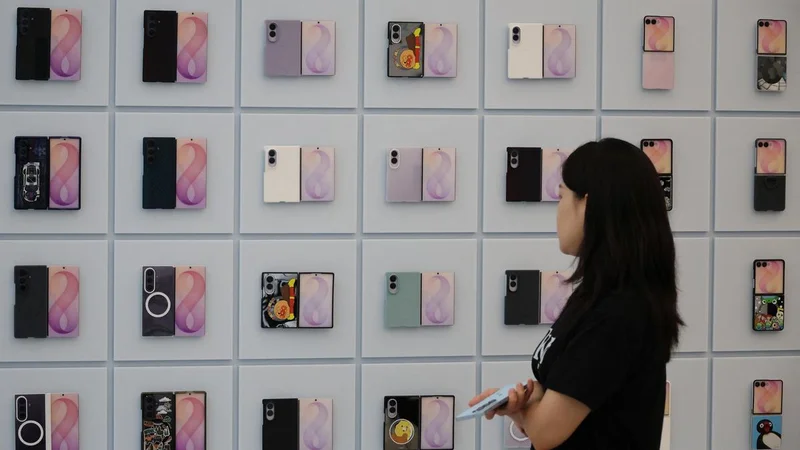
The story so far: Samsung has just launched the eighth iteration of their foldable phones. This time, the South Korean gadgets-maker added an Ultra variant to the race, claiming that Indians are using this flexible form-factor for content consumption, as well as enhancing their productivity with multi-tasking and photography.
Samsung dominates the super-luxury segment in India due to its strong legacy, along with rivals Google, Motorola, Vivo and Oppo. Globally, Samsung holds nearly 40% of the market share while Huawei has 30% of the foldable market, according to Counterpoint research. Soon, Apple is also expected to enter the market with their first foldable launch. A foldable iPhone will certainly change the course of action for the entire segment and its players across the globe.
India’s foldable smartphone market is expected to cross 3 million units by the end of 2026, according to research from Counterpoint. The foldable shipments are expected to grow around 8% YoY in 2026 and outperform the broader smartphone market.
What is the state of India’s foldable market?
India’s foldable market is largely driven by Samsung as it offers a range of folding and flipping devices and has been doing so for longer than its rivals. Over the years, it has worked on the design and durability of these novelty devices and made them into sturdier daily drivers. Along with this, Samsung has developed an ecosystem to support the foldable form factor, apart from designing apps and novel layouts for it. Samsung is also expected to account for nearly 89% of the foldable smartphone shipments in India this year.
Google too is a player in this segment and has launched two foldable phones till date, but it has a very limited reach in terms of its offline presence and aftersales service. Indian buyers still find it hard to connect with the brand.
Separately, Vivo is competing in India’s foldable space and has launched two phones so far. In terms of features and durability, Vivo has managed to attract buyers’ eyeballs.
Meanwhile, Motorola has been more of a flip player with its Razr series. However, in May 2026, it introduced the first foldable phone in India, testing the waters for the future. Oppo has only managed to launch flip phones in the country.
What are the challenges of foldable phones?
Foldable phones have been tested based on their durability and finesse. Being a large and costly phone that is folded and unfolded numerous times every day, buyers associate them with fragility. The centre crease also remains a challenge for foldable phones. With usage, the crease tends to deepen as the mechanism behind it undergoes wear and tear. However, the new age foldable phones are coming with stronger hinge mechanisms that allow them to withstand countless folding and unfolding cycles, while claiming a lifespan of more than 4-5 years.
In terms of design, a book-style foldable phone is widely preferred, as devices are getting smarter with AI. The bar-type cover screen does the majority of tasks for users, who only switch to the main screen for content consumption and editing tasks. The aspect ratio and supporting apps remain a key challenge for foldable phones. However, Samsung seems to be the only maker that has overcome this hurdle and designed a layout to suit the foldable screen and content.
How are foldables evolving?
Foldable phones are seeing a strong uptake as on-device AI emerges as a crucial preference, especially amidst growing privacy concerns. These super premium phones come with strong neural processing units (NPUs) and hence, offer better on-device computing, reducing the need for users to rely on the cloud.
Being business phones, these foldables are expected to multi-task with ease. The app and layout support have given them wings to carry forward the novelty to a necessity. Content consumption, creation and editing are also easier on foldable devices. With split-screen features, tent-mode recording and generative AI backup, foldable phones are finding fans beyond corporate users.
What is the future of foldable phones in India?
Foldable phones do have a bright future ahead of them in India. However, this is not necessarily the case for the flip phone. With the next generation of foldable phones expected from Google, Vivo, Motorola and probably Apple, these devices will find acceptance in the market. However, they will remain a super-luxury investment.
Samsung has its foot cemented firmly in this segment. By contrast, Google needs to customise foldables with better app optimisation, as well as expand their store presence and servicing channels. Vivo needs to push their refined folding phones with more confidence and try to make them mainstream. Motorola has just started unfolding with their first fold while focusing on stylish flip models. Apple’s anticipated bending screen will be interesting to track, but it is going to take time.
Certainly, foldable phones have evolved from being considered fragile luxuries to being classified as daily drivers, while AI will further help them solidify their position in the Indian smartphone market.
These devices are not a novelty anymore, but have found their place in users’ extensive work-life juggling routines.
Published - July 30, 2026 08:20 am IST