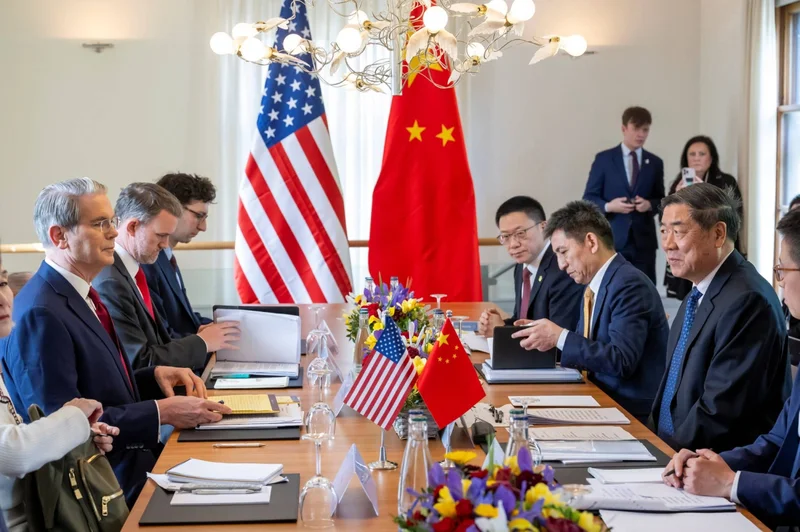
U.S. Treasury Secretary Scott Bessent said he held a call Thursday with Chinese Vice Premier He Lifeng to lay the groundwork for President Xi Jinping’s U.S. visit, a discussion that also touched on numerous flashpoints between the two countries.
“I emphasized that we expect Beijing to fully meet its commitments on rare earths and U.S. agricultural products,” Bessent said in a post on X. “We also discussed implementation of the Trade and Investment Boards as a mechanism to secure concrete progress toward a more balanced, fair, and constructive U.S.-China economic relationship.”
Bessent was also joined by U.S. Trade Representative Jamieson Greer on the call.
He, for his part, expressed “serious concern” over recent U.S. measures taken against Beijing during the discussion, according to a readout from China’s official Xinhua News Agency. The two sides agreed to “enhance communication, build mutual trust and dispel doubt,” the release said.
Bessent and He have met regularly over the past year and a half to discuss sensitive elements of U.S.-China relations, including tariffs, rare earths and the social media app TikTok. That process produced a fragile detente that allowed for U.S. President Donald Trump’s state visit to Beijing in May. Xi is due to visit the U.S. in September.
The world’s two largest economies are currently in the midst of a trade truce that led to the suspension of some tariffs and other export curbs.
More recently, however, some cracks have appeared in the relationship, including over fresh import duties as Trump moves to rebuild his tariff wall, access to rare earth minerals, potential shipments of Chinese weaponry to Tehran amid the U.S.-Iran war and the rollout of Chinese artificial intelligence models.
Those new open-weight artificial intelligence models can compete with some of the most advanced models developed by U.S. firms and have spurred worries in Washington. Bessent recently suggested U.S. sanctions could be used to crack down on what he described as potential intellectual property theft on the part of Chinese AI firms.
The U.S. has also issued restrictions on foreign-made robots and inverters, citing “supply chain vulnerabilities.” The curbs issued by the Federal Communications Commission did not mention Beijing directly but given the fact that most of these items are produced in China, it amounted to a ban on products from the nation.