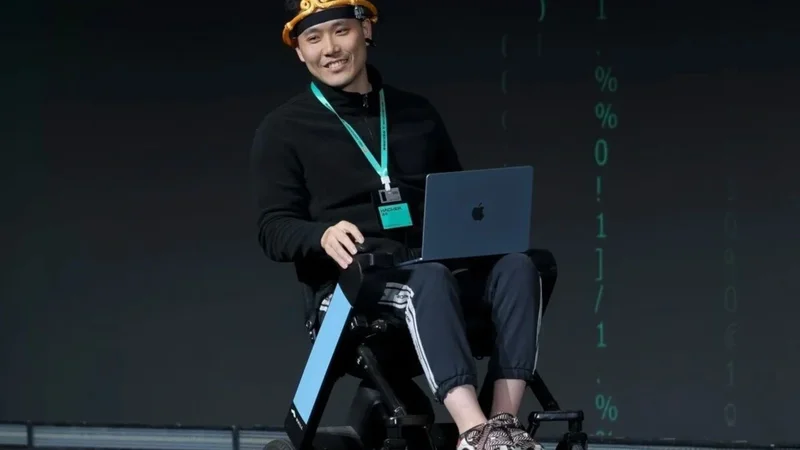
Paralysis inspires Chinese man to build mind-controlled wheelchair that wins top prize
The true value of innovation lies in empowering those who refuse to be confined by fate, says Wang
A man from southeastern China transformed his experience with paralysis into a source of inspiration, creating a mind-controlled wheelchair prototype in just 48 hours during a technology competition.
Wang Ning, 33, and his wife from Shenzhen recently took part in a Shanghai-based Hackathon hosted by RedNote, where they earned first prize in the hardware category for their innovative design.
Originating in the US, hackathons are competitions where developers collaborate under tight deadlines to create products or prototypes from the ground up. Participants typically remain on-site throughout the event, working tirelessly, often eating and sleeping there until their projects are complete.
Wang’s journey reportedly began in 2020, when he was diagnosed with a 13-centimetre spinal cord tumour. Following two major surgeries, he endured full-body paralysis twice. At his lowest point, he could move only his eyes and suffered from intense nerve pain day and night.
During his darkest moments, Wang recounted that his wife gifted him a pair of running shoes to motivate him to keep fighting. With her unwavering support, he gradually regained the ability to stand and walk through rehabilitation.
Overcoming paralysis provided Wang with a profound understanding of what it means to be “confined within the prison of his own body.” This experience later inspired him to create a mind-controlled wheelchair, aiming to empower individuals with mobility challenges to achieve greater independence.
A fine arts graduate with no prior experience in coding or hardware engineering, Wang began to self-teach artificial intelligence (AI) and brain-computer interface technology in 2022, utilising books and online resources, according to CCTV News.
He likened the learning process to “levelling up in a video game,” as he acquired skills ranging from software debugging and circuit soldering to 3D printing.