During Thursday's trading session, SK Group Chairman Chey Tae-won purchased 4.9 billion won ($3.41 million) in SK hynix shares for the first time, buying just below the threshold that would have required him to disclose the transaction plan 30 days in advance.
SK Group said the purchase reflected Chey's view that the recent sell-off in SK hynix shares had been excessive and his confidence in the company's competitiveness. SK hynix shares hit an all-time intraday high of 2.987 million won on June 25 before tumbling to 1.322 million won at Thursday's close.
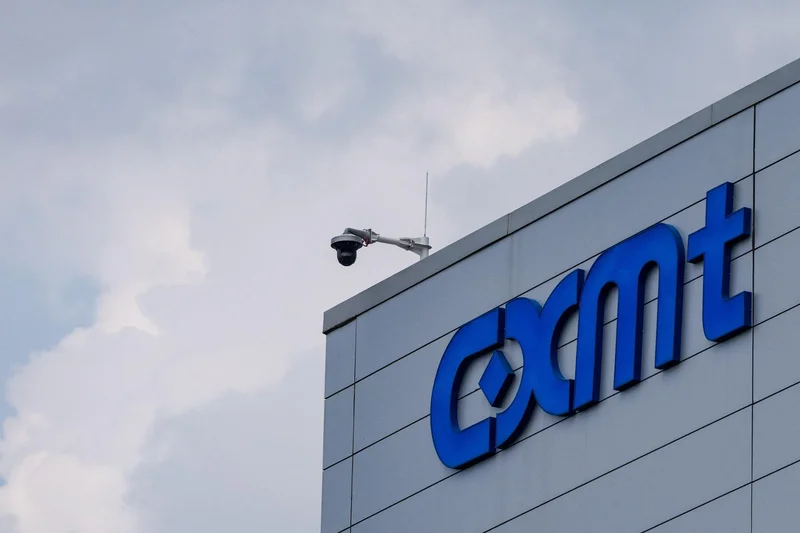
Although the stock rebounded on Friday, investors are still concerned that global Big Tech companies’ artificial intelligence (AI) infrastructure spending may have peaked, and the memory chip market may face a supply glut. At the center of those fears is China’s ChangXin Memory Technologies (CXMT), whose blockbuster stock market debut has reignited concerns over the future balance of the global memory market.
The Chinese DRAM maker raised 12.56 trillion through its initial public offering on July 27, fueling expectations that the fresh capital could finance a massive capacity expansion. A day later, Samsung Electronics shares closed down about 13 percent from the previous session, while SK hynix tumbled about 14 percent.
CXMT plans to add 100,000 wafers of monthly production capacity in Shanghai in 2027, and another 100,000 wafers in 2028. Taking those expansion plans into account, Nomura Securities and other market observers estimate the company will have monthly production capacity of about 550,000 wafers by the end of 2028.
The company has already increased its presence in the global DRAM market.
According to market tracker Counterpoint Research, CXMT accounted for 8 percent of global DRAM revenue in the first quarter, ranking fourth behind Samsung Electronics with 38 percent, SK hynix with 29 percent and Micron with 22 percent.
While still far behind the industry's top three players, CXMT's market share has climbed from just 3 percent a year earlier to 8 percent, more than doubling within a year.
Device makers using memory chips are viewing CXMT’s rise as a way to ease persistent memory supply constraints.
During Apple’s third quarter earnings call on Thursday (local time), CEO Tim Cook said, “If there were more suppliers, that would be good, and it would help us on the supply side, and perhaps the pricing side. It’s unclear on the pricing side. But it could help on the supply side."
While CXMT's rapid expansion has fueled concerns over a potential memory glut, the focus of competition is not on aggressive pricing, as Cook suggested, at least for now, because CXMT is also leveraging the current DRAM shortage as a chance to maintain high prices.
According to a report by SemiAnalysis, CXMT’s DRAM average selling prices were only 5 to 10 percent lower than those of Samsung Electronics, SK Hynix, and Micron in the first quarter.
On July 24, Reuters reported that CXMT recently priced 64-gigabyte DDR5 server DRAM modules above Samsung Electronics' comparable products, while rejecting Huawei's request for discounts.
Market observers said the key questions are whether CXMT's expansion will push the overall memory market into oversupply, and how quickly it can narrow the technology gap on advanced products such as high-bandwidth memory (HBM) with the industry's top three players.
Industry officials estimate the technology gap between CXMT and Korean memory makers at roughly three to four years. While Samsung Electronics and SK hynix are already sampling HBM4E, CXMT is reportedly still struggling to stabilize production of 8-high HBM3, with yields remaining below industry standards, according to SemiAnalysis. SK hynix became the world's first company to mass-produce HBM3 in June 2022, while Samsung Electronics followed a year later.
According to Counterpoint Research, SK hynix led the HBM market with a 58 percent revenue share in the first quarter, followed by Samsung Electronics and Micron at 21 percent each. The report, released on July 10, did not include CXMT in the HBM rankings.
“While CXMT has been gaining market share in the overall DRAM market, low-power double data rate (LPDDR) and DDR products still account for almost all of its revenue, with HBM making only a negligible contribution," an industry official said.
"In other words, CXMT's rise looks more formidable in segments where the technology gap is relatively narrow. In areas where a meaningful technology gap remains, however, it is difficult to view the company as an immediate threat."
Even in the legacy memory segment, such as LPDDR or DDR, there are signs that technological competitiveness continues to outweigh pricing. Herald Economy reported Tuesday that SK hynix, not CXMT, is set to supply LPDDR6 to Xiaomi, as the Chinese chipmaker has been slower to transition from DDR5 to DDR6.
"CXMT's financial power and production capacity are certainly influential, but its long-term competitiveness will ultimately depend on whether it can win recognition from major tech firms and improve mass-production yields," the official said.