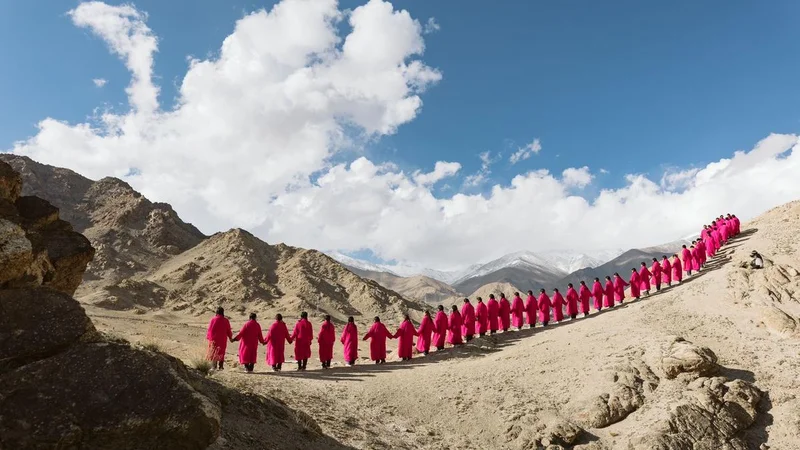
Art rarely stays within gallery walls in Ladakh. This August, it will be spreading across mountains, villages and open landscapes as the region hosts the inaugural Sā Ladakh Biennale (from the Ladakhi word sā, meaning soil). Titled Signals from Another Star, and positioned as the world’s highest regenerative art biennale (at 3,000 m above sea level), it will bring together 26 Ladakhi and international artists.
Interestingly, the inaugural edition will have no opening or closing ceremonies, no ticketing, and no white cube galleries. Instead, it will unfold across eight sites stretching over 200 km, from Leh to Kargil — with three site-specific installations at each location, made from locally sourced natural materials.
The non-commercial format, where each site can only be reached on foot, invites visitors to experience not only artworks, but also the landscapes and people that shape them. “I wouldn’t describe it as an anti-biennale,” says co-founder Raki Nikahetiya. “The word ‘anti’ suggests defining ourselves in opposition to something else, and that isn’t our intention. We don’t believe there is only one way to imagine a biennale. We’re simply asking a different set of questions.”
The idea grew out of friendship three years ago. Co-founders Nikahetiya, Tenzin Jamyang and Sagardeep Singh — an artist, mountaineer, and designer, respectively — came together united by their connection to the region. Their first collaborative project was restoring a neglected 22-acre site into a community space, Diskovalley Bike Park, in 2023. From there, their interest in land art (which uses natural materials such as rocks and vegetation to create art directly within the landscape) saw them launching Sā Ladakh, the precursor to the biennale, in the same year.
When altitude changes your pace
The biennale is less about producing objects than it is about offering a different perspective. The setting itself reshapes the experience of viewing art. “At over 11,000 ft, altitude changes your pace, your breathing and your awareness,” he says. “Walking between installations becomes part of the work. The silence, the intense light, the vastness of the mountains and the conversations with local communities all influence how the art is encountered. You simply cannot rush from one work to another, and that is part of the experience.”
For many associated with the project, the biennale also helps reflect Ladakh’s culture and the realities of living in a region where climate and landscape shape everyday life. “Living here means being constantly aware of the environment,” says Monisha Ahmed, founder of Ladakh Arts and Media Organisation and a member of Sā Biennale’s advisory board. “People here have a very intimate relationship with the land.”
In Leh, for instance, the installations reflect the region’s legacy as a historic crossroads of trade and faith, drawing on its monasteries and traditional architecture; at Mulbekh, they engage with the Maitreya Buddha and the rhythms of the pastoral landscape sustained by seasonal meltwater; and in Hunderman, Kargil, they are rooted in the village’s Balti and Purgi heritage, and the lived experience of displacement and border life.
Taking Ladakh to the world
The newest biennale on the global map is also an opportunity to broaden global perceptions of Ladakh’s artistic identity. “People know the region for its monasteries, murals and thangkas. When I tell them we have contemporary artists, they are often surprised,” Ahmed shares.
For many local artists, Sā has become an important platform. Contemporary artist Skarma Sonam Tashi says his participation in Sā Ladakh led to opportunities at the India Art Fair and the ongoing Venice Biennale, where he is part of the India Pavilion. “Land art is still relatively new in India, and participating in these biennales changes the way we think about art,” says Tashi.
Contemporary artist Jigmet Angmo says that until recently, Ladakhi artists largely exhibited outside the region, mainly through LAMO. “Earlier, we were confined to our studios. Now, the landscape itself has become part of our art,” says Angmo, who explored the impact of climate change on Ladakh’s traditional architecture at Sā Ladakh 2023. “Using clay as my medium, I created an installation that had to be covered with a plastic sheet when it rained. The gesture reflected a changing reality: Ladakh’s mud houses were never designed to withstand frequent rainfall, but a changing climate is forcing both the landscape and its architecture to adapt.”
For Zahara Batool, a contemporary artist from Pashkum village in Kargil, the initiative has created opportunities that were previously difficult to access. “Because of limited connectivity, Ladakhi artists rarely had access to international platforms,” she says. “Sā Ladakh [and Sā Biennale] have changed that by allowing us to present our work through our own culture and communities.” Batool’s work focuses on disappearing heritage settlements and the rapid replacement of traditional architecture. “In this edition, I am working on a textile-based installation with local artisans, bringing together traditional crafts such as felt-making, knitting, crochet and embroidery into a single collective artwork,” she says.
‘Not designed around scale’
As Sā Biennale readies for its first edition, the organisers insist that it will remain an evolving process rather than a fixed model. Future editions will continue to respond to changing communities and landscapes.
Also, rather than measuring success by visitor numbers, the Biennale is interested in the quality of engagement. “Sā Biennale is not designed around spectacle or scale,” says Nikahetiya. “We hope visitors leave with a deeper understanding of Ladakh, its people and the ideas explored by the artists. If art can encourage curiosity and responsibility, then it has achieved something meaningful.”
Sā Biennale is on from August 1 to 10. Entry to all sites is free and there is no opening and no closing.
The senior multimedia journalist from Ladakh writes on the region’s environment, culture and public affairs.
Published - July 31, 2026 12:12 pm IST