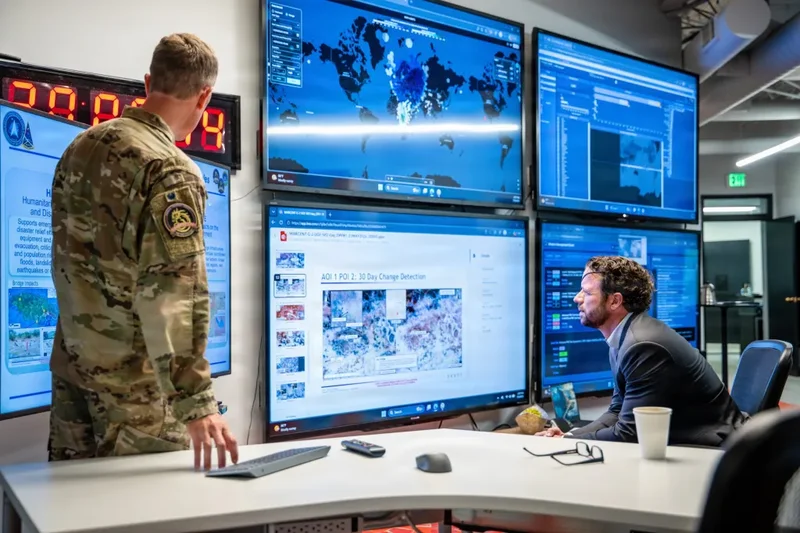
WASHINGTON — The U.S. Space Force selected 15 companies to compete for as much as $981 million in orders to build satellites, sensors and other systems intended to make military space training more realistic.
The six-year contracting vehicle, known as NITE-STAR, will support development of the National Space Test and Training Complex, a network of physical ranges and simulated environments where operators can practice responding to threats against U.S. satellites.
The $981 million represents the maximum value of task orders that can be issued across all 15 companies through July 2032, rather than an immediate award. The contract has a five-year base period and a one-year option, Space Systems Command said in a July 30 announcement.
The selected vendors are Amentum, BAE Systems, Boeing, CACI, Firefly Aerospace, L3Harris Technologies, Lockheed Martin Space, Northrop Grumman, Pacific Crest Alliance, Parsons Government Services, Redwire, Rocket Lab, Sierra Space, Viasat and York Space Systems.
Space Systems Command received 20 bids for the contract, which is formally called National Space Test and Training Complex Innovative Technology and Engineering — Space Test and Range Capability Development.
The program covers a broad mix of equipment and software, including spacecraft that can mimic adversary behavior in orbit and ground systems capable of reproducing cyberattacks, communications jamming and other forms of electronic warfare.
NITE-STAR is structured as an indefinite-delivery, indefinite-quantity contract, a vehicle that allows the government to establish a group of qualified suppliers and then hold competitions for individual task orders. The Space Force issued its request for proposals in March, with bids due in April.
The award comes as Space Force leaders place greater emphasis on training operators for a conflict in which adversaries could jam satellite communications, blind sensors with lasers or attempt to disable spacecraft.
Much of the service’s training still relies on classroom instruction, older range systems and simulations that cannot fully reproduce the speed, distances and limited visibility involved in military operations in orbit. Officials have said operators must understand not only how their own systems work, but also the threats they may encounter and the tactics needed to respond.
The service is developing what it calls a “live, virtual, constructive” training environment that would combine real spacecraft and ground equipment with high-fidelity simulations and computer generated threats.
NITE-STAR is focused largely on the physical and live portions of that effort, including satellites, sensors, instrumentation and supporting infrastructure required to conduct realistic exercises and equipment tests. Those systems could allow operators to rehearse complex missions and experiment with tactics without exposing operational satellites to unnecessary risk.
The Space Force does not have a direct equivalent of the Air Force’s large combat-training ranges, where pilots can encounter representative threats and practice coordinated operations.
Creating that type of environment for space presents different challenges. Satellites operate across vast distances, hostile activity can be difficult to observe directly, and many operational spacecraft are too costly or sensitive to use regularly in exercises.
The National Space Test and Training Complex is intended to address those limitations by linking on-orbit assets, ground systems and simulated threats into a common training and testing architecture.