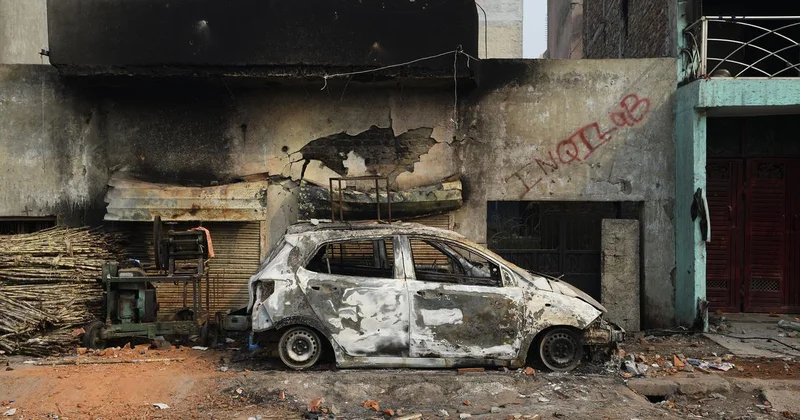
A Delhi court sentenced former Aam Aadmi Party councilor Tahir Hussain and four others to life imprisonment for the murder of Intelligence Bureau staffer Ankit Sharma during the 2020 riots in the capital. The court rejected the Delhi Police’s plea seeking death penalty, saying that capital punishment is the “last resort”.
The judge held that the convicts were not beyond reformation. It described the crime as committed with “utmost brutality” but noted that there was no evidence of a violent disposition or previous violent crimes.
Sharma was killed by a mob during the violence, and his body had been dumped in a drain. Hussain was convicted for murder and other offences but was acquitted of criminal conspiracy. Read on.
The Assam government invoked the National Security Act against activist Pranab Doley, a day after he was granted bail by a sessions court. The invocation of the Act means that the activist will not be released despite the bail order.
Doley was among among two activists arrested on July 12, days after he took part in a protest against a hotel project at Ingle Pathar, a village adjoining the Kaziranga National Park. The police alleged that during the protest, he “unlawfully trespassed into the site of the Tea Tribes Museum and thereafter trespassed into the nearby ATDC [Assam Tourism Development Corporation] Hyatt project at Ingle Pathar with deadly weapons”.
The court had said in its bail order that the police had already recorded the statements of key witnesses and that there was no possibility of Doley tampering with evidence.
The judge also said that on a preliminary reading, the dispute originated “from a deep-rooted anxiety regarding environmental degradation” and its impact on the socio-cultural fabric of the local tea tribes. Read on.
India continues to export weapons to Israel despite the risk that they could be used in the genocide against Palestinians in Gaza, Amnesty International said in a new report. The Indian government had “forged a close and profitable partnership” with the Israeli defence sector and has become a “significant contributor” to the supply chains that support Israel’s military operations, the global human rights organisation said.
The findings in the report were based on shipment-level trade data between India and Israel. It showed how Indian weapons, ammunition and components had been shipped to large Israeli firms that supply the Israeli military.
“Companies that are directly owned and controlled by the state of India are also identified in the report,” the organisation said. Read on.
Exiled Bangladesh-born author Taslima Nasreen returned to Kolkata for the first time in nearly 19 years ahead of a literary event. She is scheduled to attend an anti-fundamentalism literary programme at Rabindra Sadan on Saturday, where she is expected to recite poetry
Nasreen was forced to leave Kolkata in November 2007 after some Muslim fundamentalists claimed that her autobiographical book Dwikhandito had hurt religious sentiments.
The author has lived in exile since fleeing Bangladesh in 1994 after receiving death threats over her for her writings, particularly Lajja, her novel examining the persecution of Bangladesh’s Hindu minority in the aftermath of the Babri Masjid demolition in Ayodhya.
She had initially settled in Kolkata in 2004, where she spent three years and described the city as her second home before being asked to leave during the unrest in 2007. Read on.
We welcome your comments at letters@scroll.in.