Topline
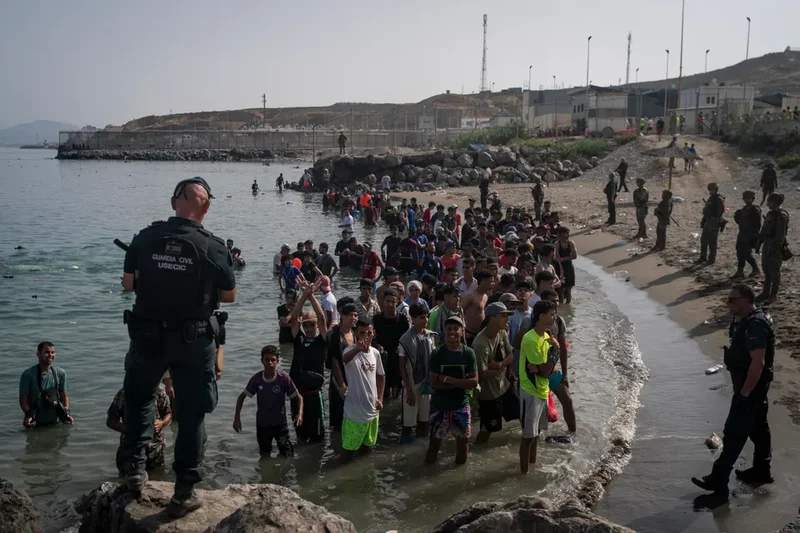
Spanish authorities on Friday afternoon said a majority of the 60,000 migrants who crossed into the Spanish Territory of Ceuta from Morocco on Thursday have returned to their home country after sparking a humanitarian crisis deemed “absolutely unsustainable."
Key Facts
At least 48,300 of the migrants who crossed the border into the Spanish enclave had returned to Morocco by Friday afternoon but thousands more remain despite warnings from the Ceuta government that there aren’t resources in the small territory to feed or house them.
The death toll rose to 57 on Friday on the Spanish side of the border, Reuters reported, including some who drowned and others who were crushed while trying to climb the breakwater that holds the border fence.
Other European countries moved to protect their own borders in the wake of the crisis, and French President Emmanuel Macron said Friday he’d asked his interior minister to strengthen controls at the country’s border with Spain by adding more police, aircraft and drones.
Italy temporarily suspended an agreement that allows people to enter the country freely from Spain without a passport or border check, a move Italian foreign minister Antonio Tajani said was “a necessary choice to safeguard the security of our citizens and defend the European borders.”
In a statement issued Friday, Spanish Prime Minister Pedro Sánchez declared the breach at the border and the large flow of migrants as “a violation of Spain’s territorial integrity,” as his government deployed the country’s military to address the situation.
Opposition party politicians in Spain and Europe pointed to Sánchez’s pro-immigration stances as the reason for the surge, referencing a policy his government implemented earlier this year that would give about half a million undocumented immigrants legal status in Spain.
crucial quote
Juan Jesús Vivas, Ceuta's President, called the crisis “a situation of absolute humanitarian and social emergency."
where is ceuta?
Ceuta is a small Spanish city located on North Africa’s coast, bordering both the Mediterranean Sea and Morocco. Ceuta has belonged to Spain since the 16th century and is one of few African territories the nation still possesses, also including Melilla, another coastal city that borders Morocco. Both Ceuta and Melilla are frequent destinations for African migrants who hope to use the cities as entry points to Europe.
Why Did Migrants Surge Into Ceuta On Thursday?
The exact reason behind Thursday’s sudden surge is unclear, but it appears to have been driven by a combination of economic hardship in Morocco, misinformation about migrants being allowed to remain in Spain and the activity of trafficking networks. When asked by the New York Times why Moroccans surged over the border, a 24-year-old arrival said “because there’s no work” in his home country. Migrants told Reuters they’d seen posts on Instagram and other platforms claiming that a Spanish court ruling meant people arriving by sea could not be immediately returned, although the ruling did not give migrants an automatic right to stay. Spanish officials have blamed traffickers for spreading similar misleading information, and there is a growing suspicion that Moroccan authorities initially failed to stop the crowds, intentionally allowing the surge to grow. Several people told the Times they’d been encouraged to enter Ceuta by Moroccan authorities, who reportedly said, 'Go that way, go that way." Morocco and Spain have denied that the event was deliberately engineered for political reasons.
key background
It has long been thought that Morocco could use migration pressure as leverage against Spain for political reasons. While Ceuta is a Spanish territory, it sits directly on Morocco’s border and Spain relies heavily____ __on Moroccan cooperation to control migration in the enclave. Morocco has previously been accused of relaxing border controls during diplomatic disputes, making a sudden mass influx a potential way to demonstrate how difficult the migration problem could become if Morocco stops cooperating. The broader dispute is also partly tied to Western Sahara, a disputed desert territory in northwest Africa that has been claimed by both Morocco and an independence group called the Polisario Front, which is backed by Algeria. Spain has supported Morocco’s position on the territory, but recent Spanish moves—including __closer engagement with Algeria and policies viewed as more favorable to Sahrawis—have created new friction with Morocco. In May 2021, Ceuta experienced a similar, sudden influx when more than 8,000 migrants poured in over just two days. Sánchez called the surge a “serious crisis for Spain and for Europe,” and the government deployed troops to control the border, after which many migrants were returned to Morocco. Vivas, at the time, said local officials were “not even in a position to calculate the number of people who have entered,” saying the “mood among Ceuta’s population is now one of anguish, uncertainty, unease and fear.” The 2021 surge occurred amid strained relations between Spain and Morocco after Moroccan officials reacted with outrage when Brahim Ghali, leader of a separatist movement fighting for Western Sahara’s independence, was treated for COVID-19 under an alias in Spain.
Videos Of Moroccan Migrants Go Viral On X
Videos of large numbers of migrants appearing to cross the Spanish border into Ceuta went widely viral on social media Thursday, frequently circulated by right-wing commentators who are critical of immigration. Billionaire Elon Musk said on Thursday afternoon the migration surge is “absolutely an invasion,” among several posts he made on the situation in Ceuta. He later shared a video purportedly showing the migrant surge while adding the comment “Looks like World War Z!” after posting, “Spain’s entire budget will be destroyed by illegal migrants.” A video posted to X by Santiago Abascal, leader of Spain’s far-right Vox party, also called the influx of migrants an “invasion” and accused “Sánchez's corrupt government” of “desperately calling in more hitmen to stay in power.” Abascal’s video garnered more than 2.2 million views as of Thursday afternoon. Abascal posted another video Thursday morning, garnering 2.6 million views, accusing Sánchez of being a “traitor, a corrupt man, and an indecent person,” calling for his ouster.
further reading
‘Absolute chaos’ as thousands of people breach Morocco’s border with Spain’s Ceuta (Associated Press)
More than 6,000 migrants reach Spain’s north African enclave Ceuta (The Guardian)