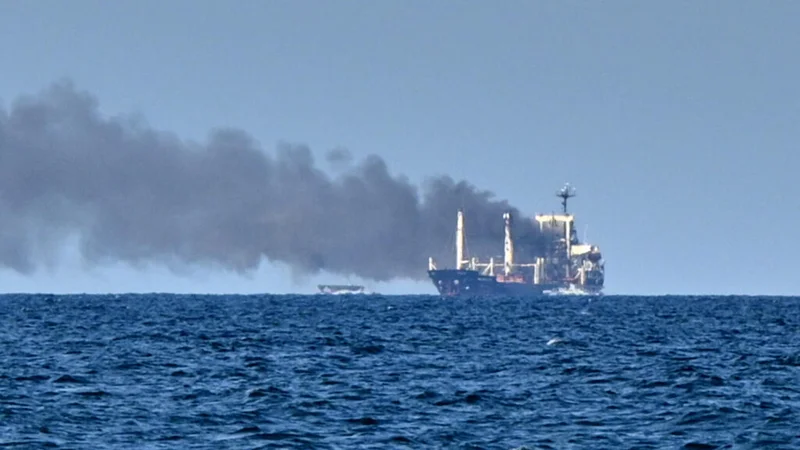
Intensifying clashes between Ukraine and Russia in the Black Sea are threatening a crucial trade artery responsible for nearly a third of the world's wheat supply, stoking fears of soaring prices and shortages.
Earlier in July, a Russian cruise missile struck the grain carrier Golden Leo, claiming ten lives. This marked the deadliest blow yet in a mounting campaign by both Russian and Ukrainian forces targeting cargo ships in the Black Sea and the Sea of Azov.
"This is a new development in recent months," claims shipping analyst Yoruk Isik, who runs the Istanbul-based Bosphorus Observer consultancy. Isik warns that cargo vessels are caught in a deadly tit-for-tat.
"Ukraine has been targeting Russian seaborne bulkers in particular, the ones transporting stolen grain from the occupied territories of Ukraine," explains Isik, "Russia retaliated and hit Ukraine's civilian port infrastructure in Odesa; a mid-sized vessel carrying corn out of Odesa was totally sunk, other vessels were damaged, and sailors died," he adds.
Turkey’s Shipowners’ Association, having logged 136 incidents involving commercial vessels in recent months, is now urging its members to avoid the Black Sea altogether.
Beyond its role as a key channel for Russian oil, the Black Sea is a lifeline for global grain exports, with Russia and Ukraine among the top suppliers.
"It is very important to note that most of Russia's agricultural commodities are exported through the Black Sea, and that almost all of Ukraine's agricultural commodities are shipped via Ukraine's ports," warns Isik.
Bad timing for harvest
Around a third of the world's wheat moves through these waters. The surge in attacks across the Black Sea and the neighbouring Sea of Azov has brought exports to a near standstill.
"No port is officially closed, but almost no shipowner wants to go there, so trade is close to zero," claims Istanbul-based international grain dealer Can Atbasoglu. "Sellers want buyers to handle the vessels, and buyers want sellers to handle the vessels, but shipowners don't want to risk it."
This deadlock arrives at the worst possible moment: harvest time. "Normally, Russian sellers would have sold all their August cargoes by now; I don't know if anybody has any sales on their books at present," says Atbasoglu.
Wheat prices are already reacting. "The price in Romania is, say, 20-25 percent higher – that's the clearest effect we're seeing. But everybody is waiting for some kind of intervention, and soon," adds Atbasoglu.
Turkey now leads a NATO mission, along with Bulgaria and Romania, to safeguard navigation in the Black Sea. However, former Turkish ambassador and navigation rights expert Mithat Rende believes Ankara will be wary of any effort to enforce passage for commercial ships. "It's very important that the Ukrainian war should not be transformed into a regional war," cautions Rende.
"Where would it stop? Would you fire missiles and intercept Russian missiles in the Black Sea? They (Russia) already accuse all of us of fighting Russia as NATO. It's very important to avoid such operations," he adds.
Full impact yet to be felt
Rende argues Ankara’s priority is diplomacy, having played a pivotal role in brokering the 2022 United Nations-backed grain export deal after Russian forces blocked Ukrainian shipments. "Turkey maintained a dialogue with both the Russian and the Ukrainian sides at the same time," says Rende, "But is there political will for a ceasefire now? I don't see it at present."
Grain trader Atbasoglu warns the full impact of the disruption is not yet reflected in prices. "Buyers are still not fully reacting. It's seen more as an August, or at the latest a September issue, and the markets still want to believe both sides will get together and talk," he says.
However, Atbasoglu cautions that time may be running out. "In 2022, Ukraine was completely closed off, and there was a major panic. We saw the effect: wheat prices jumped 50 percent in 2022, and we could expect something similar if this continues," he concludes.
Africa and the Middle East, which are heavily reliant on Black Sea grain, are beginning to seek pricier alternatives. Europe, too, may soon feel the strain, as drought-hit wheat harvests threaten to push global food prices even higher.