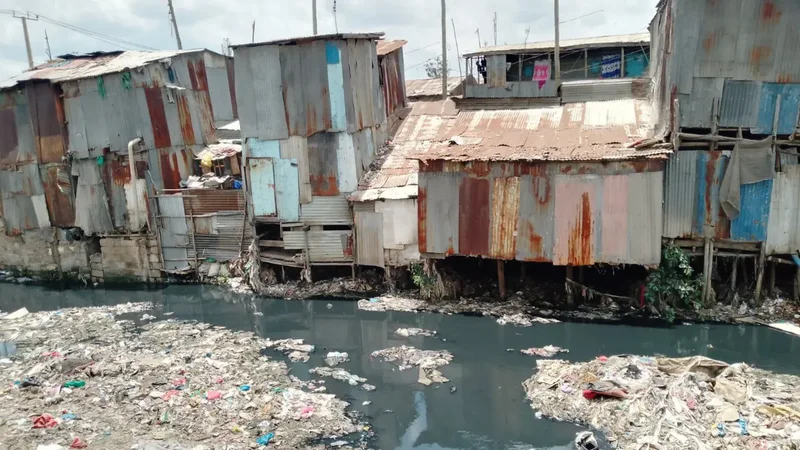
Between 2021 and 2022, researchers collected water, food, soil and other samples from places Mukuru children and adults come into contact with. In it, they found traces of the DNA (the genetic material found inside all living cells) of the bacteria that can cause cholera in 97% of surface water samples and 77% of floodwater samples. The DNA was everywhere in the water but nothing grew in the lab — a sign the bacteria may be lying dormant, in a form that can wake up and infect people.
It is the psychological impacts that come through most strongly in conversation with residents, however.
Mangi quietly admits he has felt like giving up at times, while Kambura describes an atmosphere of fear and panic whenever heavy storm clouds appear, leading people to “rush about, raising beds on bricks and hanging our belongings high”.
The link between poor mental health, sh**ty drainage
Studies conducted elsewhere, including in Africa, have linked floods to increased depression, anxiety and post-traumatic stress disorder, or PTSD, (long-lasting mental distress after trauma) but very little has been conducted in Kenya.
In 2025, seeking to address this gap, the African Population and Health Research Centre (APHRC) talked to more than 500 “flood-exposed” Mukuru residents. Preliminary findings suggest that 44% showed signs of PTSD, such as nightmares, hypervigilance and outbursts of anger and irritability, with the percentage rising to 51% among those who had experienced five or more floods. The number of people who showed signs of depression was high, too, at 24%.
Muthoni believes there are many contributors to trauma in Mukuru, from high levels of sexual and gender-based violence to deadly fires but he is convinced that Mukuru’s particular hydrological dynamics — the way that toxic run-off serially inundates low-lying villages — is the biggest contributor.
“They [APHRC] came to make a study of river flooding and instead they have made a study of our drainage!” says Muthoni.
It is a joke but the idea that the APHRC’s study results could be a proxy for the psychological toll of poor drainage is compelling. While several studies have shown that flooding can harm people's mental health, Bhekisisa found almost no research looking specifically at the psychological toll of living with chronically poor drainage.
In 2026, blocked drains caused the informal settlement of Dunoon in Cape Town to flood several times. The same thing happened in parts of Khayelitsha, Philippi and Masiphumelele. Beira in Mozambique is known for being vulnerable to cyclones but it is the annual flooding of city streets due to poor drainage that is most oppressive, requiring residents to build their homes differently, with most doorways raised 1m above the ground. Kenya arguably has the worst of it, with an estimated 60% of the population living in informal settlements or slums, most of which suffer from poor to non-existent drainage.
When I put this to APHRC research officer Henry Owoko, he nods vigorously.
“Pick any urban informal settlement in Nairobi — Viwandani, Dandora, Kibera, Soweto-Kayole — and you will find there is usually an industrial area nearby, which has a clogged drainage system, and the land slopes down to either the Nairobi River or one of its tributaries, and all through you find people struggling with flooding, either as a result of the river breaking its banks, poor drainage or both,” Owoko explains.
To strengthen the inference that flooding is a cause of poor mental health in Mukuru, the APHRC team planned to talk with the same number of people in a community that is not exposed to flooding but has similar income and living conditions.
The research forms part of a four-country study in South Africa, Kenya, Burkina Faso and Mozambique that looks at the mental health impact of increased flooding caused by climate change.
“That’s when we realised how common the experience of flooding in informal settlements is,” Owoko says.
“We visited Mombasa on the coast but found most people there have experienced flooding, too, much of it the result of collapsed drainage systems, with extreme heat as a confounding factor. We then went to Kisumu and what did we find? Floods!”
The team eventually settled on Manyatta, an informal settlement in Kisumu set some distance back from rivers on sandy, quick-draining soils. Five hundred residents submitted to the same survey conducted in Mukuru. The results were interesting.
The number of people showing signs of moderate mental health problems such as trauma, depression and anxiety was lower than Mukuru, with 30% of people showing signs of PTSD in Manyatta compared to 44% in Mukuru and 19% being symptomatic of depression compared to Mukuru’s 26%, suggesting Mukuru’s floods added measurable levels of extra stress and trauma to people’s lives.
Still, even the rate of PTSD and depression in Manyatta, the control site, remains incredibly high.
When the rates are compared with the levels of depression and PTSD in some conflict-exposed regions, as estimated in a 2020 analysis of 25 studies conducted in sub-Saharan Africa, Manyatta’s PTSD levels are on par with conflict-ridden places and Mukuru’s 15 percentage points higher.