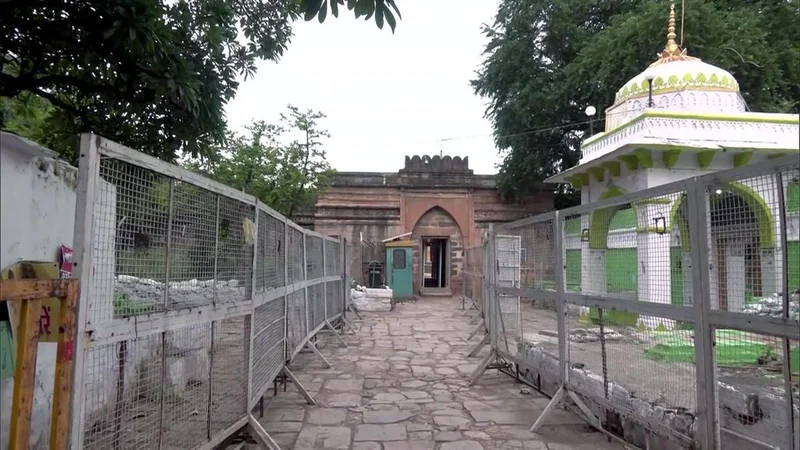
On July 14, the Supreme Court had refrained from restoring status quo ante after the Madhya Pradesh High Court declared that the Bhojshala-Kamal Maula Mosque complex was a temple dedicated to Goddess Saraswati and barred Friday namaz at the site.
\| Photo Credit: ANI
The Supreme Court on Wednesday (July 22, 2026) directed the Union and Madhya Pradesh governments to comply “in letter and spirit” with its July 14 order requiring the authorities to identify a separate open space near the disputed Bhojshala-Kamal Maula Mosque complex where members of the Muslim community could offer Friday namaz between 1 p.m. and 3 p.m. as an interim arrangement. The direction came after the court was informed that the site identified by the administration was nearly two kilometres away.
A Bench comprising Chief Justice of India Surya Kant and Justices Joymalya Bagchi and V. Mohana said the authorities were under an obligation to carry out its earlier directions in their entirety. The matter has been listed again on Friday for the court to review compliance.
The matter was mentioned before the Bench by senior advocate Huzefa Ahmadi, appearing for the Muslim petitioners, who submitted that the location identified by the authorities for offering Friday namaz was nearly 2 km from the disputed complex. “They have earmarked a place two kilometres away from the site,” Mr. Ahmadi told the court.
*Also Read \| Bhojshala case: Madhya Pradesh High Court refers to 10 principles laid down by Supreme Court in Ayodhya verdict*
Solicitor General Tushar Mehta, appearing for the Centre and the Madhya Pradesh government, however, pointed out that the earmarked space for offering namaz was about 900 m away from the disputed site. He also apprised the Bench that he had already conveyed to the authorities to identify an alternative site.
“I had a word with the authorities and it is 900 m away. But I am in talks with them and have asked them to identify an alternative site,” Mr. Mehta said.
Justice Bhagchi, however, reminded the law officer that the expression used in the interim order was “adjacent site”. “Last time when we used the expression ‘adjacent site’...”, the judge said.
The law officer assured the court that he had already spoken to the authorities and that the issue would be resolved soon. “That order will be taken care of. I have already spoken to the authorities there,” he submitted.
The Bench, however, made it clear that there could be no deviation from its earlier directions. “The order has to be complied with in letter and spirit”, it said while agreeing to list the matter on Friday.
The dispute concerns the Bhojshala Temple-Kamal Maula Mosque complex in Madhya Pradesh’s Dhar district, where both Hindu and Muslim communities have long asserted competing religious claims.
On July 14, the apex court had refrained from restoring status quo ante after the Madhya Pradesh High Court declared that the Bhojshala-Kamal Maula Mosque complex was a temple dedicated to Goddess Saraswati and barred Friday namaz at the site. The court had reasoned that it did not want to “create tension” in a “very sensitive” issue.
The Bench further prohibited the Archaeological Survey of India (ASI) from allowing any structural alterations to be made to the disputed structure without the prior permission of the apex court. The court issued formal notice to the State of Madhya Pradesh and the Union government.
“Let us not pass any order which creates tension. We are ready to hear the case on a day-to-day basis and resolve the issue. We request both sides to have patience. It is only a matter of a few days,” Chief Justice Kant had assured the Muslim appellants.
On May 15, the Madhya Pradesh High Court ruled that the disputed Bhojshala-Kamal Maula Mosque complex in Dhar district was a temple dedicated to Goddess Saraswati. It had simultaneously quashed a decades-old ASI order that had allowed the Muslim community to offer Friday prayers at the site. The High Court had also said that the Centre and the ASI could decide on the Bhojshala complex’s administration and management.
The Hindu community considers Bhojshala a temple dedicated to Goddess Saraswati, while the Muslim side calls the 11th-century monument the Kamal Maula Mosque. The disputed complex is protected by the ASI.
Published - July 22, 2026 01:10 pm IST