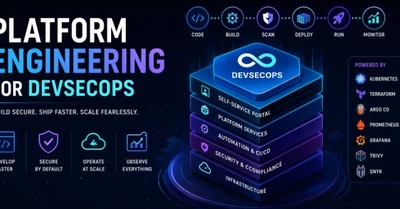
Let’s be real for a moment.
Everyone in DevSecOps loves talking about tools — scanners, pipelines, Kubernetes, zero-trust, AI security… the whole package.
But very few talk about the thing that actually makes all of this usable at scale:
📊 Hard Facts You Shouldn't Ignore
Let's ground this with real numbers:
- 💰 $4.1 billion+ is the global platform engineering market size in 2025 (growing at \~22% CAGR)
- 📉 84% of large enterprises already have a platform engineering initiative underway (Gartner, 2025)
- 🧾 56% of mid-market companies have adopted platform engineering — and the number is climbing fast
- ⚙️ Teams using IDPs report 60% reduction in developer onboarding time
- 📦 Orgs with mature platform engineering ship features 2x faster than those without (DORA, 2024)
- 📊 Elite teams deploy 973x more frequently than low performers — platform engineering is a key differentiator
- 🔐 Companies using IDP-enforced pipelines report 40% fewer critical security vulnerabilities
- 💤 Standardized infrastructure through platform engineering drives 30–35% reduction in infra costs
Now think about it:
If your engineering team has 50 developers spending 2 hours/day fighting infrastructure and config issues…
You're losing 100 hours of pure dev time every single day — time that platform engineering can give back.
👉 Platform Engineering
And if you're serious about DevSecOps in 2026, ignoring platform engineering is like trying to run Kubernetes on a laptop without Docker — technically possible… but painful and unnecessary.
So let’s break it down in a chit-chat + professional way, exactly how you’d explain it to a fellow engineer over coffee ☕.
🤔 First — What is Platform Engineering?
In simple words:
Platform Engineering is about building internal developer platforms (IDPs) that make DevSecOps easy, consistent, and scalable.
Instead of every developer figuring out:
- how to deploy
- how to secure apps
- how to configure pipelines
👉 Platform teams build a paved road 🛣️ so developers don’t walk through the jungle 🌴
🧱 Why Platform Engineering Became Essential
Let’s rewind a bit.
Before modern DevOps:
- Dev teams wrote code
- Ops teams deployed it
- Security came after (and usually broke things 😅)
Then DevOps came → CI/CD pipelines became standard
Then DevSecOps came → security shifted left
Now?
👉 Complexity exploded.
We now deal with:
- Microservices
- Kubernetes clusters
- Multi-cloud environments
- Hundreds of pipelines
- Dozens of security tools
Without a platform?
❌ Every team reinvents the wheel
❌ Security becomes inconsistent
❌ Developers get blocked
❌ Costs go out of control
🔥 Enter Platform Engineering (The Real Hero)
Platform engineering solves this by creating:
🧩 Internal Developer Platform (IDP)
Think of it as:
A self-service layer where developers can build, deploy, and secure applications without worrying about infrastructure complexity
🏗️ Platform Engineering + DevSecOps \= Perfect Match
Now let’s connect the dots.
Without Platform Engineering:
- DevSecOps \= tools + chaos
With Platform Engineering:
- DevSecOps \= standardized, automated, secure workflows
🔄 The DevSecOps Platform Flow (Real World)
Here’s how a modern setup looks:
1️⃣ Code Commit
Developer pushes code to Git
👉 Platform ensures:
- Pre-configured repo templates
- Built-in secret scanning
- Secure defaults
2️⃣ CI Pipeline (Auto-triggered)
Platform provides reusable pipelines using tools like:
- Jenkins
- GitHub Actions
- GitLab CI
👉 Security baked in:
- SAST
- Dependency scanning
- Secret detection
3️⃣ Containerization
Apps are containerized using:
👉 Platform enforces:
- Secure base images
- Image scanning
- Policy checks
4️⃣ Kubernetes Deployment
Orchestrated via:
👉 Platform provides:
- Pre-approved Helm charts
- Namespace isolation
- Network policies
5️⃣ GitOps Deployment
Using:
👉 Platform ensures:
- Desired state enforcement
- Audit trails
- Rollback safety
6️⃣ Runtime Security \& Observability
Monitoring + protection via:
👉 Platform gives:
- Dashboards out of the box
- Alerts configured
- Security policies enforced
🧠 Key Principles of Platform Engineering in DevSecOps
1️⃣ Golden Paths (Paved Roads)
Developers don’t start from scratch.
They get:
- Pre-secured templates
- Ready pipelines
- Best practices built-in
👉 This reduces mistakes by design.
2️⃣ Self-Service (No More Waiting)
Instead of:
“Hey DevOps, can you deploy this?”
Developers can:
- Create environments
- Deploy apps
- Access logs
👉 Without needing permission every time
3️⃣ Security by Default (Not Optional)
Security is not a step.
It’s:
- Embedded in pipelines
- Enforced via policies
- Automated everywhere
4️⃣ Standardization at Scale
Same:
- CI pipelines
- Security rules
- Deployment strategies
Across all teams.
👉 This is huge for enterprises.
5️⃣ Developer Experience (DX) First
Bad DX \= people bypass security ❌
Good DX \= people follow the system ✅
Platform engineering focuses heavily on:
🧰 Tools That Power Platform Engineering
Let’s look at the ecosystem:
🔧 Platform Layer
- Backstage (by Spotify)
- Port
🔐 Security Layer
☁️ Infrastructure Layer
🔄 Workflow Automation
⚡ Real Benefits (Not Just Theory)
🚀 Faster Delivery
Developers ship faster because everything is pre-built.
🔐 Stronger Security
Security is enforced automatically — not manually.
💰 Cost Optimization
- Standard infra
- Controlled environments
- Reduced duplication
📊 Better Visibility
Everything is:
⚠️ Challenges (Let’s Not Ignore Reality)
Platform engineering is powerful… but not easy.
❌ Initial Setup is Heavy
Building a platform takes time and planning.
❌ Requires Culture Change
Teams must:
- Trust the platform
- Follow standards
❌ Platform Team Responsibility
You need a dedicated:
👉 Platform Engineering Team
🔮 Future: Platform Engineering + AI
This is where things get exciting.
We’re moving towards:
- AI-generated pipelines
- Auto-remediation of vulnerabilities
- Smart policy enforcement
- Self-healing infrastructure
👉 Platform engineering will become the control plane for intelligent DevSecOps
🧾 Final Thoughts
If DevSecOps is the engine 🚗
Then Platform Engineering is the chassis that holds everything together.
Without it:
- Tools feel disconnected
- Security feels forced
- Developers feel frustrated
With it:
- Everything flows
- Security scales
- Teams move faster with confidence
💬 One-Line Takeaway
“Platform Engineering turns DevSecOps from a collection of tools into a scalable, secure, and developer-friendly system.”