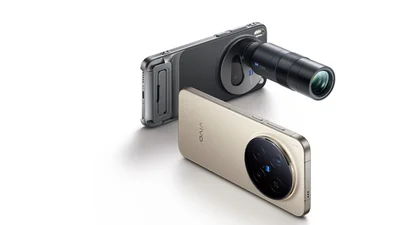
A few weeks ago Xiaomi launched its top phone. The Xiaomi 17 Ultra, the bestest and most expensive Xiaomi phone in India, comes with a feature that turns it from a communication tool into a camera within minutes. All thanks to its photography kit. But it is not the only such smartphone that we are going to see. In the coming weeks and months, two more such phones will hit the market. One would be from Vivo and one from Oppo. The Vivo X300 Ultra is expected to launch in May and the Oppo Find X9 Ultra too should come around the same time.
The common factor in these three phones, apart from that Ultra attached to their name, is the photography kit. All three phones not just come with specialised and overly large camera hardware, including large sensors and exotic lenses, they are also paired with a kit that turns them into a camera. If you are willing to spend, you even get external lenses with this kit, which offer the kind of optical zoom that was earlier only possible in dedicated cameras.
The trend begs a question: why are the big phone companies — and most notably Oppo, Vivo and Xiaomi — focussing so hard on turning their phones into cameras? There are several reasons but they all eventually converge on one single point. Trying to unseat Apple and Samsung in the ultra premium market, Vivo, Oppo and Xiaomi believe strongly that the camera performance is one area where they can truly distinguish themselves.
Is it a phone or is it a camera?
The trend is not new. All three companies have been gradually improving the camera hardware in their phones. What once began as a megapixel race has evolved into something far more ambitious. Companies like Vivo, Xiaomi and OPPO have focused on turning their top phones into full-fledged imaging systems, complete with physical controls, pro-grade optics, and AI-powered processing.
So much so that in 2024 when someone rhetorically asked on X whether the new Xiaomi phone was a camera or a phone, with the image of its photography kit attached, Xiaomi CEO Lei Jun replied: “This is a camera phone, not a phone with a camera.”
The ambition seemed clear in that post by Jun. The other phones, such as the Samsung Galaxy or the iPhone, have a camera in them. But the Xiaomi Ultra, or so implied Jun, was a new kind of device. It was a “camera phone.”
The same sentiment was visible in a post made by Pete Lau, chief product officer at Oppo, in 2024. Introducing his top phone then, he wrote: “The Find X7 Ultra is a game-changer in smartphone cameras! It's not just a phone with a camera; it's a camera with a phone.”
These are not mere words. The hardware in the Xiaomi 17 Ultra, Vivo X300 Ultra and the Oppo Find X9 Ultra is indeed quite similar to what we once used to get in proper cameras. The 17 Ultra, for example, comes with a 1-inch sensor that is huge compared to the image sensor used in a phone like Galaxy S26 Ultra, or even in the Google Pixel 10 Pro. The upcoming X300 Ultra and Find X9 Pro too will use large 1-inch sensors. These sensors are then paired with exotic lenses, which have ever-complicated designs for better photography performance. For example, the 17 Ultra has the world’s first variable zoom lens in a phone.
Xiaomi 17 Ultra
To ensure that the consumers get the message, this unique camera hardware is paired with some storied names with photography legacy. Xiaomi works with Leica to buttress the camera credentials of its phones. Vivo has taken inputs from Zeiss and flaunts the tag on its top phones proudly. Oppo, meanwhile, has partnered with Hasselblad and at every opportunity loves to tell potential customers how its top phones have cameras tuned with colour science of the iconic camera brand.
The only viable way to stand out
Over the years, as smartphones have matured as gadgets and their technologies have stopped being cutting-edge, there is not much room to innovate. This is the reason why so many phones nowadays just look and perform like their predecessors. Earlier, smartphone companies would try to outdo each other in areas like screen, design, battery and performance. But now most phones are good-enough or great at these things. It’s hard for brands to stand out.
This makes camera performance, because this is one area where phones still struggle, the aspect on which brands can score against each other. That is if they can innovate. And Vivo, Oppo and Xiaomi have decided to go all in on it.
Prabhu Ram, a vice president at CyberMedia Research, sees the strategy for what it is. “As hardware-led differentiation becomes increasingly challenging, the strategic focus has shifted further toward enhancing imaging capabilities and experiences,” says Ram. “This is why brands such as Vivo and OPPO have built strong identities around imaging leadership. Similarly, Xiaomi has strengthened its premium positioning through its partnership with Leica.”
Consumers connect with camera focus
One more reason why camera performance has taken center stage for Vivo, Oppo and Xiaomi in the ultra premium segment is also because it is an idea easy to sell to consumers. People themselves demand more and more of it.
Tarun Pathak from Counterpoint Research says that camera performance of an ultra premium phone makes or breaks it in the market. “The rise of social media and content creation has made imaging capabilities central to everyday smartphone usage,” he says. “Importantly, in offline retail (mainline) channels, the camera is one of the easiest features to demonstrate in-store, unlike aspects such as processor performance or battery life, making it a strong tool for influencing purchase decisions at the point of sale.”
Oppo Find X9 Ultra
He also highlights that by turning a phone from a communication tool into a photography-first device, companies can charge premium prices for it. “Cameras (in a phone) play a key role in premiumisation, with brands leveraging advanced optics, larger sensors, and AI-led imaging to justify higher price points, particularly in the premium segment,” says Tarun.
Will it finally click?
This is a key question. While the trend is clear, at least as far as the premium phones from Vivo, Xiaomi and Oppo are concerned, the proof of the pudding is in eating. Or in other words, will Vivo, Xiaomi and Oppo get the cake? Only time will tell.
Tarun says the strategy is working. “Brands that have built a clear and consistent camera-led identity whether around portrait, low-light, or video are seeing strong traction, especially in the mid-premium and premium segments,” he says.
Yet, it is also true that for now the iPhone remains the king of the hill. At least in India, as soon as we get into the ultra premium segments, the iPhone reigns supreme. And if we talk about the company that is second behind Apple, then that is Samsung with the Galaxy lineup.
Having said that, Vivo, Xiaomi and Oppo have started to create enough buzz to be a choice for many consumers in the ultra premium segment. They are not yet in a place where they can beat the established players in terms of volume. But at least in creating buzz for their products, they are becoming more and more successful. A big reason, probably the biggest reason, for this is the camera capabilities of their ultra premium phones. Whether the momentum sustains and then turns into a sizable volume of sale is something only time will tell.
- Ends
Published By:
Divya Bhati
Published On:
Apr 17, 2026 10:40 IST