Blue Origin made history twice on Sunday, first by launching its New Glenn rocket for the third time, and then by successfully landing its reused booster on a drone ship in the Atlantic Ocean.
The rocket lifted off from Launch Complex 36A at Cape Canaveral Space Force Station in Florida, carrying AST SpaceMobile’s BlueBird 7 satellite into low-Earth orbit.
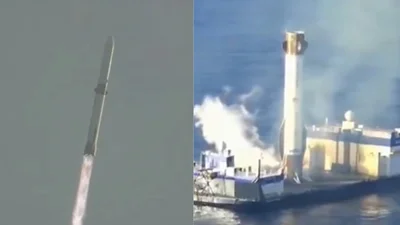
Never Tell Me The Odds touches down on the drone ship Jacklyn in the Atlantic Ocean. This is Blue Origin's first-ever successful booster reuse, completing a remarkable round trip from the edge of space. (Photo: X/@NASASpaceflight)
This is the band of space roughly 200 to 2,000 kilometres above the Earth’s surface, where most communication and weather satellites operate.
WHAT MAKES BLUEBIRD 7 SO SPECIAL?
BlueBird 7 is not your average satellite. It carries a phased-array antenna, which is a massive, flat panel that directs radio signals precisely without physically moving, spanning roughly 223 square metres, about the size of two tennis courts.
That makes it the largest commercial communications antenna ever placed in low-Earth orbit.
The goal is ambitious: to build a space-based cellular network that lets ordinary smartphones connect to the internet from anywhere on Earth, whether you are in the middle of the ocean, a remote forest, or a signal blackspot in a city.
No special hardware needed, just your regular phone.
WHY IS THE BOOSTER LANDING SUCH A BIG DEAL?
The real showstopper on Sunday, however, was the booster. New Glenn's first-stage booster, nicknamed Never Tell Me The Odds, a nod to Han Solo's famous line in Star Wars, flew for the second time, marking Blue Origin’s first-ever booster reuse.
After separating from the rocket, it guided itself back from the edge of space using onboard computers and engines, slowing from hypersonic speeds before touching down with pinpoint precision on the drone ship Jacklyn.
Reusing rockets is the future of spaceflight.
Building a new rocket from scratch costs hundreds of millions of dollars.
Recovering, inspecting, and reflying one costs a fraction of that, the same logic as reusing an aircraft instead of scrapping it after every flight.
SpaceX made this concept famous with its Falcon 9 rocket.
Sunday’s double achievement shows Blue Origin, founded by Amazon’s Jeff Bezos, is now very much in the same league.
- Ends
Published By:
Radifah Kabir
Published On:
Apr 19, 2026 17:31 IST