Your support helps us to tell the story
From reproductive rights to climate change to Big Tech, The Independent is on the ground when the story is developing. Whether it's investigating the financials of Elon Musk's pro-Trump PAC or producing our latest documentary, 'The A Word', which shines a light on the American women fighting for reproductive rights, we know how important it is to parse out the facts from the messaging.
At such a critical moment in US history, we need reporters on the ground. Your donation allows us to keep sending journalists to speak to both sides of the story.
The Independent is trusted by Americans across the entire political spectrum. And unlike many other quality news outlets, we choose not to lock Americans out of our reporting and analysis with paywalls. We believe quality journalism should be available to everyone, paid for by those who can afford it.
Your support makes all the difference.
Read more
The wreckage of a Pan American Airways flight that crashed off the coast of Puerto Rico has been found sitting on the ocean floor, 74 years on.
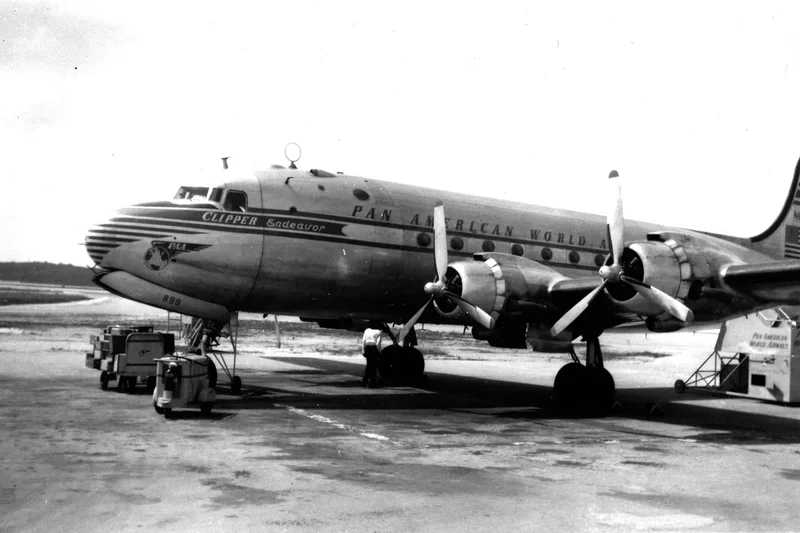
The remains of the Pan Am “Clipper Endeavor” were found in June at the bottom of the Atlantic Ocean, the Discovery Channel said on Tuesday.
It was located by the channel’s series Expedition Unknown, along with the Air/Sea Heritage Foundation and other groups.
The Douglas DC-4 plane took off from Puerto Rico on 11 April 1952, as Pan Am Flight 526A to Idlewild Airport (now known as JFK) in New York City.
Sixty-four passengers and five crew members were on board.
The Pan American World Airways logo on the nose section of the Clipper Endeavor wreck (Air/Sea Heritage Foundation and Deep Sea Vision via AP)
It crashed into the sea shortly afterwards, breaking into two sections and coming to rest on the ocean floor.
Everyone on board survived the initial impact, but 52 passengers subsequently drowned. Twelve passengers and all five crew members were rescued.
The disaster led to sweeping reforms in the aviation industry, and pre-flight safety briefings and demonstrations of emergency procedures were instituted shortly afterwards.
“We are all stunned and elated by this discovery yet also humbled to remember what happened in that place so long ago,” Russ Matthews, the president of the Air/Sea Heritage Foundation, said.
The search, which involved the Deep Sea Vision company, used high-resolution sonar and autonomous underwater drones.
The wreckage was found almost 2,000 feet under the Atlantic Ocean.
From left, Air/Sea Heritage Foundation (ASHF) president Russ Matthews, ASHF director Idee Matthews-Montijo, Expedition Unknown's Josh Gates and Deep Sea Vision president of operations Craig Wallace inside a hangar
Why did Pan Am Flight 526A crash?
One of the engines on the plane’s right wing failed just after takeoff, and the pilots decided to return to San Juan Airport.
As they climbed to 550 feet, the other right-wing engine failed.
The flight’s captain, experienced pilot John C. Burns, declared an in-flight emergency and told the control tower that he planned to attempt a water landing.
Clipper Endeavor ditched in the Atlantic Ocean nine minutes after take-off.
The plane broke in two and the wreckage sank less than three minutes later.
Survivors later reported that many passsengers had panicked, fearing the rough seas and sharks, and had refused to leave the sinking aircraft to board life rafts.
An investigation and subsequent legal proceedings found that the crash was caused by inadequate maintenance and faulty plane parts.