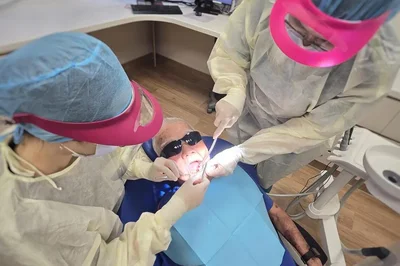
SINGAPORE – Mr Thung Joo Seng, 79, sought help at Serangoon Polyclinic earlier in 2026 for a cut on his head from a fall, but he also had a loose tooth found and later extracted as part of the polyclinic’s new comprehensive programme for oral frailty.
His attending doctor had noted several risk factors for frailty, including weak lower limbs, a history of falls and having fewer than 20 teeth, and referred Mr Thung to an advanced practice nurse (APN) at the polyclinic for a comprehensive frailty assessment.
Screening for oral frailty, the age-related decline in mouth function, has been incorporated into the enhanced frailty care at the clinic since it opened in late November 2025. It is the first polyclinic under NHG Health to offer the service.
A total of 11 seniors were identified as mild to moderately frail, of whom 10, including Mr Thung, were found to have dental issues due to oral frailty, Dr David Ng, a family physician, senior consultant and deputy director of clinical services at NHG Polyclinics (NHGP), told The Straits Times.
These issues, which can include having fewer than 20 teeth and difficulty chewing hard foods, are strongly linked to physical frailty and could increase the risk of falls.
“When one has fewer than 20 natural teeth as a result of oral frailty, it makes it harder for the person to chew. Hence, they may turn to consuming very soft or overcooked foods, leading to limited food variety, which contributes to poor nutrition or reduced protein intake,” Dr Ng said.
“This in turn can lead to muscle loss (sarcopenia) and (a) higher tendency of falls.”
As the progression of oral frailty is subtle and declining mouth functions can affect speech, it leads to the gradual avoidance of social participation, contributing to social isolation and psychological decline, he added.
While only 10 patients at the polyclinic were identified as having oral frailty, this figure does not represent the true extent of the problem, which is underdiagnosed here, said Dr Holy Koh, principal dental surgeon at NHGP.
“We don’t have the data yet,” he said.
In Japan, where the concept of oral frailty was first defined in 2014, studies have shown that the age-related condition affects up to 40 per cent of older adults.
In Singapore, there is growing recognition of oral frailty as a predictor of overall frailty, with the goal of supporting successful ageing among seniors.
Under Serangoon Polyclinic’s Strive (Strengthening The Resilience, Independence and Vitality of sEniors) initiative, seniors aged 65 and above who are pre-frail or living with very mild frailty will be advised by care coordinators on the appropriate diet and exercise, and referred to community exercise programmes. If needed, they will also be referred to a pharmacist for a medication review to determine whether any medication that may be harmful or no longer effective can be reduced or stopped.
Those with mild to moderate frailty will undergo a proactive, comprehensive, in-depth assessment for hearing, vision, sarcopenia, malnutrition, oral frailty, polypharmacy, cognitive decline, mood, social isolation and osteoporosis or falls risk.
They will receive added help for problems identified by the APN, such as dental interventions for those with oral frailty, sessions with a physiotherapist for those who need help strengthening weak limbs, or referrals to community partners, including day rehabilitation centres, if needed.
Dr Ng said it is better to proactively assess and manage a person’s frailty issues holistically, instead of attending to problems one at a time, as and when they are raised by the senior, which is typically the case at polyclinics today.
“People may not realise that falls are never a single problem. It is usually a constellation of deficits that put you at a higher risk of falls,” he said.
“If you fall down, it may not be only because you cannot see or your knees are weak. It’s typically due to a combination of various reasons such as weak knees, poor balance, low muscle mass and cognitive impairment,” he added.
NHGP will extend its new frailty approach to Geylang Polyclinic in July, and thereafter to its remaining eight polyclinics by April 2027, Dr Ng said. While the group has had a frailty programme since 2022, the focus was on advising patients in the pre-frail and very mildly frail categories.
Oral frailty was also included as part of the overall assessment for sarcopenia or age-related muscle loss at Tan Tock Seng Hospital’s Muscle Health for Staying Active and Robust Clinic, which began in July 2025.
From November 2020 to November 2023, the National Dental Centre Singapore (NDCS) also initiated screening for oral frailty through its Oral Health Movement 8020 programme, which encourages Singaporeans to retain at least 20 natural teeth beyond the age of 80.
Clinical Assistant Professor Chan Pei Yuan, a senior consultant at NDCS’ department of restorative dentistry, who headed the programme, said it led to the launch of a mobile dental clinic for vulnerable seniors as well as an oral frailty self-assessment questionnaire on the SingHealth Health Buddy app.
Additionally, community nurses perform oral frailty screening at community health posts in the SingHealth region and refer at-risk patients to NDCS or a nearby CHAS dental clinic, said Dr Yang Jingrong, chairwoman of the Oral Health Promotion and Disease Prevention committee at NDCS.
Seniors adjust their diet when they have tooth loss and dental pain, not knowing that this may lead to malnutrition, frailty and other health problems.
“It’s a common adaptive mechanism that we see. They think that ‘I am old and I need to have this kind of diet because I have fewer teeth now’,” Dr Yang said.
In Mr Thung’s case, his daughter Thung Shin Wei, 45, said his appetite remained intact despite having few teeth.
“It didn’t occur to me that (his oral issues) were linked to frailty because he was still eating well,” she said.
The APN who attended to Mr Thung said orally frail seniors like him are likely to eat less of certain foods, such as meat, even though they can eat three meals daily.
She also advised Mr Thung on his diet and falls prevention and sent him for a bone mineral density test in July, after finding no issues with his vision, hearing, cognition and mood.
In early April, Mr Thung had a loose tooth extracted, leaving him with six natural teeth. As he does not have any lower back teeth and his upper dentures were unsatisfactory, his dental surgeon at Serangoon Polyclinic advised him to have a specialist consultation to make his upper and lower dentures so that he can chew his food properly.
Meanwhile, a local study has found that older adults who retain 20 to 32 natural teeth and do not use removable dental prostheses experience substantially longer periods of independent living than those with no teeth.
For instance, at age 60, they gain an extra five years free from difficulties with activities of daily living and three more years without physical function limitations.
Led by NDCS, in collaboration with researchers from Duke-NUS Medical School, the study found that the largest benefits were observed among men and those with primary or lower education, suggesting that poor oral health may contribute to inequalities in ageing outcomes.
If tooth loss is unavoidable, the use of removable dental prostheses can also promote healthy ageing, the study found.
The findings, published online in the Journal of Epidemiology and Community Health in February, were drawn from a nationally representative longitudinal survey of more than 3,000 Singaporeans aged 60 and above.
The Oral Frailty five-item checklist (OF-5) is one of the tools used by health professionals in community settings to assess oral frailty, a gradual age-related decline in oral function, including tooth loss and difficulties in communicating. At-risk patients will typically be referred to a dentist for further interventions.
OF-5 has five components – fewer than 20 teeth, chewing difficulty, swallowing difficulty, dry mouth and low articulatory oral motor skills. If you answer “yes” to two or more of the following questions, you may be experiencing “oral frailty”:
1. Do you have fewer than 20 teeth?
2. Do you have any difficulties eating tough foods compared with six months ago?
3. Have you choked on your tea or soup recently?
4. Do you often experience dry mouth?
5. Have you had difficulty with clear pronunciation recently?