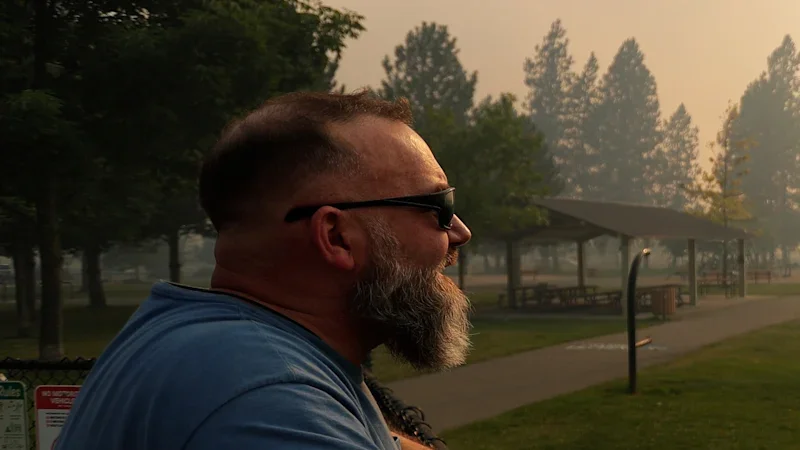
Wildfires burning across more than a quarter of a million acres in Washington state have prompted widespread evacuations and power outages in and around the city of Spokane, state officials say.
About 4000 people were fighting more than a dozen fires throughout the state, Dave Upthegrove, the state’s commissioner of public lands, said during a virtual press conference on Sunday AEST.
Earlier, Governor Bob Ferguson declared a statewide emergency and burn ban amid unusually high temperatures and strong winds, while the US National Weather Service issued an unprecedented “particularly dangerous situation” red-flag alert for the east of the state.
No injuries or fatalities related to the fires were known at this point, officials said.
The Old Trails Fire, a fast-moving wildfire driven by the strong winds and high temperatures, swept across north-west Spokane before jumping the Spokane River, prompting the evacuation of thousands of people.
Spokane, home to about 230,000 residents in eastern Washington, is dealing with the Old Trails Fire, which State Forester George Geissler said was active on 3,000 acres (12 square kilometres) and threatened 4000 structures.
Some major facilities in the city have been evacuated, Mayor Lisa Brown said, including water reclamation facilities, a waste-energy plant and the Department of Veterans Affairs hospital.
As of 3.30pm US time (7.30am Sunday, AEST), about 200 homes in Spokane had been evacuated, but officials expected that figure to change.
“These are large areas of the city, so I assume it’s going to be more than that,” Brown said.
Utilities company Avista, which services eastern Washington, reported that 60,000 people were without power, according to Stacey McClain of the Washington State Emergency Management Division.
“Our state is facing a very serious situation with multiple fires,” Ferguson said, noting that high winds and high temperatures throughout the weekend would make fighting the fires more challenging.
For the summer so far, about 450,000 acres have burned in Washington state, Upthegrove said. “This is not normal. Throughout the state of Washington, we’re seeing fires raging”, he said.
The fire in Spokane is one of five “major complex fires” in the state, Geissler said. The biggest, the Kaiser Canyon Fire in the north-eastern part of the state, is approximately 134,000 acres, he said.
Wildfires this summer have been a problem in other parts of the Pacific Northwest.
Nearly 34,000 lightning strikes last month led to a series of fires and evacuation orders in the southern part of British Columbia.
A red flag alert was also issued for eastern Oregon, where crews battled several large fires, including the Rowe Creek Complex blaze, which has grown to 1269 square kilometres with 57 per cent containment.
In addition to the National Guard, firefighters from more than a dozen states are helping, Washington officials said during the news conference.
“It’s a tragedy what we’re seeing over there,” said Major General Gent Welsh, adjutant general of the Washington National Guard.
“When the sun rises in the morning, I think we’re going to be in shock to see some of the scenes that emerged out there”.
The Washington fire alerts came as a heatwave gripped large swaths of the Western United States, with temperatures hovering near record highs, heightening wildfire risks and prompting warnings for people to stay inside.
By late afternoon on Saturday, Las Vegas reached 46 degrees, just one degree off the daily record, while Phoenix was expected to reach 47 degrees and El Centro, California, was predicted to hit a record 48 degrees.
The high in Las Vegas was 10 degrees above normal, and meteorologists warned of dangerous heat on Sunday, with a high of 45 degrees, according to weather service meteorologist Morgan Stessman.
High overnight temperatures would make the situation especially dangerous because they prevent people’s bodies from recovering. “There’s just no relief,” Stessman said.
Last month could be the warmest month on record across the mainland United States, the Washington Post reported on Friday.
Pending final data, national temperatures for July, which have been about 2.5 degrees above average across the contiguous states, are on track to break the previous record set in July 2012.
July 2026 is also on track to become the warmest for overnight temperatures and the highest for humidity on record, while daytime high temperatures have been the third highest.
Climate change driving new extremes
Scientists say the burning of coal, oil, and natural gas is causing larger, more intense, and longer-lasting heat waves driven by climate change, which lead to more intense droughts and contribute to larger, more destructive wildfires.
This year’s weather is also expected to be affected by an El Nino phenomenon, where the Pacific Ocean near the equator naturally warms, altering weather patterns and spiking global temperatures.
The current El Niño is expected to rank among the most intense since the weather service began tracking in 1950, experts say. It has already broken records for intensity at its early stages, United Nations officials said on Friday.
AP