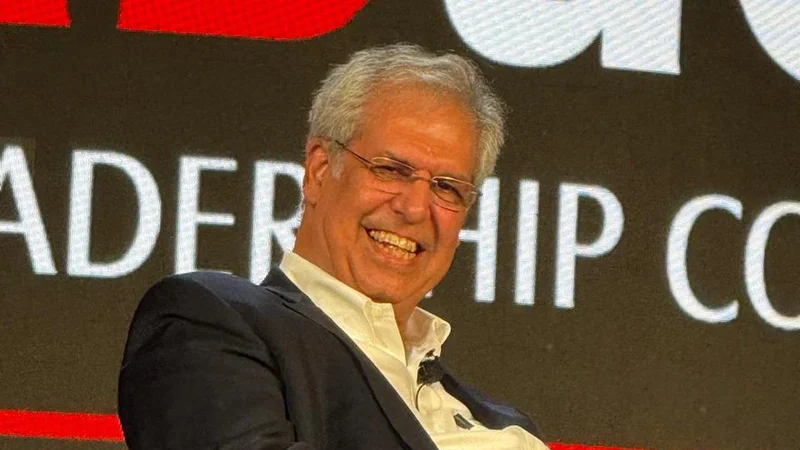
“Tata Trusts, the philanthropic arm of the Tata Group, has decided to move beyond its traditional role of supporting non-governmental organisations and development programs to create institutions capable of serving future generations,” said Noel Tata, Chairman of Tata Trusts, in Bengaluru on Sunday, (August 2, 2026).
Participating in a fireside chat at IIMBue 2026, an annual conclave hosted by old students of the Indian Institute of Management-Bangalore, Mr. Tata outlined the future direction of Tata Trusts, emphasising institution-building over project-based philanthropy and reaffirming a philosophy that has shaped the Tata Group for more than a century.
“He also unveiled a new roadmap for one of India’s largest philanthropic organisations, signalling a strategic shift toward building enduring institutions in healthcare and education, while calling for greater accountability in philanthropy.”
“The founders left their shares in the companies to the Trusts with one message: do good for India. They never said to become the biggest company. The companies exist to serve India and improve the quality of life,” Mr. Tata emphasised.
The new strategy revives a legacy that produced some of India’s most respected public institutions, including the Indian Institute of Science, Tata Institute of Fundamental Research and Tata Memorial Hospital.
According to Mr. Tata, as part of this renewed focus, Tata Trusts will establish 40 to 50 not-for-profit general hospitals across the country. The proposed hospitals will operate on a cross-subsidy model, where premium-paying patients help finance treatment for economically weaker sections without compromising the quality of doctors, medicines, or healthcare infrastructure.
Mr. Tata stated that education would be another major area of investment, describing the proposed undergraduate institution being developed in partnership with IIM Bangalore as an important beginning. He argued that India urgently needs many more world-class higher education institutions and expressed concern that thousands of talented Indian students continue to leave the country each year due to the limited availability of quality institutions.
“There is no reason why India cannot build enough quality institutions so students can study in India instead of leaving simply because there are too few seats,” he stated.
He also advocated reforms that would encourage greater private investment in higher education, arguing that existing restrictions on for-profit educational institutions have discouraged long-term capital from entering the sector.
Pointing to the large number of Indian-origin professors teaching at globally renowned universities, including Harvard University, Mr. Tata observed that India’s challenge was not the availability of academic talent but the lack of sufficient institutional infrastructure capable of attracting and retaining it.
Beyond expanding healthcare and education, he stressed that philanthropy itself must become more accountable. Charitable organisations should move beyond broad claims of impact and instead demonstrate measurable outcomes, he argued.
“When someone says we have touched thousands of lives, my question is: what does ‘touched’ actually mean? We need measurable outcomes. We need to know what difference our spending has actually made,’’ he elaborated.
Mr. Tata observed that India’s philanthropic landscape was itself transforming, with a growing number of entrepreneurs committing substantial personal wealth to social causes. “Every day I come across people who want to give back to society. It is inspiring and it also puts pressure on older institutions like ours to become more effective and accountable,” he shared.
Reflecting on the Tata Group’s own history, he further said many of its iconic businesses were created not merely as commercial ventures but to address national developmental priorities. For instance, Tata Motors evolved from manufacturing locomotives after recognising India’s need for commercial vehicles, and Tata Power pioneered electricity generation at a time when industries largely depended on steam power.
Recalling the philosophy of former Tata Group chairman, Jehangir Ratanji Dadabhoy Tata, he summarised the group’s enduring approach in a single line: “Do what India needs.”
“Drawing lessons from his own corporate journey, Mr. Tata recounted the creation of Trent Limited following the Tata Group’s exit from the Lakme cosmetics business in the late 1990s. The decision to build the retail company around private-label brands, despite years of criticism over slower growth, reinforced his conviction that organisations should prioritise excellence over scale.”
“My philosophy has always been to be the best in everything you do. If you become the best, size follows. Trying to become the biggest without first becoming the best can end in disaster,” Mr. Tata cautioned.
With its renewed emphasis on institution building, affordable healthcare, quality education and measurable social impact, his address of a packed audience of IIM-B old students outlined an ambitious blueprint for the next phase of Tata Trusts.
Calling his transition from corporate leadership to philanthropy a profound shift in purpose, he said, “You stop trying to make money and start trying to spend it.” Working in the social sector exposed one to the magnitude of challenges faced by ordinary citizens and the responsibility of ensuring that every rupee spent created meaningful and lasting impact, he commented.
Published - August 02, 2026 06:38 pm IST