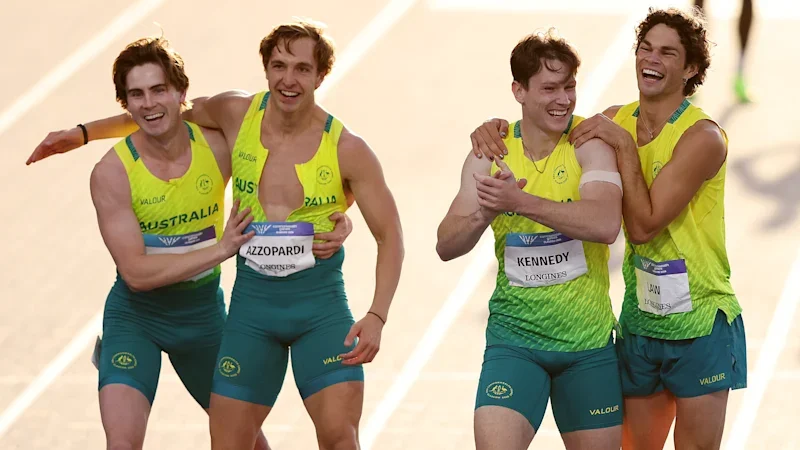
Glasgow: The 2026 Commonwealth Games were the return of the track for Australian athletics.
The track is back.
Australia has long had strong athletics teams, especially at Commonwealth level, but aside from Sally Pearson they have often been carried by technical events, such as the jumpers, the throwers and the road racers (marathons and the walks).
In Glasgow, the new generation of track runners, from sprints to middle and long distance, owned the track.
The measure is not in a boastful medal tally. Australia have won more athletics medals at a Commonwealth Games before, in Melbourne ’06, Gold Coast ’18 and Perth in 1962. Australia have won more athletics gold medals at Games before, too – Glasgow is only equal sixth for Commonwealth golds by Australia.
The key takeaway in Glasgow is that we have been forecasting for the past two years the emergence of a golden age of athletics, headlined by Gout Gout, and this was the first big athletics competition where we have seen breakout performances from that next generation. And that was without that headline act of Gout.
The Commonwealth Games always are put in the perspective of who is not here – the Americans obviously, and the Europeans. And further, some athletes who could have been here competing for their country chose instead to compete in Europe. So there is a caveat on the quality in some events. But not in others.
Torrie Lewis, Lachlan Kennedy, Cam Myers and Rose Davies all delivered performances that made the world take notice.
Kennedy’s run of 9.85 seconds for silver in the 100 metres, was not just another sub-10 run, but a sub-9.9s run that turned heads in the US. It puts him in the conversation now at any aths meet around the world. At the world championships next year and the LA Olympics in 2028, he is now a serious medal chance.
Likewise, Lewis running sub-11 seconds in the 100m, particularly coming off a terrible lead-in with shocking Achilles trouble, puts her on the same path as Kennedy. She can legitimately lay claim to the podium in any 100m event around the world.
Australia have sprint relay teams that the world is worried about now.
Myers was the same. Sprinters always hold slightly more allure, but Myers could end his career as one of Australia’s all-time greats. He ran a bad race in the mile and won silver – behind the man who just broke the world record in the distance and who was running in front of a home crowd. For a 20-year-old, that was a run of maturity beyond his years.
The women’s team clean sweeping the podium for the mile was not just flat-track bullies monstering weak opposition. All three medallists – Abbey Caldwell, Jess Hull and Claudia Hollingsworth – did it against runners from the African nations that have dominated middle-distance running.
There is no doubt this was a fast track in Glasgow. Kennedy spoke of a fast track being like the difference between running on grass versus sand, it just pushes you forward. So maybe some times were quicker than normal, but you also have to set that against the fact it was bloody cold. The nights were only about 10 degrees celsius at the track, often with rain or mizzle and cold winds. The weather was not conducive to fast running, even if the track was.
“It was incredible. We started off with a fantastic opening two nights and finished with our best day at the Commonwealth Games ever, with 17 medals and seven gold, and 34 medals overall,” Australia’s head coach Andrew Faichney said.
“We now have athletes performing incredible feats. Rose’s double [10,000m and 5000m] was sensational. And 9.85 and under 11 seconds, you know Lachie and Torrie were just amazing, and so young, and made that next step up.
“And we’ll see that go on for the next period through to LA [Olympics in 2028] and Brisbane in 2032. They’ll be hometown heroes just ready to have an amazing Games, but between now and then there’s a lot of Championships where they’re going to have some great successes.
“All the way through we had performances that would have achieved similar outcomes had they been at a world championships, and I think that that was the most wonderful thing. And yes, the track was fast, but the conditions weren’t perfect, and there was a lot of wind, and you’ve got to compete in the wind against everyone else. And that’s important for us going into next year, going to LA and going into our own Olympics in six years’ time.”
Get around our Commonwealth Games coverage
- As it happened: The last day of competition in Glasgow
- Diamonds disaster: Australia’s historic netball loss to Jamaica
- Michael Gleeson: Glasgow may have saved the Commonwealth Games, but it made a crucial mistake
- Three venues in five hours: How the royals spent a day at the Commonwealth Games