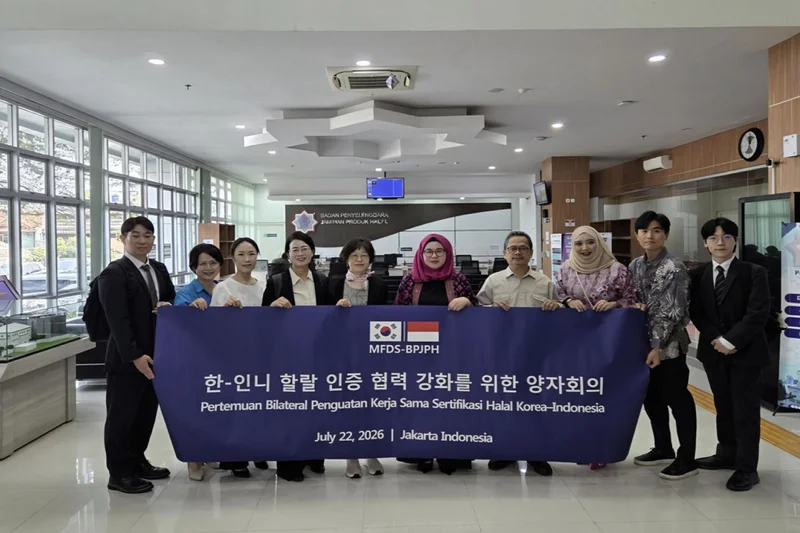
Korea’s booming cosmetics industry scored a crucial regulatory victory in Southeast Asia on Monday after a Korean delegation successfully negotiated a series of concessions to ease strict halal certification rules in Indonesia.
Following high-level bilateral talks in Jakarta, Korea’s Ministry of Food and Drug Safety announced a landmark agreement that slashes administrative red tape just months before Indonesia’s mandatory halal labeling law takes effect on Oct. 18.
Indonesia, home to the world’s largest Muslim population, represents a cornerstone market for Korean beauty exports. However, impending mandates requiring all cosmetics sold domestically to bear official halal certification threatened to stall K-beauty momentum due to stringent labor and facility requirements.
In response, a joint public-private delegation led by Korean regulators met with Indonesia’s Halal Product Assurance Organizing Agency (BPJPH) and the Indonesian Food and Drug Authority (BPOM) from July 20-22. The negotiations yielded immediate breakthroughs designed to keep supply chains moving smoothly.
Under the new terms, Indonesian authorities agreed to accept non-Muslim personnel as certified "halal supervisors," provided they complete approved training courses — resolving a major hurdle for Korean certification bodies operating in non-Muslim-majority environments. Additionally, BPJPH agreed to eliminate duplicate, on-site factory inspections for cosmetics manufacturers. If a Korean manufacturing facility has already earned halal certification for one brand, other brands contracting work at the same facility will no longer face redundant inspections, drastically reducing costs and lead times.
Meanwhile, BPOM committed to easing the transition for products already clearing customs and hitting store shelves before the October deadline by pushing to extend the grace period for existing inventory. Indonesian regulators also established clear guidelines allowing Korean companies to bring in up to 20 cosmetic samples per individual for market research and R&D without burdensome customs holdups.
"The government taking the lead to represent industry grievances and secure concrete solutions provides immediate, tangible relief for companies expanding into Indonesia," said Suh Kyung-bae, chairman of the Korea Cosmetic Association and CEO of AmorePacific.
To maintain momentum, both countries established a direct regulatory hotline and a joint working group. Beyond cosmetics, the ministry said Seoul plans to leverage this momentum to expand regulatory cooperation into pharmaceutical approvals, ensuring Korea's beauty and health sectors continue their seamless expansion across Southeast Asia.
This article was published with the assistance of generative AI and edited by The Korea Times.