I don’t recall Glenn A. Baker ever using my Christian name. I was always Little Deuce – a reference to the Beach Boys song Little Deuce Coupe.
Nearly everything in Baker’s life was framed by the world of music, for which he had an encyclopaedic knowledge, reinforced globally after winning the BBC’s Rock Brain Of The Universe award not once but three times in the 1980s.
Baker, who passed away on July 31 after a lengthy period of ill health was, alongside Ian “Molly” Meldrum, the recognised face and voice of gushing, exuberant commentary on popular music. And in Baker’s case, the knowledge was obsessively factual.
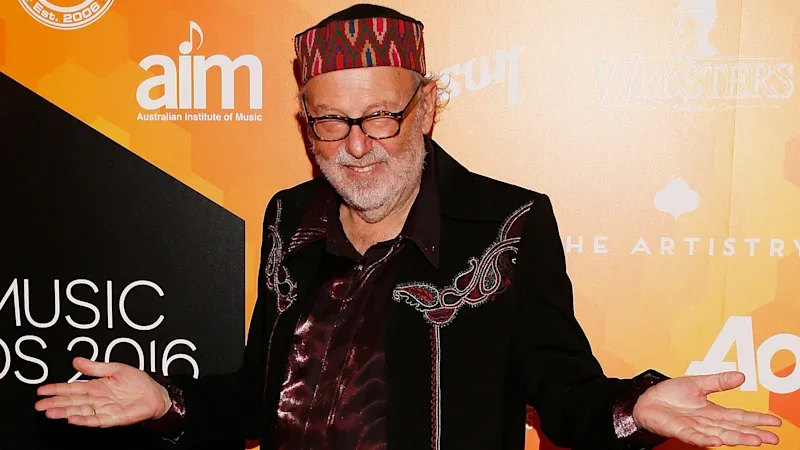
And recognisable he was. As his hair thinned, he took to wearing a variety of colourful fezzes – Ottman-era Turkish headwear. Baker enjoyed being recognised. He loved being “Glenn A. Baker”.
Aside from his astonishing knowledge, he gained that fame by being constantly accessible, always available to both media and people who stopped him in the street or at concerts.
If there was an event of any significance that required commentary on radio or television, the first thought was “call Glenn A. Baker”. And he responded with extremely erudite, passionate observations, usually framed by his own encounters with the individual in question.
He was loud, could talk the legs off several chairs without drawing breath and would frequently have whatever audience he was commanding drawing breath in awe as he pulled fact after fact on a multiplicity of subjects with apparent ease. It was a case of “doesn’t everyone know who the producer’s assistant was on the B side of the third Pink Floyd single which – by the way was released on ...”
Although Baker was phenomenally articulate and informed, he was first and foremost a music fan. He’d met everyone who could be met (“I remember Sting told me ... when I was with the Stones ... I laughed about that with Elton ...“), often delivering them arcane facts about their careers that they’d either forgotten or, in some instances, didn’t wish to be reminded about – “remember that song you recorded in 1965 and the B side was a duet with ... well, I have a copy and would you sign it”.
Baker wouldn’t just front up with one copy or a photo to be signed – he’d often arrive at an interview, press conference or backstage with the artist’s entire catalogue ready for signatures. He wasn’t doing it for resale. He wanted everything signed to him personally. He was the ultimate fan.
One of his proudest moments was when Bob Dylan asked to meet him backstage before a Sydney concert in 1986. It was a story he told repeatedly with the sense that this was a high watermark in the recognition of who he was and what he had achieved – but he went on to do so much more.
In many ways music was Baker’s salvation, his escape from a less-than-idyllic childhood. Born at the Royal Women’s Hospital in Paddington on July 28, 1952, he was named after the actor Glenn Ford and the band leader Glenn Miller. He was eight before he learnt the name of his biological father.
His mother, Joyce Dadd, took the young Glenn to Lithgow for the first year of his life before marrying John Brian Baker, who legally adopted the young child. The oldest of four children, Baker spent his early years in the beachside Sydney suburb of Coogee before the family moved to Canberra when he was nine. His younger brother, Johnny, drowned during this period and his parents separated soon after.
In his unpublished memoir, Baker recalls his mother peeling potatoes and singing along to Perry Como’s Catch A Falling Star. She would sing him songs like the Everly Brothers’ Lighting Express to put him to sleep.
After the separation, the family moved many times; Baker attended 12 schools in 10 years. His life revolved around a Malvern Star bicycle (without gears) and a tiny Japanese-made transistor radio which seemed permanently attached to his ears.
In 1965, he heard Dylan’s Like A Rolling Stone and his world changed.
“It was at this moment that I fell truly in love with words and realised, perhaps unconsciously, that language would play a significant role in what I would do with my life,” he wrote.
With it came an obsession with artists such as the Beatles, the Hollies and the Easybeats.
Leaving school at the legal age of 15, Baker became a junior postal officer, but his ever-increasing love was pop and rock music, and it was a passion he wanted to share with anyone who would listen.
He had a phenomenal memory and attention to detail and used that to write and talk – oh boy, could he talk! – about these passions.
From the 1970s, Baker was working in the public service and, when time permitted, honing his skills as a music journalist. He bought as many records and music memorabilia as he could afford.
Whilst working at the ADP (Automatic Data Processing) computer centre in North Sydney, Baker met fellow staff member Lorelle Sumner, and after a brief courtship, the two 20-year-olds were married. A son – Orson – was born in 1976 and would be followed by Rudi, Tristan, Rohan, Reilly and daughter Cairo.
Whenever Baker and singer Sting met he would make a point of reminding Gordon Sumner (Sting’s real name) that he shared a surname with his wife.
After a flirtation with the Jehovah’s Witnesses, Baker embraced the Mormon faith for 40 years and for this reason never smoked, drank or took drugs.
The music enthusiast began putting on concerts by folk artists at the Parramatta Chapel of the Mormon Church featuring the likes of Richard Clapton, Judy Bailey, Dick Hughes and Mike McClellan.
Baker wrote – and wrote. Despite not studying at the universities, he submitted reviews and articles to their publications Tharunka and Honi Soit.
Ear For Music published a long piece by Baker on American singer/songwriter Laura Nyro. This was edited by Anthony O’Grady, who went on to become the editor of RAM (Rock Australia Magazine), another publication Baker later wrote for.
In fact, Baker wrote for anyone who would publish his work. And there was no shortage of outlets – Baker wrote beautifully and passionately. This was the start of a journalism career in which literally millions of his words were published in what he estimated to be more than 200 publications. He wrote or co-authored 16 books including The New Music and The New Rock’n’Roll with me.
Baker, while working for the Department of Media, was involved in a research project that contributed to the formation of Double J radio, where he later became a broadcaster. This was the start of a long radio career with numerous stations and networks and later many television appearances.
Baker became Australian editor of American magazine Billboard in the early ’80s and held that position for more than two decades. Here his primary focus was to champion Australian talent to the world. He wrote and broadcast constantly about Australian bands and their music and history at a time when some people in this country weren’t overly supportive of their homegrown talent.
For decades, Baker beat that drum, loudly and constantly for Australian music. Apart from star performers, Baker, along with Ian Meldrum and Michael Gudinski, were first of mind when Australian music was mentioned on a global stage.
But writing and broadcasting wasn’t enough for the hyperactive, always-in-motion Baker, who was constantly on the lookout for new and challenging projects. In the 1970s, he encountered a 1950s-orientated band called Fanis and persuaded them to change their name to Ol’ 55 and take him on as manager. Ol ’55 became one of the most successful Australian bands of the mid-to-late 1970s. He also managed Punkz (later to become Cheek), which enjoyed some pop-chart success.
From the 1980s onwards, Baker was a juggernaut of productivity. As well as his music writing, he became an accomplished and award-winning travel writer and visited more than 130 countries. He wrote for various publications, assembling those pieces into one of 16 books which included tomes on the Beatles tour of Australia in 1964, his long-standing obsession with The Monkees and a number of rock’n’roll trivia publications. There was a rock trivia board game bearing his name.
In the 1980s, with some associates, Baker opened a record shop – Glenn A. Baker’s Timewarp – in Sydney’s CBD. With two friends, he also started the record label Raven which was devoted to reissuing classic recordings by local and international artists. The label would release many hundreds of recordings on vinyl records and CDs, all annotated with incredible detail, frequently written by Baker.
He would also compile and write sleeve notes for what he estimated to be more than 600 compilation albums for major record labels – plus spend three decades presenting an Inflight channel for Qantas. Baker also escorted travel groups to music-orientated locations such as Liverpool for the Beatles-obsessed. He also wrote for the Herald and The Age many times including obituaries for Australian music identities, his last being Midnight Oil drummer Rob Hirst.
The Glenn A. Baker Archives – more than 80,000 items from vinyls to CDs, magazines, books and posters – were in constant demand for photos and recordings. If there was a piece of music memorabilia within grabbing distance, you could be assured that Baker would try to add it to his collection.
Eventually, as his health declined, the archives became unmanageable and were sold in 2024 for more than $300,000.
Baker was made a Member of the Order of Australia in 2018 for services to the music and entertainment industries.
In 2014, he and Lorelle divorced. Baker later had triple by-pass heart surgery following a heart attack but recovered well. His health declined rapidly in recent years following a stroke in 2017.
Baker is survived by Lorelle, his six children, 13 grandchildren and long-term partner Julie Newbould.
Stuart Coupe is a music journalist and author and Baker’s friend.