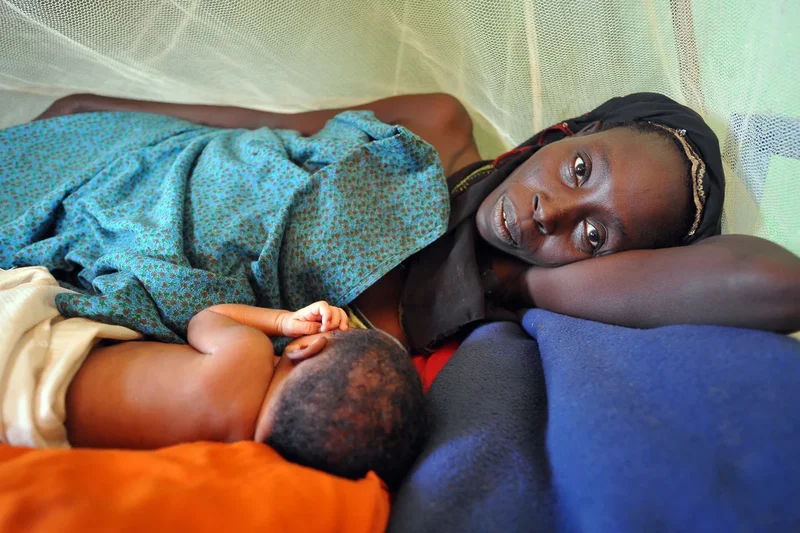
More than one in five pregnant and breastfeeding women in eastern Chad have been found to be acutely malnourished, with severe funding shortages impacting access to food and healthcare.
More than 20 per cent of the women screened in the border town of Adré during the first six months of the year were suffering from moderate or severe acute malnutrition, Médecins Sans Frontières (MSF) said.
That is above the threshold used to define a critical humanitarian emergency, and the crisis is being worsened by a lack of support for host communities due to rules that restrict access to registered refugees.
Since the war in neighbouring Sudan began, almost a million refugees have crossed into Chad, most of them women and children and more than 700,000 crossed through Adré.
Analysts have warned that the past two months have seen Chad increasingly drawn into Sudan’s civil war, with tensions rising in areas with scarce resources. Massive displacement, intercommunal tensions and cross-border violence are all pushing an already fragile region into deeper instability, according to the International Crisis Group.
Three-quarters of malnourished women belong to host communities, often excluded from aid programmes despite sharing already limited resources with arriving refugees.
“Having survived months of relentless violence, refugees arrive in Adré physically shattered, malnourished and deeply traumatised,” said Léa Ledru, MSF Project Coordinator in Adré. “[They are] met with a brutal new reality, finding themselves in areas where host communities are already living in poverty and humanitarian actors remain scarce.”
Malnutrition among pregnant women drastically increases the risk of miscarriage, obstetric haemorrhage and premature birth.
Child malnutrition admissions at an MSF health centre in Adré also rose by 30 per cent.
It comes amid global aid funding shortfalls, with pipelines to treat acute malnutrition severely strained. Food aid is projected to run out in September.
Global aid fell by 23 per cent in 2025 compared to 2024, and is projected to drop by a further 5.8 per cent in 2026. Women and children have been disproportionately affected.
The US was the world’s largest donor, but President Donald Trump slashed foreign assistance programmes by 57 per cent last year, with the UK and Europe also reducing aid.
Hard-won successes in efforts to stop women and babies dying in childbirth have faced a serious setback as a result, reversing the trend in some countries.
It is particularly acute in parts of Africa as exposed in __ Hard Labour__, a documentary by Bel Trew for Independent TV. The documentary lays out how efforts to stop women and babies dying in childbirth have been blunted in the Central African Republic and Nigeria, with aid cuts playing a significant role.
On Friday, the World Health Organisation called on countries to strengthen breastfeeding support and health systems ahead of World Breastfeeding Week next week.
Breastfeeding has significant health benefits for women and their babies, the WHO said, but support is disrupted in low-income countries and fragile humanitarian settings.
To mark the release of Hard Labour, The Independent is shining a light on the lifesaving work of the United Nations Population Fund (UNFPA) to raise awareness of the urgent maternal health needs of millions of women around the world. You can help save the life of a mother and baby by donating £8 for an emergency birth kit.
This article has been produced as part of The Independent’s Rethinking Global Aid project