Kids were banned from social media. Now their teachers can’t get enough of it
Save
You have reached your maximum number of saved items.
Remove items from your saved list to add more.
AAA
A NSW public school principal rises from his desk, wiggles his hips, shimmies his shoulders, spins towards the camera and strikes a pose. The dancing video, shared on the NSW Department of Education Instagram account, has racked up almost 300,000 views.
In another video, from a different primary school, students line up behind a teacher and say hello, holding whiteboards with their names as the teacher guesses their identity from their voice.
At an independent primary school in south-western Sydney, a teacher arrives at his classroom at 6am. He grabs a wad of Blu-Tack and sticks his phone on the whiteboard. He then taps record. His satirical skit poking fun at complaining parents will be viewed by thousands.
Across the country, teachers are arriving early and staying back late to film videos of themselves, their classrooms and sometimes their students.
While social media may be banned for Australian children, the Herald has observed a sharp increase in schools, particularly public schools, creating Instagram accounts. Simultaneously, individual teachers are turning to social media to share teaching resources, outfits, classroom decorations and satire.
“It is the best promotion,” said one Sydney public school principal, who spoke anonymously due to the department’s strict media policies. “If your school is not on social media, it is almost as if you are losing one of the most effective ways to communicate with parents,” they said. “I can run 20 open days but sometimes a few posts on social media will have bigger impact.”
Classrooms across the nation have become the backdrop for teachers’ social media content. So prolific has the trend become that some teachers are leaving education altogether to pursue full-time social media jobs.
Emily Kristopher from Queensland taught for 12 years before transitioning into full-time comedy and social media after her teacher parody videos went viral. One skit, “POV: getting robbed, but you’re a teacher”, has been viewed 25.5 million times.
“I think it’s really cathartic for fellow teachers. I just feel so supported,” Kristopher said, adding that her videos are frequently circulated in staff rooms. Eventually, her brand deals surpassed her teaching income.
“I think I just hit my cap on my patience. I do miss the kids. I don’t miss the workload or the mental load,” she said.
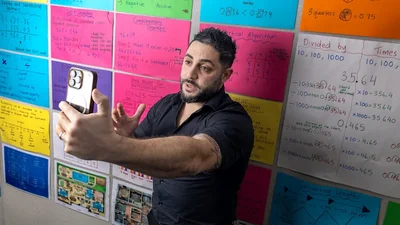
Ravi, known online as completeteacher, arrives at school at 6am to film content before lessons start.Sitthixay Ditthavong
Others squeeze content creation in between their regular full-time jobs. The south-west Sydney primary school teacher known online as completeteacher, or The Complete Teacher, shot to fame after he snapped a video of himself telling his students to “never, ever use the words bro or cuz”. He arrives at school at 6am to film, using his platform to highlight “genuine issues in education and teacher struggles, but presented in a satirical way”.
“It has become an outlet for me, it helps me manage the stress of teaching, and it allows other teachers to relate to it,” The Complete Teacher said.
This viral video – filmed during class time – was a rare divergence for the teacher, who goes to great lengths to keep students out of the frame.
“I’ve seen teachers post content with students in the videos, and I am personally very against that. You should never use a child for content,” he said.
His stance highlights a growing debate over child privacy. Recently, Brigidine College in Brisbane made headlines after deciding it would no longer share recognisable images of students online without informed consent. Earlier this year, the Australian Federal Police cautioned parents against sharing images of children in school uniform.
“It is an unfortunate reality that innocently posted pictures have been taken, shared and altered by those who have less-than-innocent intentions,” Commander Helen Schneider warned.
Yet, in many NSW public schools, the pendulum has swung the other way. Many public school social accounts feature students and staff taking part in viral trends, such as “day in the life of” videos, as well as sharing their work.
Managing this flood of digital content takes resources. Some schools have begun hiring social media managers. When the Herald visited Lindfield College on Sydney’s north shore in March, the school’s social media manager tailed our interviews, filming content of the visit. Other schools rely on staff.
“Some schools do have more human resources dedicated to it than others, whereas other schools it’s principals at 11pm going crazy on Canva,” the anonymous principal said.
Oatley West Public School recently acknowledged this toll in a tongue-in-cheek video showing a teacher with her feet on the desk and a Post-it note on her shoe reading, “Not on my phone - editing reels.” The caption read, “The reality of teaching and taking care of social media too! ;)”
The Herald asked the Department of Education how teachers balance content creation with daily teaching requirements. Department Deputy Secretary Deborah Summerhayes said, “NSW public schools have used social media to keep parents informed and engaged with enrolments, events and student achievements for over a decade.”
According to department policy, schools must follow “strict parental consent protocols for publishing student images”.
Still, the content has high-level backing. Department of Education Secretary Murat Dizdar frequently partakes in trending videos on his official account.
The nature of the content varies. “It all depends on your demographic,” said the anonymous principal. “I know principals in western Sydney where there is a different vibe to their social media accounts, but on the north shore it is quite polished. It’s academic. It’s pretty serious. It’s not really light-hearted.”
The trend has sparked political scrutiny. In budget estimates earlier this year, Education Minister Prue Car was pressed by deputy Liberal leader Natalie Ward whether the department had conducted a risk assessment on the impact of filming content in classrooms, on teacher workload and student learning outcomes, and whether content creation or brand ambassadorship was now considered an informal part of a teacher’s role.
Car dismissed the questioning, saying, “I’ve spoken to thousands of teachers, and they really want to celebrate what is happening in their classrooms.”
For regional NSW kindergarten teacher Bronte Marshall, social media has been a way to share the tips and tricks she didn’t learn in university. While she loves teaching, she admits social media offers an enticing fallback. “If there ever comes a day when I’m not feeling fulfilled in the classroom space, I would definitely love to take that social media side further,” she said.
Start the day with a summary of the day’s most important and interesting stories, analysis and insights. Sign up for our Morning Edition newsletter.
Save
You have reached your maximum number of saved items.
Remove items from your saved list to add more.
Emily Kowal is a Walkley award-winning education reporter for The Sydney Morning Herald.Connect via email.