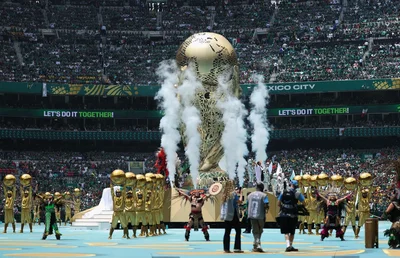
MEXICO CITY, MEXICO - JUNE 11: Performers dance during the Opening Ceremony before the FIFA World Cup 2026 Group A match between Mexico and South Africa at Mexico City Stadium on June 11, 2026 in Mexico City, Mexico. (Photo by MB Media/Getty Images)
Getty Images
The World Cup is (sadly) over, but it will generate a lingering impact on a host of media-related businesses, not just in the U.S. but globally.
The breadth of the cultural, business and political impacts hit home as I attended the World Cup “Playmakers” event sponsored by NBCUniversal and Telemundo (in the hallowed Studio 8H of course), which broadcast the Spanish-language version of the World Cup on Telemundo and streamed it on Peacock. It’s not just for sports fanatics. Few of us can hope to identify an offside before it gets called, but we all saw and felt the passion of the World Cup and its extensive cultural tendrils in the last month.
Music and Fashion
Global football purists may have hated some of it, but the link between the World Cup and music is here to stay. The final and its elongated half-time show brought together stars from the world’s four corners: Madonna, Burna Boy, Shakira, BTS, Justin Bieber, Post Malone, Robbie Williams, Nicole Scherzinger and Gustavo Dudamel. That pretty well covers the waterfront of musical eclecticism. In a world where live events of all kinds are at the center of the media business, expect a whole lot more live music at World Cup venues next time around.
The NBCU-Telemundo event noted the powerful link between the influence of Latin America in global football and in music. That forum did highlight a missed opportunity for the World Cup in Karol G, an infectious Colombian singer who sells out stadiums around the world and whose top Spotify streams are closing in on 2 billion. Karol G was the first ever Latina to headline at Coachella and has previously collaborated with the Barcelona club on their jersey’s which featured her own Bichota logo (standing for strong, powerful women – it fits).
Speaking of fashion, Gabriela Heart joined the NBCU-Telemundo conversation to highlight her collaboration with her home country of Uruguay. Hearst has established a global brand known for using sustainable, “noble” materials to supply “luxury with a conscience.” Uruguay proudly hosted the very first World Cup in 1930 and this year hired Hearst to design its “off-pitch” (off the field) outfits. The Uruguayan looks resonated with the country’s history and culture.
Of course, well beyond Uruguay, the “kits” (ok, uniforms) of so many World Cup countries have become ubiquitous across social media in the last month, from Argentina’s iconic baby-blue stripes to the checkerboard of Croatia to the collared jerseys of “Les Bleus” of France. And you can expect to see a flood of genuine and copycat “boots” (sneakers) like the pink ones that adorned so many a player in the tournament.
Politics
Wasn’t it something to see the embrace in both red and blue states of people from so many different parts of the world? Who wasn’t taken with tiny African nation Cape Verde, which nearly beat Argentina and whose Syndey Lopes Cabral scored maybe the most spectacular goal of the tournament? Boston fell rapturously in love with Scotland’s Tartan Army, joining together in native customs like singing “Sweet Caroline” at Red Sox games.
At a time when the Latino community is grappling with the challenges of U.S. immigration policy, U.S. host communities like Kansas City and others enthusiastically adopted and embraced players and fans from Argentina, Spain, Colombia, Ecuador and Portugal. As Cesar Conde pointed out, the most-purchased jersey in the entire tournament belonged to Mexico.
No, I don’t think the World Cup is likely to move the needle on the U.S. mid-terms or the popularity of the new Prime Minister of the UK. But a bit of “we’re in this together” is a welcome salve in our perilous times, and when the next World Cup gets still bigger at 64 teams, the heterogeneity will only expand.
Sports
Ironically, the World Cup may have its smallest impact going forward on sport itself in the U.S.
Soccer/football already dominates across the world stage, but it will be hard to transfer the World Cup love on an ongoing basis to Major League Soccer in the U.S. It is still a growing operation, but unlikely to crack the four major sports in the U.S. of (American) football, basketball, baseball and hockey. The U.K.’s Premier League is already carried in the U.S., and some of the World Cup’s biggest stars don’t even play in that league, such as Lionel Messi, Kylian Mbappe and Harry Kane. The Cup probably didn’t do much to propel women’s sports which have a momentum of their own here in basketball and hockey in addition to soccer.
As the lovable (and British) commentators Roger Bennett and Michael Davies have noted, soccer is definitely the game of the future in the U.S. - just as it has been since 1972.