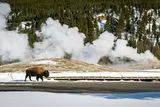
Yellowstone National Park has a dynamic landscape. It can be extremely hot due to the volcanic activity rumbling beneath the surface, but come wintertime, temperatures can drop well below zero.
Those cold snaps, however, do not cover the park in layers of ice as past glacial periods have. Glaciers have had major impacts on volcanic areas such as Iceland and the Chilean Andes in the past, suppressing volcanic activity beneath the surface and allowing pressure to build. When those glaciers melt, explosive volcanic eruptions can occur, according to a 2025 study in JGR Solid Earth.
As the glaciers receded from Yellowstone, did it see explosive volcanic eruptions as well? That’s something researchers with the United States Geological Survey (USGS) wanted to find out.
Read More: As Glaciers Retreat, Powerful Volcanoes May Erupt More Frequently Across the Planet
Determining Glaciation Periods in Yellowstone National Park
After analyzing deep-sea sediments and ancient ice cores, researchers identified periods of warming and cooling worldwide during the Quaternary Period — the last 2.6 million years, according to the USGS. By focusing on oxygen isotope ratios in shells or other hardened parts of marine organisms within those sediment cores, researchers found that glacial-interglacial cycles, sometimes known as Milankovitch cycles, have repeated every 100,000 years or so since the middle of the Quaternary.
Researchers then compared that data with cosmogenic isotope dating of boulders left behind by glaciers, determining that there had been two periods of glaciation in the Yellowstone area. The first and oldest was known as the Bull Lake glacial period, which ranged in Yellowstone from about 150,000 to 140,000 years ago, and the Pinedale glaciation period, which ranged from about 22,000 to about 14,000 years ago.
According to the USGS, it’s unclear if there was a glaciation before the Bull Lake period, as a lava flow may have buried the evidence.
Do the Yellowstone Glaciers Correlate with Past Volcanic Eruptions?
After establishing when glaciers covered Yellowstone, the team compared eruption ages with the timing of known glacial periods. According to the USGS, the Yellowstone Caldera formed about 631,000 years ago, and since then, there have been 28 rhyolite eruptions in the area, occurring in two distinct episodes.
The first episode, the Upper Basin Member, likely erupted between 580,000 and 250,000 years ago, while the second eruption, the Central Plateau Member, likely erupted about 160,000 to 70,000 years ago. More research is still needed to narrow down more precise dates, but according to the USGS, there doesn’t seem to be a correlation between receding glaciers and volcanic eruptions.
However, there is one piece of evidence that may suggest otherwise.
A Volcanic Conundrum
Though the USGS says that the timing of the Central Plateau Member rhyolite flow and the Bull Lake glaciation don’t seem to line up, geologist Robert L. Christiansen points to evidence at Madison Plateau.
“The West Yellowstone flow, at the north end of the Madison Plateau, is here interpreted as having been emplaced against a body of glacial ice that must have occupied much of the rhyolite plateau farther east when the flow was extruded,” Christiansen wrote in the book The Quaternary and Pliocene Yellowstone Plateau Volcanic Field of Wyoming, Idaho, and Montana.
This, according to the USGS, is a conundrum. The West Yellowstone flow dates to about 109,000 years ago, which is later than the end of the Bull Lake glaciation. This report suggests that the West Yellowstone flow is much more complex than previously thought. There are older flows present on the margin of the West Yellowstone flow, according to the USGS, and these likely interacted with ice, or perhaps an ice sheet was present during that eruption. More study is needed to understand this fully.
The findings do indicate no correlation between volcanic eruptions and the Pinedale glaciation in Yellowstone. However, radiometric and luminescence dating results show that after the thick ice cap retreated from the Yellowstone Plateau around 14,000 years ago, several large hydrothermal eruptions occurred. The hydrothermal eruptions took place at Mary Bay, Rush Lake, and Pocket Basin, among others, according to the USGS.
The removal of the ice may have reduced pressure on these hydrothermal systems, leading to a buildup of boiling groundwater and, in turn, eruptions. Dating suggests the eruptions all happened within 1,000 years after the ice age ended — though that doesn’t mean the ice was the cause. More research is still needed to determine this.
Read More: Global Thaw 10,000 Years Ago May Have Fueled Volcanoes and Sped Up Continental Drift
Article Sources
Our writers at Discovermagazine.com use peer-reviewed studies and high-quality sources for our articles, and our editors review for scientific accuracy and editorial standards. Review the sources used below for this article: