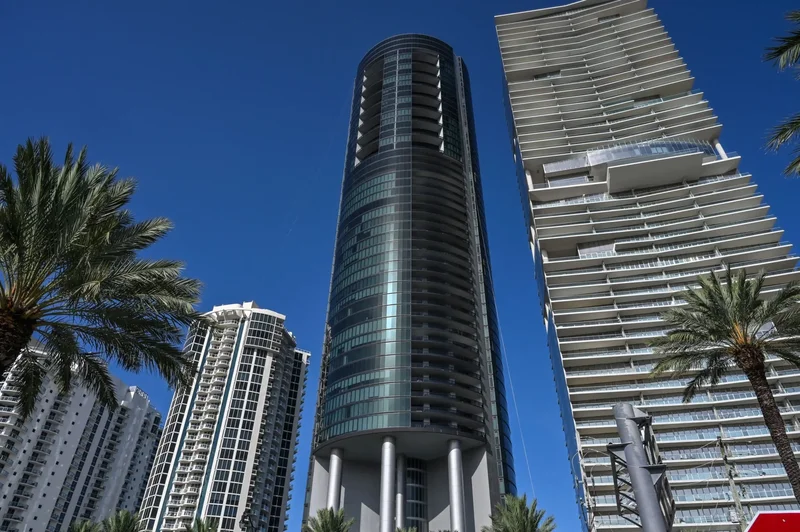
On the oceanfront stretch of Sunny Isles Beach, Florida, residents of the Porsche Design Tower don’t park their cars in a garage. Instead, the garage rides upstairs with them.
Residents pull their vehicles into a cylindrical glass elevator that lifts both the driver and the car more than 60 stories into the air. The elevator—or “Dezervator,” as the building’s developer, Gil Dezer, calls it—deposits the vehicle directly into a private sky garage attached to the apartment, where the car sits behind a glass wall like a display in an auto showroom, visible from the living room.
The 644-foot high-rise, whose 132 condos are priced as high as $47.5 million, was designed to embody the aesthetics of Porsche engineering: a sleek, metallic building whose curved glass balconies mirror the shape and aerodynamics of the iconic German sports car.
The Porsche Design Tower is part of a rapidly growing slice of the luxury real estate market, known as branded residences, apartment buildings designed in partnership with global luxury brands. It’s a strange development in modern real estate, where a new class of apartment buildings functions less like housing and more like 3D brand experiences.
“For brands, standalone residences provide an opportunity to expand geographically without the operational intensity of hotel development—and provide an additional revenue stream,” says Riyan Itani, founder of Global Branded Residences, in an interview.
From the sail-shaped Aston Martin Residences overlooking Biscayne Bay in Miami to Fendi-designed apartments in Dubai, high-end brands once associated with sports cars, couture, and fine jewelry are increasingly lending their names and their design to real estate.
Luxury brands increasingly see real estate as the next frontier of brand immersion, says Markus Schreyer, a branding expert at Vanderbilt University, in an interview. High-end labels are “no longer only selling fashion, watches, or cars; they are selling access to a community, aesthetics, service philosophy, and emotional experience,” Schreyer says. “In many ways, this is the evolution from ‘brand’ to ‘ecosystem.’”
Just a two-minute walk away from the Porsche Design Tower, developers are building the Bentley Residences, where condos also promise car elevators and diamond-pattern detailing inspired by the automaker’s quilted leather seats. In Dubai, the Armani Hotel translates Giorgio Armani’s minimalist fashion aesthetic into muted color palettes, leather-covered walls, and zebrawood panels.
Meanwhile, new Manhattan residences offered by Nobu, the upscale Japanese restaurant chain, come with spacious balconies, 16-foot ceilings, and woodblock art by modern master Takatoshi Kuronuma—but even if you buy one, you’ll still have to wait an hour for a table at the Nobu restaurant downstairs. Nobu also has developments in Abu Dhabi, Los Cabos, and Al Marjan Island, with more underway in Cairo and Tulum.
What began as a niche experiment in luxury real estate has become a fast-growing sector of the global real estate market—valued at about $67 billion, according to Sotheby’s International Realty. By the end of 2025, there were 1,907 combined active and pipeline branded residential developments worldwide, according to industry research firm Global Branded Residences. Upcoming projects include developers partnering with brands ranging from fashion labels like Elie Saab to automakers like Bugatti and Mercedes-Benz.
If those projects get built as planned, the supply of branded real estate could more than double over the next decade.
“Non-hospitality brands are gaining market share, and the branded residences sector in general shows no real signs of slowing down or weakness,” says Jason Payne, CEO and founder of The Branded Residences Hub, a consultancy company for the sector.
Hotel giants pioneered branded residences—now automakers and fashion houses are catching up
The branded residences industry began with hotels. For decades, luxury hotel companies such as Four Seasons and The Ritz-Carlton have sold apartments within their hotels, granting wealthy homeowners access to amenities such as housekeeping, concierge services, fine-dining restaurants, and spas. The concept largely appealed to high-net-worth individuals who valued hotel-level services alongside real estate ownership.
What’s new is the kind of brands now entering the market. Automakers, fashion houses, and jewelry brands increasingly see real estate as a way to expand their identity beyond products.
“A house is a very big emotional product that you buy in your life,” says Ziad El Chaar, CEO of Dar Global, a Dubai-based luxury real estate developer specializing in co-branded projects. “And if I am a brand, I want to own that feeling.”
For brands, the projects are a chance to embed themselves into customers’ everyday lives, not just occasionally. “When I sell you a Missoni or Pagani apartment, you are living in Pagani all of your life, and you will tell this to your friends. They will visit you, they will see the lifestyle of Pagani,” El Chaar says, adding that customers will feel an experience from the brand.
Behind the high-brow posturing, an entire ecosystem has emerged to connect developers with prestige brands. Historically, developers have approached luxury companies for such projects, but in the last five years, many partnerships have been brokered by consultants who pitch the idea of brand-extension residences to both developers and the sellers of marquis products.
But the push from developers alone doesn’t account for the sector’s boom. Social media has given the wealthy something the French monarchs at the Palace of Versailles never had—a real-time global audience of millions. Unlike a palace that impressed its visitors, a single post from a Bentley-branded penthouse can generate millions of likes and comments within minutes—because what’s the point of a $40 million condo if no one’s watching?
Social media turbocharges demand
In a short, minute-long video that has racked up nearly 50 million views, one resident of the Porsche Design Tower films himself pulling into the building’s car elevator in his very own white Porsche. He drives onto a circular platform, and the glass capsule closes around the car.
The caption on the video reads: “pulling into my $7M condo that has a car elevator to my living room.”
Within seconds, the elevator doors open directly into the apartment’s private garage, where another Porsche already sits. (One is hardly enough.)
Several other videos by that resident’s neighbors follow a similar pattern, showing the elevator ride, then leading to the big reveal: the “carport” that is, in fact, a glorious apartment overlooking the ocean.
“Before the early 2000s, we did not have any branded residences,” says El Chaar. “The phenomenon started in the 2000s. This period introduced us to social media, where our lives moved from being most of the time private to being public.” In the stone-age aughts, people did not have the propensity to boost their ego by owning stuff and boasting about their possessions online.
Influencer culture has only turbocharged the urge to flaunt. The most followed among them document the good life, including private jet travel, Loro Piana outfits, and homes featured in Architectural Digest. Research by Launchmetric shows that luxury influencer collaborations generate 81% higher engagement rates compared to brand-created content alone—and branded residences are basically luxury influencer content waiting to happen, benefiting both the brand and the resident.
Ultimately, a car parked in a living room is not just for convenience. It’s ripe for social media content.
Schreyer says branded residences represent a more subtle form of modern status signaling. “It is less about showing a logo and more about signaling access, taste, and lifestyle alignment. Living inside a branded environment communicates that the consumer identifies so strongly with a brand’s philosophy that they want it embedded into their everyday life.”
What separates successful branded residences from flops
Behind the extravaganza of branded towers lies a formula for success.
“Buyers are willing to pay and are paying the price premiums as long as all those elements are in place and the project authentically portrays what the brand is all about. But adding a logo alone will not guarantee faster sell-outs or price premiums,” Payne says.
Many successful brands entering the sector already have a hand in interior design collections or luxury furnishings. Fashion houses, like Fendi, design furniture lines, while automakers like Aston Martin and Pagani have collaborated on yacht and aviation interiors.
“When you select a brand that has nothing to do with interiors, has no DNA in real estate, people are not dumb,” El Chaar says. “They understand you have nothing to do with real estate.”
Demographics matter too.
“A buyer in their 30s is likely to be more attracted to a Lamborghini-branded home with modern architecture, cool interiors, and amenities like car lifts and bars, than someone in their 50s who may prefer a Ritz-Carlton residence with world-class service, fine-dining restaurants, and traditional marble everywhere,” Payne says.
“The gap comes about when developers and the brands fail to deliver on those brochure promises. That’s when buyers feel the disconnect between expectation and reality,” he adds.
In February, owners at Aston Martin Residences sued the developer, German Coto, accusing him of self-dealing, fraud, and building defects, including alleged water damage.
“Unit Owners purchased their residences relying on promises of luxurious amenities – including a marina, a helipad, and exclusive beach club privileges,” the civil lawsuit says. “Defendants not only failed to deliver these promised amenities but also systematically looted Association funds.”
The ongoing lawsuit seeks more than $5 million in damages and a full accounting of the building’s finances. Coto did not respond to multiple requests for comment.
Then comes the golden rule of real estate: location, location, location. Most branded residences cluster in global cities such as Miami, Dubai, and London, where international buyers treat real estate as both an investment and a lifestyle purchase.
A recognizable marque can also offer reassurance in an unfamiliar country. “The international buyer coming into a new city, you don’t know the developer, the city, the streets that well,” El Chaar says. “So sometimes you trust the brands that you know very well.”
Developers can charge a premium for that trust, though El Chaar warns that pushing prices too far can lead to failure. “The maximum you can increase your price by is 20-30% in a co-branded project. I’ve seen many developers try to sell at 50%, 60%, or 70% higher, and the project never gets sold, and most of the time, the project never gets built.”
For El Chaar, branded residences will experience robust demand as long as social media platforms exist. But this strong demand will only continue if the right elements of a project, including the right pricing, location, and brand, are implemented. “If you make a mistake in any of these elements, the project will not be a success,” he says.
What the next wave could bring
As the sector expands, consultants say the next wave of branded residences could include technology companies, wellness brands, or other lifestyle categories.
“As consumers increasingly define themselves by what they eat and the tech they use, it’s not hard to imagine a future where brands like Apple translate their design ethos and innovation into residential living,” Itani says.
Schreyer believes the rise of branded residences reflects a broader transformation in luxury culture itself. “As technology becomes more dominant and digital life more fragmented, curated physical experiences, meaningful human interaction, hospitality, and community become more valuable,” he says.
Luxury brands are increasingly moving beyond products and into what Schreyer calls the “human interface”—clubs, wellness, residences, and immersive environments.
The Fortune 500 Innovation Forumwill convene Fortune 500 executives, U.S. policy officials, top founders, and thought leaders to help define what’s next for the American economy,
Nov. 16-17 in Detroit. Apply here.