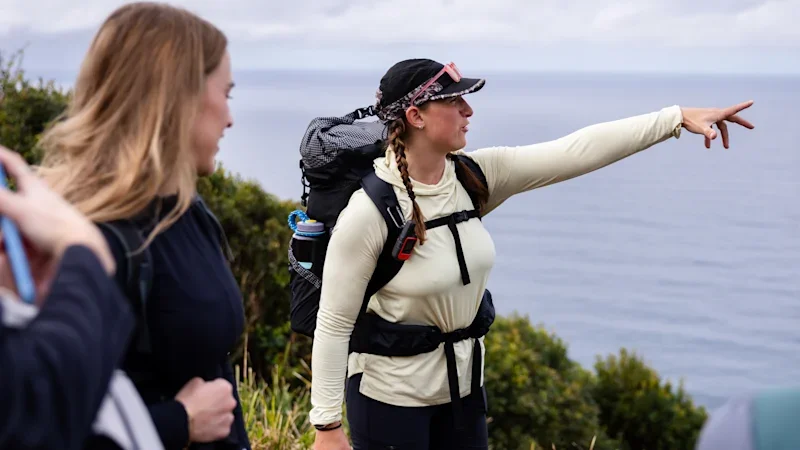
Emily Duck says one inspiration for starting her female outdoor tour company, Cool Girls Club, was a friend going through a break-up.
“[She and her partner] had been doing van trips together. She was sad she could no longer do it because she didn’t have her partner any more and didn’t feel she was experienced enough on her own,” says Duck.
So, 30-year-old Duck, an outdoor education guide, took her friend camping for a weekend in the Blue Mountains, where the brokenhearted friend confided that she wished she could adventure in the outdoors confidently alone.
Duck describes Cool Girls Club, launched in March 2025, as an adventure alternative to run clubs for women who might not feel confident going it alone or who, like herself, didn’t grow up in an outdoorsy family.
The club offers guided hikes primarily around Sydney national parks, and Duck says it provides women with the opportunity to get outdoors and meet people in a low-commitment way.
About 18 months after launching her business, Duck has expanded the adventure offerings from hikes to overnight treks, climbing and canyoning. The ticketed events vary in nature, with a new calendar advertised every month. The adventures are open to all women, but Duck says they often attract solo participants in their late 20s.
Duck says her goal has always been to get women interested in the outdoors, help them find community and educate them. And it’s working.
Cool Girl Club has a group of day-one members who now get their new friends together and trek the Great North Walk on the weekend.
The community is diverse in experience, says Duck. Some have zero experience, some are looking for like-minded women.
“A lot of members come, and they work in finance or hospitals. They have a lot of friends, but they don’t have friends interested in doing these activities because it can be niche.
“One member joined because she wanted to start her ‘granola girl’ era,” says Duck, referencing the outdoorsy aesthetic or style.
While one in four kids are dropping out of sport by 15, involvement in organised sport or physical activity also generally decreases with age.
Having a school-camp guide, which Duck has experience in, is providing adventure-curious women with a safe way to forge ahead.
Nerkez Opacin, a senior research fellow in nature and people at the University of Melbourne, says there is growing evidence on the benefits of spending time outdoors with others, more specifically that being in nature allows for more relaxed social interactions.
Almost one in three Australians feel lonely, with young and middle-aged people showing the highest levels.
“Nature often acts as a kind of social facilitator – we often refer to nature as the ‘third facilitator’. People frequently describe feeling more open, relaxed and present outdoors compared to more formal indoor environments,” says Opacin, who explores how nature-based social programs can help combat loneliness.
The shared experience can make conversation come more naturally and create connection. “In many ways, nature becomes an active part of the social experience itself,” says Opacin.
Di Westaway OAM, health activist and founder of Wild Women on Top, says her decision to create a female-dedicated adventure community was because she saw her own need for what she calls her “tribe”.
“Women just approach it differently. My experience has been women see a risk and want to mitigate and manage. Women approach risk more cooperatively. Women thrive more in adventure with other women,” says Westaway.
At 66, she says her life has never been better. She attributes 99 per cent of that to adventure.
When Westaway decided to start Wild Women on Top, which runs guided hikes Australia-wide and internationally, she says she felt compelled to share what she had learnt.
“Men didn’t need what I was offering. If a man wants to go, he will do it,” she says. “It’s about empowering women. It attracts a kind of woman who has a spark of adventure in her.”
Westaway says that group adventuring is also a way for the modern woman to multitask her socialising, mental health and physical health.
“As a busy woman, if you are trying to squeeze it all in, then this is for you,” says Westaway.
AllTrails chief medical advisor Suzanne Hackenmiller says time outdoors is vital for anyone as it promotes overall physical health, reduces stress and elevates mood by releasing dopamine and serotonin. But it may also be especially beneficial to women.
And it’s never too late to start, she says.
“For women in transition periods, like perimenopause or menopause, this time outside can even improve hormonal balance and provide a greater mind-body connection to ease symptoms,” she says.
“Research consistently points to the importance of nature exposure across the entire lifespan … My primary advice is to scale back the strict rules and ‘shoulds’ of the commercialised wellness industry, and simply show up. You do not need fancy equipment or years of training to get started.”
Hackenmiller recommends familiarising yourself with your trail before you set off.
“A major barrier is that women and other marginalised groups frequently feel unsafe or are afraid of getting lost on the trail,” she says.
Duck suggests asking someone to show you the ropes.
If you have a friend or family member that can show you the way, it takes a lot of fear factor out of the outdoors.
“Build your confidence rather than putting yourself in a situation where you don’t feel safe or comfortable, and you never want to do it again.
But the most important thing for the club founder is opening the door for women.
“As women, we can exist in the outdoors,” she says.
Make the most of your health, relationships, fitness and nutrition with our Live Well newsletter. Get it in your inbox every Monday.