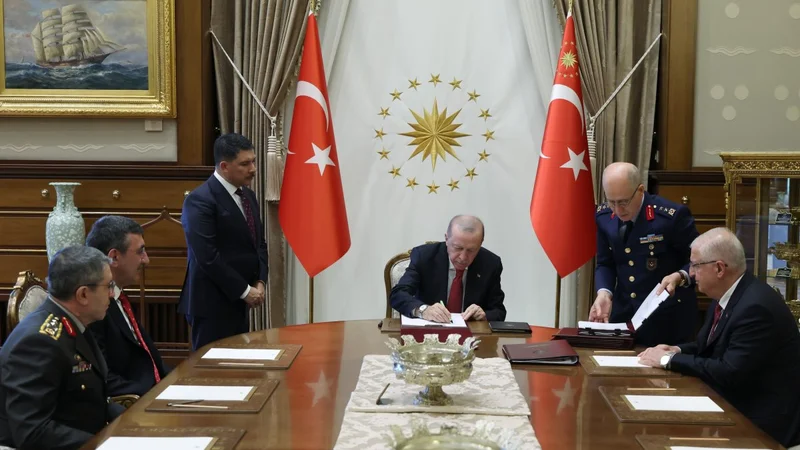
President Recep Tayyip Erdoğan on Tuesday chaired the Supreme Military Council (YAŞ), which approved the promotion and retirement of senior military officers at its annual meeting. Erdoğan and members of the council (Cabinet ministers and commanders of the Turkish army's branches) visited Anıtkabir, the mausoleum of the Republic of Türkiye's founder Mustafa Kemal Atatürk, before the meeting, paying their respects to the man who led the War of Independence.
Twenty-five generals and admirals, along with 69 colonels, were promoted. Ziya Cemal Kadıoğlu, commander of the Turkish Air Force, retired. He was succeeded by Gen. Rafet Dalkıran, commander of the Combat Air Force Command. The commanders of the other top posts in the Turkish Armed Forces (TSK) remained in their positions, with their terms extended. Alper Gezeravcı, an Air Force colonel who became Türkiye's first astronaut in 2024, was promoted to the rank of brigadier general.
The tradition of high-level military councils in Türkiye dates back to the Ottoman era, with the first Supreme Military Council established in 1837 under Sultan Mahmud II. Initially tasked with drafting military regulations, resolving service-related issues and adapting Western military practices, the council underwent several reorganizations and periods of abolition during the late Ottoman era.
Following the founding of the Republic of Türkiye in 1923, the modern Supreme Military Council was formally established in 1925. In its early years, it operated during peacetime, advising on military affairs and promotions, with the president serving as its ex officio chair.
Over the decades, its structure and leadership evolved, reflecting shifts in Türkiye's political system and civil-military relations.
During the multiparty era that followed 1946, the prime minister assumed the chairmanship, and the council's membership was expanded to include senior commanders and selected ministers. The council's mandate became more formalized in 1972 under Law No. 1612, focusing on promotions, retirements and strategic planning.
The council's authority and composition changed significantly following major political developments, including the 1980 military coup and, more recently, the Gülenist Terror Group's (FETÖ) failed coup attempt on July 15, 2016.
The reforms introduced after 2016 expanded civilian oversight and aligned the council's procedures with Türkiye's transition to a presidential system in 2018, making the president its chair and broadening ministerial participation.
Today, the Supreme Military Council meets annually to decide on promotions, retirements and extensions of service for senior officers. While its core mission remains the management of senior military personnel, the council also serves as a symbolic and strategic forum reflecting the balance between civilian authority and military leadership in modern Türkiye.