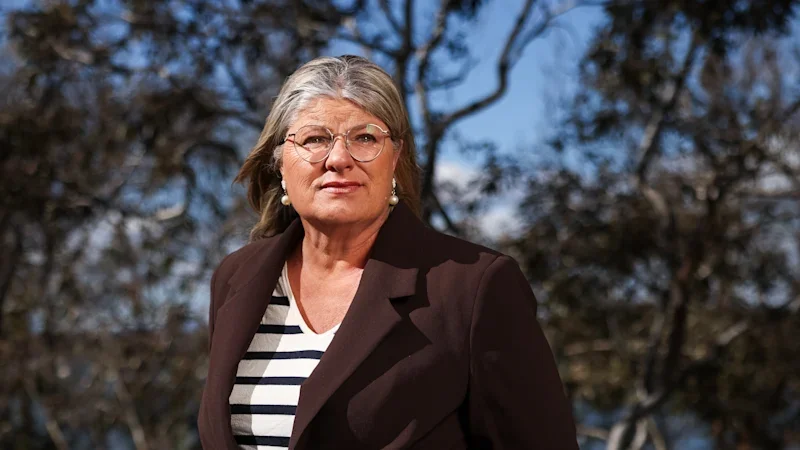
Snowy Monaro councillor Tanya Higgins has been labelled a “fat dumb blonde” by serial pest and fellow councillor Andrew Thaler. Her children have heard men repeatedly call their mother a “stupid fat bitch” and “fat liar” online.
But an incident that “breached a line” happened on Boxing Day last year, when a trespasser repeatedly drove up and down the driveway of their home.
“My children should feel safe at home, they don’t deserve to be anxious about whether certain people will come to our house,” she said.
Women from across the political spectrum, and from all levels of government, have described patterns of gendered abuse designed to drive them out of public office.
New research from nonpartisan not-for-profit organisation Women for Election reveals that almost 90 per cent of women politicians had experienced gendered online abuse, with more than half reconsidering their positions in public office. The national research draws upon the experiences of 110 current and aspiring women politicians across all three levels of government.
While male politicians receive threats too, abuse targeted at women is often more personal, gendered and sexualised, chief executive Licia Heath said. For women from multicultural backgrounds, LGBTQ+ women and young women, the abuse is worse, Heath said.
“The stories were so similar, from mayors in Queensland to women in the WA parliament and everything in between – they have been suffering for some time.”
Last week, NSW Agriculture Minister Tara Moriarty said threats of violence towards her following a feral pig program announcement she made had been reported to NSW Police. Opposition Leader Kellie Sloane deactivated her X account after receiving violent threats when she criticised a neo-Nazi protest outside NSW Parliament House last November.
When Bayside Council deputy mayor Heidi Lee Douglas ran for local government in 2021, men from her community called her in droves, trying to convince her not to run at all. Some later set up a Facebook group, and that was where trolling and misinformation directed at her escalated.
“It takes significant emotional resilience to withstand that kind of harassment, and it’s made many people who have witnessed it question whether this should be accepted as part of putting yourself forward to serve your community,” Douglas said.
Higgins said that nobody who had made sexual threats, remarks about her appearance or created content such as songs mocking her had faced any consequences for their actions. Tech giants, the legal system and law enforcement needed to take a more proactive stance on the abuse, she said.
“None of this stuff ever reaches what’s called a threshold. It’s seen as minor, as verbal, as not physical. It’s petty and childish, until it isn’t,” she said. “I would like us to not get to that point. How can we live with ourselves if we had the opportunity to do something before the worst happens?”
The rapid growth of artificial intelligence has also “scaled abuse at a faster rate than our democracy can respond”, as it was easier to create highly sexualised deepfakes with AI or manipulate and distribute content that reaches larger audiences, Heath said.
“Two years ago, we weren’t talking about nudification apps and how they’ve been deployed and weaponised … it amplifies online abuse,” she said.
Higgins said that she could “no longer, in good conscience” recommend other women take up roles in public office unless they had a support network, a psychologist and “quite a lot of money in the bank” for court proceedings.
But she said that trolls both online and offline who “go against everything democracy stands for” didn’t deserve to win.
“Even though there are times when I just think, ‘Oh gosh, what is the point?’, I dust myself off,” she said.
“I’m nobody special, but I have the right to stand up and try.”