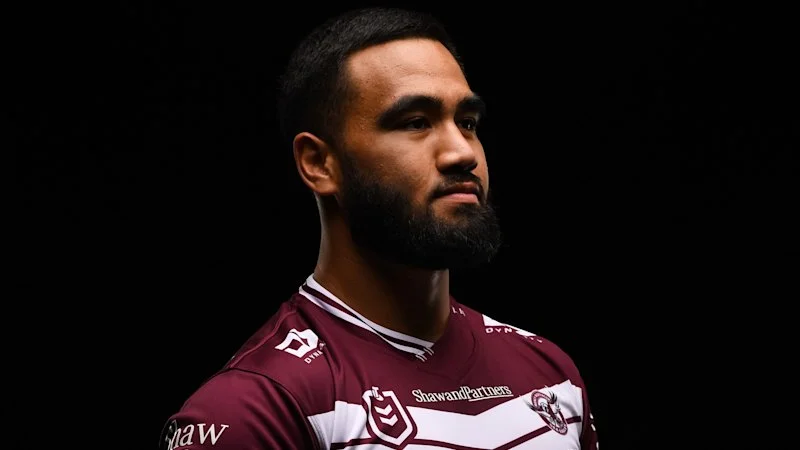
The Manly Sea Eagles allegedly failed to follow its own heat policy, or turn on the fans in its dojo, during the training session in which promising player Keith Titmuss died, explosive court documents have revealed.
The family of Titmuss has commenced a multimillion-dollar action in the NSW Supreme Court after a coronial inquest found he died of exertional heat stroke after a session deemed “more likely than not inappropriate”. In the defence filed by Manly, it states “the back doors of the dojo were open” and 10 staffers were present to monitor 15 players.
The inquest found Titmuss died after “most likely suffering involuntary dehydration” when he entered a wrestling gym for a cardio workout at the end of Manly’s first field session of NRL pre-season training on November 23, 2020.
A paramedic who tended to Titmuss described his body temperature of 41.9 degrees as the “hottest they’d ever seen”, with the inquest finding a pre-existing heart condition played no part in his death.
Another former player, Lloyd Perrett, is also taking legal action against the club after alleging suffering exertional heatstroke, heat stress-induced seizure and psychiatric injury suffered during a training session in November 2017. The Sea Eagles are defending both matters.
This masthead has obtained the statement of claim filed by lawyers acting for the Titmuss family, as well as Manly’s defence.
The claim states that during pre-training tests conducted four days before the fatal session, “The deceased’s comparative level of fitness was the lowest among the training cohort.”
When Sea Eagles training began outside at the Academy of Sport in Narrabeen at 9am on November 23, the temperature was 21.3 degrees and humidity was 92 per cent.
The outdoor component of training - which included repeat high-intensity effort exercises was completed in 90 to 100 minutes. The players then jogged 800m to the dojo, where they were required to complete a “100 passes drill”, as well as a cardio circuit that comprised burpees, bear crawls and fireman carries. The indoor session lasted 15 to 20 minutes.
“The Dojo was not fitted with air conditioning,” the claim stated.
“There were a number of large floor-standing cooling fans, but they were not on.”
The claim states that the club doctor, Dr Luke Inman, formulated a heat policy after the Perrett incident in November 2017. It included access to education, medical equipment and identified the “first four days of pre-season” as one of the “high-risk periods for heat stress”.
However, it claims a breach of duty of care by “failing to provide a safe work system”, take heed of Inman’s policy, failing to conduct player “screening and welfare measures of the deceased, which demonstrated he had the lowest level of aerobic fitness within the player training cohort”, not providing a “cool environment” in the Dojo and not properly hydrating the players “during the training session”.
Sources not authorised to speak publicly because of the sensitive nature of the situation said the Titmuss family had received a payment of about $1 million from the NRL and Manly’s insurer.
Manly’s defence further stated that Titmuss “failed to sufficiently manage his health, weight and diet in the off season ahead of the training session,” that he didn’t properly investigate any pre-existing health conditions that could expose him to greater risk, and he “failed to communicate his condition/fitness to coaching staff at the training session.”
In a statement provided to this masthead, a Sea Eagles spokesperson said: “The Manly Warringah Sea Eagles remain deeply saddened by the tragic passing of Keith Titmuss in November 2020.
“Our thoughts continue to be with Keith’s family, friends, and loved ones, who have endured an unimaginable loss.
“During the Coronial inquest, the club welcomed the opportunity to be involved and to take on board any and all potential learnings as highlighted during the proceedings. Since then, the club has continued to work with the NRL to make improvements to the welfare and safety of players, particularly regarding heat illness policies and protocols.
“Keith’s family are currently suing the club for damages in the NSW Supreme Court. It is not appropriate to comment on the matters that are the subject of those proceedings.
“Our focus remains on acknowledging Keith’s memory and supporting those who continue to grieve his loss.”
Titmuss’ mother, Lafo, said the tragedy was “preventable” during an interview in February.
“We are just seeking justice. That’s why we’ve made the decision we’ve made,” Lafo said.
“It’s a very hard thing because you have Manly, who acknowledged soon after the inquest that it should never happen again. It should never have happened in the first place.
“[When it comes to] duty of care, [the] club absolutely failed our son. He went to work and never came home on that day.”