One of three newly discovered tombs at Saqqara preserves the names of three generations of one family. The inscriptions identify a merchant called Paremwia, also known as Samut, along with his wife, mother, and four sons.
Paremwia held the title Great Merchant of the Estate of Ptah. His wife, Tuwi, was called Lady of the House, while his mother, Atibyu, held the title Singer of Amun. The walls also record the names of his four sons.
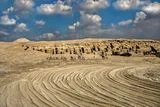
An Egyptian archaeological mission discovered Paremwia’s tomb with two others during excavations in the Bubasteion Necropolis. Cut into the eastern side of a rocky cliff, all three tombs date to the New Kingdom, which lasted from roughly 1550 B.C.E. to 1069 B.C.E, according to Egypt’s Ministry of Tourism and Antiquities. Archaeologists identified the tomb owners, their relatives, and their positions by reading hieroglyphic inscriptions preserved on the walls.
In a translated press release, Hisham El-Leithy, secretary-general of Egypt’s Supreme Council of Antiquities, said the inscriptions help reconstruct the lives of the tomb owners and restore parts of their histories that had remained buried for thousands of years.
New Kingdom Tombs at Saqqara Record Powerful Officials
Saqqara is an archaeological site on the west bank of the Nile, about 20 miles (30 kilometers) south of central Cairo. It forms part of the wider ancient Memphite necropolis, a UNESCO World Heritage site.
According to Egypt’s Ministry of Tourism and Antiquities, the name Saqqara most likely derives from Sokar, the god associated with the necropolis.
Another newly discovered tomb belonged to Mentuhotep, a high-ranking official from the early New Kingdom. Amr El-Tayeb, director general of the Saqqara archaeological site, explains that its northern walls depict people carrying offerings and hunting, along with a large image of Mentuhotep seated beside his mother, Ahhotep.
Inscriptions identify Mentuhotep as Hereditary Prince, Mayor, Royal Seal Bearer, Administrator, Overseer of Foreign Lands, and Overseer of the Army of Khabeshet. He also held the title He Who Pleases the Ruler’s Heart.
According to El-Tayeb, the family scene reflects Mentuhotep’s high social standing, while the titles indicate that he held senior roles in both government and the military.
An Ancient Egyptian Inscription Points Toward Northern Syria
The third tomb belonged to Nehesy. Although it is poorly preserved, surviving inscriptions identify him as Supervisor of the House. They also name his wife, Neferptah, who held the title Lady of the House.
Part of a column contains hieroglyphs referring to a military commander returning from Naharin, a region in northern Syria. The reference helps confirm the tomb’s New Kingdom date and adds evidence of Egypt’s relations with the Near East.
According to Egypt’s Ministry of Tourism and Antiquities, Egypt became a major empire during the New Kingdom, with its territory extending south into Nubia and north into what is now Syria. The reference to a commander returning from Naharin fits a period when Egyptian rulers conducted military campaigns and competed for control in the Levant.
Excavations Will Continue at the Bubasteion Necropolis
Archaeologists plan to return to Mentuhotep’s unfinished burial shaft during the next excavation season. They hope it will provide more information about Ahhotep, the family’s history, and its role in ancient Egyptian government.
Work will also continue in other unexplored parts of the necropolis. The inscriptions have identified the people connected to the three tombs, but parts of their histories may still remain below the surface.
Read More: Nearly 1,800-Year-Old Kohl Bottle Found in Roman York May Have Been Carried From Egypt
Article Sources
Our writers at Discovermagazine.com use peer-reviewed studies and high-quality sources for our articles, and our editors review for scientific accuracy and editorial standards. Review the sources used below for this article: